
Airport advertising effectiveness Does Airport Advertising Work?
For building awareness and stature with travelers, yes, and the research agrees. Most of that research is paid for by media owners, though. Here’s what it shows, when airport advertising works best, and how to measure your own campaign.

- 125+Airports worldwide
- 40+Media vendors
- 5Continents served
You’re in good company






The short answer
Is airport advertising
effective?
Yes, for what it is built to do: making a brand look bigger, more credible, and more familiar to the people who travel. Travelers have time to look, they notice airport ads, and in published research they rate the brands behind them as more successful and trustworthy. It is weaker as a direct-response channel, and its effect has to be measured on purpose, because an airport wall doesn’t produce clicks.
- What it does well
- Awareness, recall, and perceived stature with business and leisure travelers
- What it does less well
- Immediate, trackable sales or sign-ups from the ad itself
- How to prove it
- A brand-lift study planned before the flight, plus proof that every unit ran
The evidence
What does the research
say?
The best-known studies agree: travelers notice airport advertising, read it, remember it, and think better of the brands in it. Every one of them was paid for by a media owner. That doesn’t make the findings wrong, but it means they measure what sells airport media, so read them as directional and measure your own campaign.
| Study | Paid for by | What it found | How to read it |
|---|---|---|---|
| Nielsen for Clear Channel Outdoor (2025) | Clear Channel Outdoor, a media owner | Of frequent flyers who noticed airport advertising, 82% read it, 61% remembered it, and 57% took some action after seeing it. | Strong evidence of attention. The figures are self-reported, and “took action” covers a wide range of behavior. |
| ResearchBods for JCDecaux (2021) | JCDecaux, a media owner | Travelers rated airport advertising highest for perceived value and prestige among the advertising channels tested (an index of 113). | A perception measure. It supports the stature effect, not sales. |
| Ipsos for JCDecaux (2024) | JCDecaux, a media owner | Travelers describe brands they see advertised in airports as global, successful, innovative, and trustworthy. | Brand-image association, consistent with the prestige finding above. |
EAM’s take
We read media-owner research the way a buyer should: it tells you the channel gets attention and lends stature, which matches what we see in brand-lift results. It doesn’t tell you what your campaign will do. That depends on the airports, the formats, the creative, and whether your audience actually flies through them.
Why it works
Why does airport advertising
get noticed?
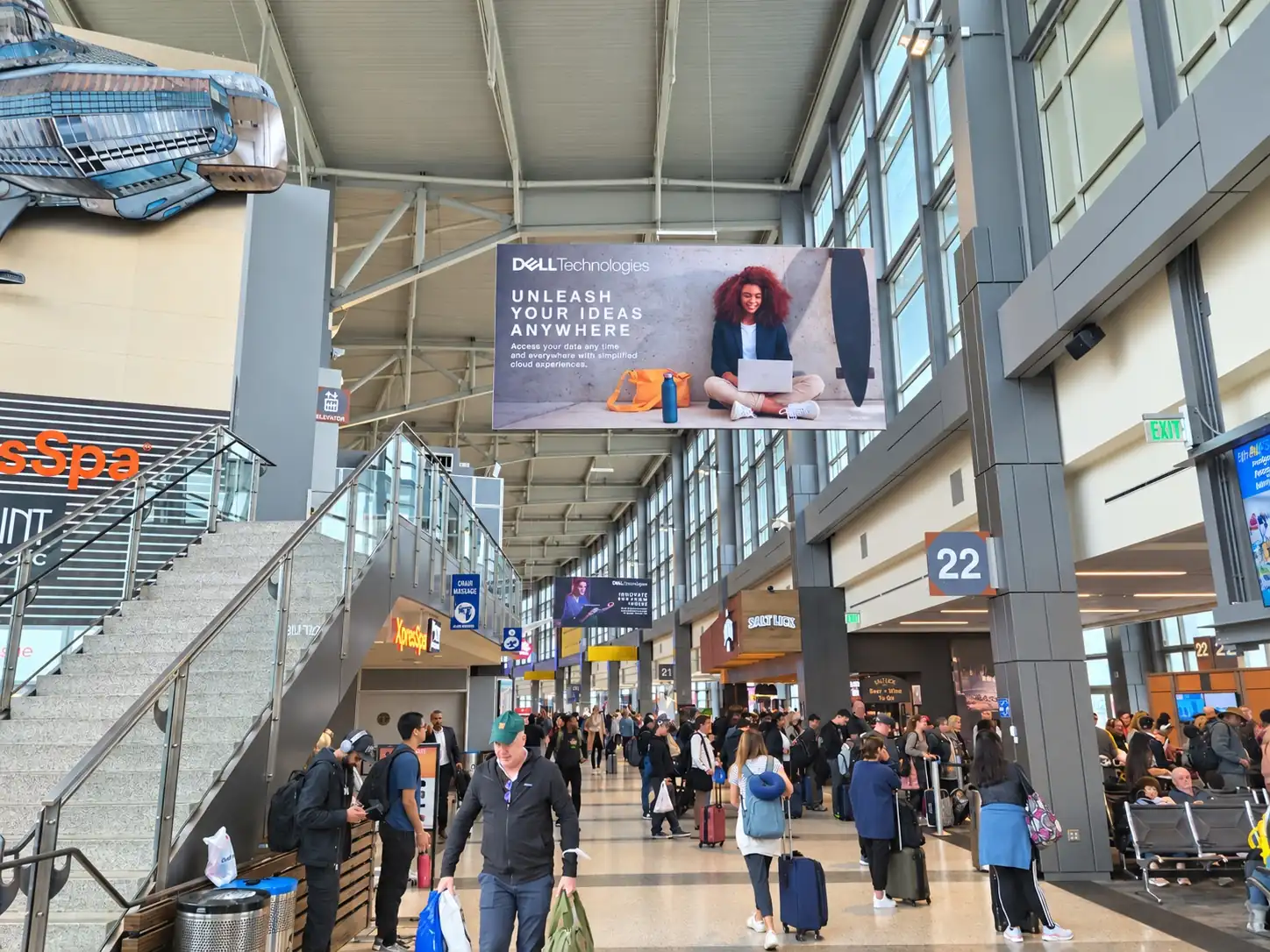
Airports combine three things most media can’t: time, a valuable audience, and a setting that makes brands look established. Plans that use all three, the right airports, units on the path your audience walks, and a simple message, are the ones that show results.
- Time to lookAttention
Travelers wait in check-in lines, security, gate areas, and baggage claim, often for an hour or more, with few other demands on their attention.
- The right peopleAudience
Business travelers and frequent flyers include decision-makers who are hard to reach in ordinary media, and they pass through the same few airports again and again.
- The setting lends staturePerception
Advertising in a major airport signals scale. Travelers read it as a sign the brand is established, which is what the prestige research measures.
- Repetition along one pathFrequency
The same traveler passes several units on one trip, from check-in to security to the gate, so a plan builds frequency within a single visit.
- Concentrated audiencesTiming
Conference weeks, product launches, and home-market hubs put a specific audience in one building at one time.
- Few distractions at key momentsFocus
At the security trays and the baggage carousel, travelers are waiting with little else to look at.
When it works
When does it work best,
and when doesn’t it?
Airport advertising works best when the audience is concentrated, the message is simple, and the goal is awareness or stature. It works least well when the campaign is judged only on immediate, trackable response.
- Concentrated audiencesWorks best
An industry’s conference week, a company’s home airport, the lounges of a financial center.
- Simple, confident messagesWorks best
One idea that lands in a few seconds, repeated across units.
- Category leadershipWorks best
Brands that want to look like the leader in their space, often against larger competitors.
- Launches and new marketsWorks best
Entering a city or launching a product where the people who matter fly in and out.
- Recruiting and employer brandWorks best
Reaching professionals in both directions at the airports in your hiring markets.
- Direct responseWorks less well
Campaigns judged on click-level tracking or immediate sign-ups.
- Complex offersWorks less well
Messages that need explaining, fine print, or a long read.
- Budgets spread too thinWorks less well
A unit or two across many airports rarely builds enough frequency to register.
Measurement
How do you measure
airport advertising?
Proof of posting and play logs show the campaign ran as bought. Delivered impressions size the audience but are modeled. A brand-lift study, set up before the flight, is the only method that measures effect. Anyone promising attributed sales from airport media should show exactly how they calculate it.
Ways to measure an airport campaign, and how much weight each one carries
- Proof of posting
Photographic confirmation that every unit ran, at every airport, for the full flight
Highfactual - Play logs
Spot counts and share of voice on digital networks
Highlogged - Delivered impressions
Modeled audience delivery from passenger volume and unit position; useful for sizing, not for proving effect
Moderatemodeled - Brand lift study
Awareness or perception among travelers in campaign markets, against a control group; must be set up before the flight
Moderateneeds budget and lead time - Mobile location studies
Devices seen at the airport during the flight, matched to later visits against a control group; privacy rules limit where it can be used
Moderatemodeled - Market-level signals
Branded search, web traffic, and inbound inquiries by metro during the flight versus before it
Directional - Direct sales attribution
Not reliably available for airport media
Lowtreat claims with skepticism
Planning for proof
How do you plan a campaign
you can prove worked?
Decide what success means before you buy, measure the starting point, and keep the creative simple enough to register. Most campaigns that “didn’t work” were never set up to show whether they did.
Working back from the flight
- 6–8 weeks out
Pick one goal (awareness, consideration, or perception) and the measure that will show it. Choose airports your audience actually flies through.
- 3–4 weeks out
Field a baseline survey in the campaign markets and in a comparable market without the campaign. Set up tracking for branded search and web traffic by metro.
- Launch
Confirm every unit posted on day one, with photos. Start play logs on digital networks.
- During the flight
Keep one message across every unit. Don’t change creative halfway through unless something is wrong.
- After the flight
Field the follow-up survey against the control market, compare search and traffic by metro, and collect the proof-of-posting report.
- Next decision
Scale the airports and formats that moved the measure, and drop the ones that didn’t.
Airport advertising: formats, costs, and how to buy Airport advertising costs Airport advertising examples
Questions
Questions about airport
advertising effectiveness
Is airport advertising effective?
Yes, for building awareness, recall, and perceived stature with travelers. Published research, all of it paid for by media owners, finds that most frequent flyers who notice airport ads read them and remember them, and that travelers see brands advertised in airports as more successful and trustworthy. It is less effective as a direct-response channel.
Why does airport advertising work?
Airports give travelers time to look, gather business travelers and frequent flyers who are hard to reach elsewhere, and lend brands a sense of scale. A traveler also passes several units on one trip, which builds frequency within a single visit.
How do you measure airport advertising effectiveness?
Proof of posting and play logs confirm the campaign ran. Delivered impressions size the audience but are modeled. A brand-lift study, comparing travelers in campaign markets with a control group, is the only method that measures effect, and it has to be set up before the flight. Branded search and web traffic by metro add directional evidence.
What is a brand-lift study?
A survey of your target audience before and after the campaign, in markets with the campaign and in a comparable market without it. The difference in awareness or perception between the two is the lift the campaign produced. It needs budget and three to four weeks of lead time before launch.
Can you track sales from airport advertising?
Not reliably. Airport media doesn’t produce clicks, and mobile location studies are modeled and limited by privacy rules. You can see directional signals, such as branded search, web traffic, and inquiries from campaign markets rising during the flight. Treat any promise of exact sales attribution with skepticism.
Which airport advertising formats are most effective?
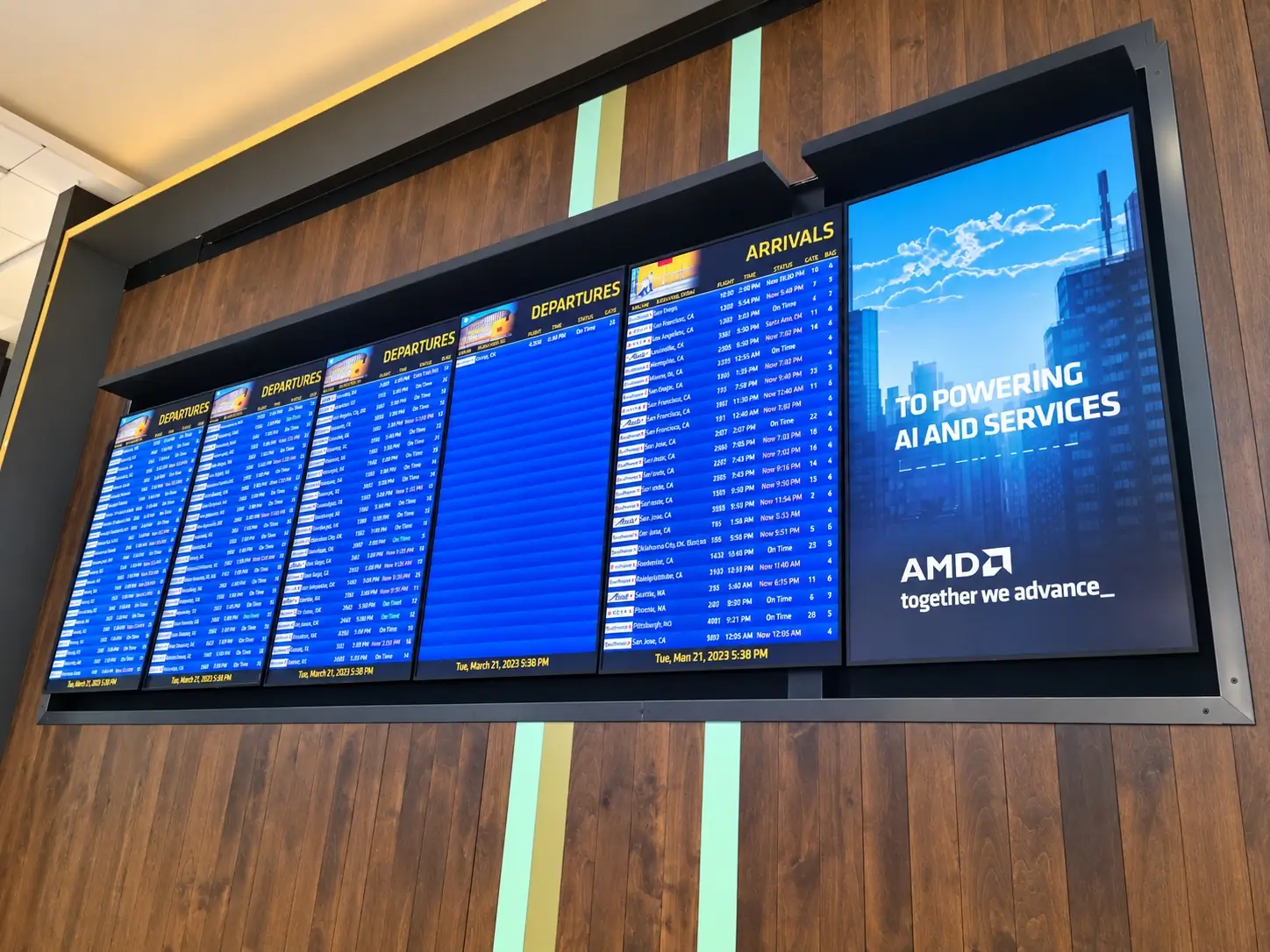
The ones on the path your audience actually walks. Digital networks build frequency across a terminal; security trays reach every departing passenger up close; baggage claim reaches people arriving in the city; lounges reach executives and frequent flyers. A simple message repeated across two or three formats usually beats one large unit on its own.
How long should an airport campaign run?
Most airports sell in four-week periods, and one full period is the practical minimum for an effect to register. Event-week campaigns can be shorter when the audience is concentrated, such as a conference week. Longer campaigns build more frequency among frequent flyers who pass through repeatedly.
Is the research on airport advertising reliable?
The findings are consistent across studies, but every major study was commissioned by a media owner that sells airport advertising. Read them as evidence that the channel gets attention and lends stature, not as a forecast for your campaign. Your own brand-lift study is the reliable measure.
Airport advertising media agency. 125+ airports. Est. 2015.
One airport or twelve.
Start with the media kit.
Send your work email for the media kit: formats, planning ranges, and how EAM works. We’ll follow up to learn who you need to reach and when, then come back with current availability and a recommended mix.
125+ airports · 40+ media vendors · Since 2015
Sources
Sources
and methodology
- Nielsen for Clear Channel Outdoor (2025), paid for by Clear Channel Outdoor, a media owner: investor.clearchannel.com.
- ResearchBods for JCDecaux (2021), paid for by JCDecaux, a media owner: www.jcdecaux.com.
- Ipsos for JCDecaux (2024), paid for by JCDecaux, a media owner: www.jcdecaux.com.
- Measurement methods and planning guidance: EAM Advertising campaign practice across 125+ airports, 2015–2026. Weights in the measurement list reflect how directly each method shows that a campaign ran or changed perception.