- MCO handled 57.7 million passengers in 2025, the busiest airport in Florida and seventh in the country. About 8.5 million were international. The single busiest day in the airport's history was January 3, 2026, the tail of the holiday season.
- It is an origin-and-destination airport with three terminals: A and B share the North Terminal and its four airsides; Terminal C is a separate building with its own gates, baggage claim, and the train station. Which terminal your audience uses follows the airline, and the placement plan starts there.
- One week is the minimum buy; four weeks is the standard flight. A conference week is the case where one week is the right length. Every digital network runs ten-second spots with no more than eight advertisers in the loop, a minimum 12.5% share of voice. That is a simpler and more generous loop than most large airports offer.
- Two calendars drive the buy. Convention weeks (IAAPA November 16–20, 2026; the PGA Show January 26–29, 2027; MegaCon in May) bring an industry in all at once. The vacation calendar (Thanksgiving through New Year, spring break, summer) brings families and international leisure. Every network costs roughly a third more in Q4.
- Planning ranges: a single network runs $8,000–$55,000 for one week outside Q4 and $11,000–$75,000 in Q4. A two- or three-network plan runs $40,000–$130,000 for the week. A week across every digital network in the building runs north of $150,000. Those are planning ranges, not a rate card.
- Creative is due 14–18 business days before the flight. Holds expire in 5 business days. Proof photos within 5 days of posting. No competitive separation. Contracts are non-cancellable once signed.
- Why do brands advertise at Orlando International (MCO)?
- Who actually flies through MCO?
- Which Orlando weeks matter for airport advertising?
- What does Orlando airport advertising cost?
- What airport advertising formats do brands use?
- How far in advance do you need to book, and what do convention and holiday weeks cost?
- What kinds of brands advertise at MCO, and what are they trying to do?
- Where should your ads run inside MCO?
- What does airport advertising look like in practice?
- What has EAM run beyond Orlando?
- How do you measure an MCO campaign?
- How does EAM run an MCO campaign?
- Frequently asked questions
- Related reading
- Where else does EAM run airport campaigns?
Why do brands advertise at Orlando International (MCO)?
Because the trip was the point. Fifty-eight million passengers a year come to Orlando for the parks, the convention center, the cruise ports, and the Central Florida economy, and almost none of them are connecting to somewhere else. Whoever you need to reach, they walk through one of three terminals at the start and end of a trip they planned.
MCO is not a hub. Nearly every passenger in the building is beginning or ending a trip in Orlando, which means the annual passenger count and the audience you care about are close to the same thing. What changes is who they are, week by week.
Most weeks, the building is families and leisure travelers headed to Walt Disney World, Universal, SeaWorld, and Port Canaveral, plus the international arrivals that made MCO the fastest-growing gateway in Florida: British, Brazilian, Canadian, Mexican, and now Munich, Madrid, and Paris nonstops. For a consumer, hospitality, transportation, or destination brand, that audience is the reason to be here.
Then the convention calendar takes over. The Orange County Convention Center is the second-largest convention facility in the country, and when IAAPA, the PGA Show, MegaCon, or a healthcare or technology show is in town, the arrivals at MCO are that industry, arriving all at once, through the same three terminals. For a B2B brand, that week is the reason to be here.
The airport prices the difference. Every network costs roughly a third more in the fourth quarter, when the holiday calendar and the year-end convention calendar overlap. That premium is the clearest signal in the media kit about when Orlando is worth the most, and it's the reason this page talks about weeks rather than months.
Who actually flies through MCO?
57.7 million passengers in 2025, almost all beginning or ending in Orlando. Terminals A and B carry about 2 million passengers a month each; Terminal C carries about 750,000 and most of the long-haul international traffic. Terminal follows the airline: Southwest and Frontier through A, Delta, American, United, and most of the legacy and Latin American carriers through B, the long-haul international, JetBlue, and a growing domestic mix through C.
MCO served 57,675,573 passengers in 2025, its second-highest year (2023 remains the record at 57.7 million, by a few thousand). International traffic grew about 8% to nearly 8.5 million. Domestic traffic slipped 1%. The airport ranked seventh in the country and 25th in the world, and it added three transatlantic nonstops in 2025: Munich, Madrid, and Paris.
Terminal by airline, as of September 2026. Confirm against the current MCO map when planning; assignments shift as Terminal C grows.
| Terminal | Monthly passengers | Airlines | What it means for the buy |
|---|---|---|---|
| Terminal A (North Terminal, A side; Airsides 1 and 2) | About 2 million | Southwest, Frontier, Avelo, Air Transat | Southwest is the largest carrier at MCO; A is the leisure and family side |
| Terminal B (North Terminal, B side; Airsides 3 and 4) | About 2 million | Delta, American, United, Alaska, Allegiant, Breeze, Air Canada, LATAM, Sun Country, WestJet, Viva, Volaris, Bahamasair, BermudAir, Flair | The legacy carriers and most of the business and convention traffic; Canada and Latin America |
| Terminal C (separate building, gates 230–254) | About 750,000 | JetBlue, Virgin Atlantic, British Airways, Aer Lingus, Aeromexico, Air France, Avianca, Azul, Caribbean, Copa, Discover, Emirates, GOL, Iberia, Icelandair, Norse, Porter, TAP, Zipair | JetBlue plus long-haul and most non-U.S. international carriers. Expansion gates 250–254 opened June 30, 2026 |
Terminals A and B are two sides of one building. Passengers check in and clear security in the North Terminal, ride an automated people mover to one of four airsides, and on arrival ride it back to the main terminal for baggage claim on the A side or the B side and ground transportation below. Terminal C is its own building with its own security, gates, baggage claim, and the train station for Brightline and the parking and hotel connections.
What matters for advertisers is not the annual total. It is who is in which terminal on a given week.
Convention attendees
IAAPA suppliers and operators in November, golf brands and PGA professionals in January, comic and entertainment fans at MegaCon, health IT buyers when HIMSS is in Orlando, kitchen and bath, pro-AV, and the rest of the OCCC calendar. They fly the legacy carriers and land in Terminal B; international exhibitors land in C. This is the audience most B2B buys at MCO are for.
Families and leisure travelers
Walt Disney World, Universal (Epic Universe opened in 2025), SeaWorld, the cruise ports at Port Canaveral. Southwest and the budget carriers through A, the legacy carriers through B. Heaviest around school calendars: Thanksgiving, Christmas through New Year, Presidents' Day, spring break, Easter, summer. The vacation calendar is why Q4 costs more.
International arrivals
About 8.5 million a year. The UK and Brazil are the largest markets; Canada, Mexico, Colombia, and now Germany, Spain, and France follow. Long-haul lands in Terminal C. Digital networks at MCO reach international departures and domestic arrivals; international arrivals exit through federal inspection and reach the public areas at baggage claim and the curb.
Central Florida residents
Orlando is a metro of nearly 3 million people, home to the University of Central Florida (one of the largest universities in the country by enrollment), Rollins, Full Sail, the Lake Nona medical city, the simulation and defense industry around UCF Research Park, and the theme-park companies themselves. They fly out of MCO for business and back home through it. This is the audience for recruiting, healthcare, financial, and university campaigns, and it is in the building every week.
Which Orlando weeks matter for airport advertising?
For B2B, the convention weeks: IAAPA in November, the PGA Show in January, and whichever OCCC show your industry attends. For consumer, hospitality, and destination brands, the vacation weeks: Thanksgiving, Christmas through New Year, spring break, and summer. The airport prices the fourth quarter about a third higher than the rest of the year.
Two calendars. Inventory is quoted by the week: one week minimum, four weeks standard. The table covers the weeks that change who is in the building and what the week costs.
| Week | Timing | Who arrives | What it means for the buy |
|---|---|---|---|
| PGA Show | January 26–29, 2027 |
Golf industry: brands, retailers, PGA professionals; more than 34,000 at the 2026 show | The first B2B week of the year. Terminal B arrivals; the Gateway network in the gate holds reaches them on the way out |
| Marathon weekend and Presidents' Day | Mid-January to mid-February |
Runners, families | Consumer volume; the shoulder before spring break |
| Spring break | March, rolling by school district |
Families, students | Six to eight weeks of heavier leisure arrivals; Terminals A and B |
| MegaCon Orlando | May 20–23, 2027 |
200,000-plus comic, gaming, and entertainment fans | The largest single event on the calendar by attendance; entertainment, streaming, and consumer brands |
| InfoComm / other OCCC shows | InfoComm: June 12–18, 2027. Other shows vary; some rotate with Las Vegas |
Pro AV, healthcare IT, dental, education — when that show is in Orlando | InfoComm 2027 is confirmed at OCCC. KBIS 2027 is Las Vegas. Check the other OCCC shows before planning |
| Summer | June through early August |
Families, international leisure (UK, Brazil) | The longest sustained leisure period; Terminal C international at its heaviest |
| Halloween season | Late September through early November |
Universal and Disney event traffic | Consumer and hospitality; the start of the Q4 premium |
| IAAPA Expo | November 16–20, 2026 (education opens the 16th; show floor the 17th) |
The global attractions industry: parks, suppliers, operators, investors; more than 40,000 | The B2B week that belongs to Orlando the way CES belongs to Las Vegas. Q4 pricing applies. Book early |
| Thanksgiving through New Year | Late November to the first week of January |
Families, international leisure | The busiest stretch of the year; the record day was January 3, 2026. Every network at Q4 rates |
Orlando is the one market where a B2B brand and a family-travel brand can be in the same loop the same week and both be right. The mistake is buying the wrong calendar. A software company that buys Thanksgiving week is paying Q4 rates to reach families. A hotel brand that buys PGA Show week is paying convention-week competition to reach golf retailers. Match the week to the audience first; the network second.
What does Orlando airport advertising cost?
$8,000–$55,000 for a single digital network for one week outside Q4; $11,000–$75,000 in Q4. $40,000–$130,000 for a two- or three-network week. North of $150,000 for a week across every digital network. Every network runs ten-second spots with no more than eight advertisers, so share of voice is at least 12.5% on every unit you buy. Those are planning ranges, not a rate card.
One week is the minimum; four weeks is the standard flight. Rates are quoted by the week. For a convention, one week is the buy that matches the audience. A leisure or holiday run is usually four weeks or more.
The loop is the other thing to know. Every digital network at MCO runs ten-second spots in a loop capped at eight advertisers, a minimum 12.5% share of voice. Most large airports run loops of twelve, sixteen, or twenty-four; MCO's is short. A passenger standing at baggage claim for 20–30 minutes sees your spot roughly every 80 seconds. For a brand that has bought crowded loops elsewhere, this is the most important line in the media kit.
| Network | Where it reaches them | Screens | Your spot in the loop | Best for |
|---|---|---|---|---|
| Prestige Digital Network | The full airport: high-traffic points in all three terminals, beside the flight information boards, and now above the baggage carousels | 88 screens, mixed sizes | :10 spot, no more than 8 advertisers, at least 12.5% share of voice | Frequency across every terminal; the network for a brand that wants the whole building for a week |
| Gateway Digital Network | Gate holds in Terminals A and B, at seat level, where passengers wait with their phones out | 40 vertical units, 55″ | :10, at least 12.5% SOV | Departure-side dwell; the one network where a QR code works |
| Main Terminal Digital Domination | Four large spectaculars in the North Terminal atrium between check-in, the food court, and the airside trains, reaching every A and B departure | 4 spectaculars, about 5.75′ × 19′ | :10, at least 12.5% SOV | The biggest read in the building on the departure side; the unit the attractions use |
| Arrivals Digital Spectaculars | Overhead at Terminal C baggage claim, beside the arrivals boards | 4 spectaculars, about 48″ × 162″ | :10, at least 12.5% SOV | The Terminal C arrival dwell moment; domestic arrivals and the meeters and greeters |
| Digital Escalator Arrivals Spectaculars | Four large full-motion screens on arrivals escalators, in high-traffic paths with a long read | 4 spectaculars | :10, at least 12.5% SOV | Arrivals frequency on the way to baggage claim and ground transport |
| 360 Digital Columns | Two full-motion wraparound columns in the Terminal C arrivals hall, on the walk from the gates to baggage claim and the train | 2 columns, 77″ tall | :10, at least 12.5% SOV | Terminal C arrivals, both directions of the hall; the lowest cost of entry on the page |
Static and exterior inventory at MCO sits beside the digital program. Large-format exteriors: two double-sided banners at the curb — the first and last message on the property, facing rideshare passengers and drivers on the approach roads. Static banners and immersion zones sit in premium locations near airline lounges, central concourses, and high-dwell areas; those units are how a brand dominates a stretch of the terminal rather than a loop. Production, sizes, and available faces come back with the quote. The digital networks above are what a one-week buy typically uses; static and exterior flights follow the static production window.
A note on international arrivals. Every network reaches international departures and domestic arrivals. International arrivals clear federal inspection before they reach public areas, so the first place a Terminal C international arrival sees advertising is the public baggage claim and the curb. For a brand targeting the UK, Brazil, or Latin America inbound, the Terminal C arrivals spectaculars and the 360 columns are the units; the gate-hold network is not.
Contract realities. One-week minimum. Four weeks is the standard flight. Holds expire in 5 business days. Creative is due 14–18 business days before start. Proof photos go out within 5 days of posting. There is no competitive separation. Contracts are non-cancellable once signed. Pricing is quoted by quarter and Q4 carries the premium.
For pricing methodology across airports and tiers, see the multi-airport campaign cost guide.
What airport advertising formats do brands use?
These are examples of digital, static, experiential, and exterior units brands buy in airports. For MCO we plan specific units and dates against what is open at the time.

Digital screens and video walls in airline business club lounges reach affluent business decision-makers and high-net-worth travelers in a captive setting.
Travelers often spend 90 minutes or more in the club. Screens in dining and seated areas and larger video walls (about 84–100 inches) give the brand both frequency and a dominant face.
Full motion or static creative can rotate through the loop while the audience is already seated.
- Spot30 seconds
- LoopRanges from 5 to 6 minutes
- TypeFull motion animation and static. Use different rotating ads.
- Lead time14–18 business days
* Differs depending on the airport.

Target high-level decision-makers and affluent individuals with entrance banners in airport business club lounges.
Engage with a discerning audience in a premium, brand-safe environment.
Showcase innovations for business-to-business brands or emphasize luxury for high-end brands.
- SizesVarious sizes
- Production costPrinting, shipping, install, and removal
- Lead time18–21 business days
* Differs depending on the airport.

Baggage claim digital network screens provide a unique opportunity to connect with travelers at a prime moment.
Strategically placed in high-traffic areas throughout the baggage claim area, these screens ensure maximum exposure for your brand.
By using baggage claim digital network screens, you can deliver your message to travelers multiple times, building frequency and driving engagement.
- SpotRanges from 8 to 30 seconds
- LoopRanges from 30 to 240 seconds
- TypeFull motion animation and static. Use different rotating ads.
- Lead time14–18 business days
* Differs depending on the airport.

Packages can range in screen size and quantity. Strategically positioned throughout central airport concourses.
These screens reach arriving and departing traffic as passengers move towards the airport exits and a large percentage of departing traffic as passengers move through the concourses and frequent favorite concessions in the area.
- SpotRanges from 8 to 30 seconds
- LoopRanges from 30 to 240 seconds
- TypeFull motion animation and static. Use different rotating ads.
- Lead time14–18 business days
* Differs depending on the airport.

Large format banners offer a large, eye-catching space that can capture the attention of everyone walking through the airport.
They can be strategically placed on walls or hung from ceilings throughout the airport, ensuring maximum exposure for your brand.
With large format banners, you have the opportunity to own 100% of the share of voice in that area.
- SizesVarious sizes
- Production costPrinting, shipping, install, and removal
- Lead time18–21 business days
* Differs depending on the airport.

Experiential advertising at airports lets the brand interact with a captive audience through immersive installations.
Activations can include brand ambassadors, tech-focused displays, and product sampling.
Exhibit space is the same idea: a physical footprint where travelers can engage face-to-face.
- SizesVarious sizes
- Production costFabrication, printing, shipping, install, materials, and removal
- Lead time2–4 months
* Differs depending on the airport.

Digital charging network screens are a highly effective advertising tool for brand marketers looking to reach a captive audience of travelers.
Travelers engage with the screens while charging devices, which adds dwell to the impression.
- SpotRanges from 8 to 30 seconds
- LoopRanges from 30 to 240 seconds
- TypeFull motion animation and static. Use different rotating ads.
- Lead time14–18 business days
* Differs depending on the airport.

Digital spectacular screens offer a powerful advertising tool to capture significant attention in airports.
Strategically located in high-traffic areas, these screens provide maximum visibility and impact for your brand.
With their attention-grabbing size and creative flexibility, digital spectacular screens hold the attention of travelers and drive engagement.
- SpotRanges from 8 to 30 seconds
- LoopRanges from 30 to 240 seconds
- TypeFull motion animation and static. Use different rotating ads.
- Lead time14–18 business days
* Differs depending on the airport.

By using digital network screens, you can deliver your message to travelers multiple times throughout their journey.
Strategically placed in high-traffic areas, these screens ensure maximum exposure for your brand.
These screens build frequency and drive engagement, making them an effective advertising option.
- SpotRanges from 8 to 30 seconds
- LoopRanges from 30 to 240 seconds
- TypeFull motion animation and static. Use different rotating ads.
- Lead time14–18 business days
* Differs depending on the airport.

Dioramas are backlit displays at eye level in corridors and holdrooms.
They offer a lit, poster-scale face with 100% share of voice on that unit.
- SizesVarious sizes
- Production costPrinting, shipping, install, and removal
- Lead time18–21 business days
* Differs depending on the airport.

Leverage exterior signage to engage airport visitors as they arrive or depart, keeping the brand visible on the campus.
High-impact banners on the building or approach create a lasting impression before travelers enter the terminal.
- Production costPrinting, shipping, install, and removal
- Lead time18–21 business days
* Differs depending on the airport.

Flight information screens are some of the most frequently viewed screens in the airport, where passengers already look for gate and time updates.
Advertising on these screens puts the message next to information travelers are actively reading.
- SpotRanges from 8 to 30 seconds
- LoopRanges from 30 to 240 seconds
- TypeFull motion animation and static. Use different rotating ads.
- Lead time14–18 business days
* Differs depending on the airport.

Jet bridge wraps put the brand on the walk between gate and aircraft.
The space is captive and sequential: every boarded passenger on that gate walks the length of the wrap.
- SizesVarious sizes
- Production costPrinting, shipping, install, and removal
- Lead time18–21 business days
* Differs depending on the airport.

Large format digital screens offer a unique opportunity to make a lasting impression on travelers.
These screens have the wow factor needed to capture your target audience's attention and inspire them to engage with your brand.
Large format digital screens offer creative flexibility to showcase your brand's messaging and art in a way that resonates with your target audience.
- SpotRanges from 8 to 30 seconds
- LoopRanges from 30 to 240 seconds
- TypeFull motion animation and static. Use different rotating ads.
- Lead time14–18 business days
* Differs depending on the airport.

Large format banners offer a large, eye-catching space that can capture the attention of everyone walking through the airport.
They can be strategically placed on walls or hung from ceilings throughout the airport, ensuring maximum exposure for your brand.
With large format banners, you have the opportunity to own 100% of the share of voice in that area.
- SizesVarious sizes
- Production costPrinting, shipping, install, and removal
- Lead time18–21 business days
* Differs depending on the airport.

Mini-spectaculars are smaller spectacular units that still dominate a sightline without a full-wall takeover.
They own share of voice on that face and work in tighter terminal pockets.
- SizesVarious sizes
- Production costPrinting, shipping, install, and removal
- Lead time18–21 business days
* Differs depending on the airport.

Exterior digital billboards at the airport engage a wide mix of travelers on the approach and campus roads.
Creative on digital billboards can run full motion or static.
- Spot5–10 seconds
- TypeFull motion animation and static
- Lead time14–18 business days
* Differs depending on the airport.

Large format banners offer a large, eye-catching space that can capture the attention of everyone walking through the airport.
An overhead banner package is sequenced across multiple faces so the brand owns a stretch of the travel journey and a specific airport area, which is what creates the wow effect.
They can be placed on walls or hung from ceilings, with 100% share of voice in that zone.
- SizesVarious sizes
- Production costPrinting, shipping, install, and removal
- Lead time14–18 business days
* Differs depending on the airport.

Spectaculars are large-format displays built for a single dominant face in a high-traffic terminal space.
With the ability to own 100% of the share of voice, your message is the only one being seen by travelers in that area.
- SizesVarious sizes
- Production costPrinting, shipping, install, and removal
- Lead time18–21 business days
* Differs depending on the airport.

Tension fabric displays are a visually stunning way to showcase your brand or product in the airport.
They command attention in a crowded terminal and offer a cost-effective way to reach a large audience.
With tension fabric displays, you have the opportunity to own 100% of the share of voice in that area.
- SizesVarious sizes
- Production costPrinting, shipping, install, and removal
- Lead time18–21 business days
* Differs depending on the airport.

By using vertical digital network screens, you can deliver your message to travelers multiple times throughout their journey.
These are vertical units with a different view profile: most sit at eye level and read with a poster feel.
Strategically placed in high-traffic areas, they build frequency as passengers walk the concourse.
- SpotRanges from 8 to 30 seconds
- LoopRanges from 30 to 240 seconds
- TypeFull motion animation and static. Use different rotating ads.
- Lead time14–18 business days
* Differs depending on the airport.

Video walls are strategically positioned in high-traffic areas of the airport, ensuring maximum visibility and engagement for your brand.
These high-impact screens provide maximum visibility for your brand, making a lasting impression on travelers.
- SpotRanges from 8 to 30 seconds
- LoopRanges from 30 to 240 seconds
- TypeFull motion animation and static. Use different rotating ads.
- Lead time14–18 business days
* Differs depending on the airport.

Wall wraps offer a visually striking and modern way to showcase your brand in the airport, with the ability to customize them to your brand.
Strategically placed in high-traffic areas, wall wraps capture attention and own 100% of the share of voice on that surface.
- SizesVarious sizes
- Production costPrinting, shipping, install, and removal
- Lead time18–21 business days
* Differs depending on the airport.

Sponsoring Wi-Fi access at airports engages travelers on their personal devices.
Call-to-action pages can be video or static, which is what turns access into a media placement.
- Spot30 seconds
- TypeVideo and static. Choose from a variety of call-to-action pages.
- Lead time2–4 months
* Differs depending on the airport.

Window wraps offer a visually striking and modern way to showcase your brand on terminal glass, with the ability to customize them to your brand.
Strategically placed on windows in high-traffic areas, they capture attention from the interior walkway or the curb and own 100% of the share of voice on that glass.
- SizesVarious sizes
- Production costPrinting, shipping, install, and removal
- Lead time18–21 business days
* Differs depending on the airport.
How far in advance do you need to book, and what do convention and holiday weeks cost?
IAAPA, the PGA Show, and the Thanksgiving-to-New-Year stretch: hold inventory 4–6 months out. Mid-tier convention weeks and spring break: 10–16 weeks. Standard weeks: 4–8 weeks is usually enough. Every network costs roughly a third more in Q4; convention weeks in Q1–Q3 are priced at standard rates but sell first.
MCO prices by quarter, not by event. That's different from Las Vegas, where the premium follows the show. Here, a week in early December costs the same premium whether or not a convention is in town, because the holiday calendar is what the vendor is pricing. IAAPA sits inside that premium; the PGA Show, MegaCon, and the spring and summer shows do not. For a B2B brand, that makes January through September the efficient convention season and November the expensive one.
What sells first is the same everywhere: the arrival-side units in the terminal your audience uses, and the full-airport network when a brand wants frequency across all three buildings.
| Tier | Examples | Hold by | What sells first | Pricing character |
|---|---|---|---|---|
| Peak | IAAPA week, PGA Show week, Thanksgiving week, Christmas through New Year | 4–6 months | Terminal C arrivals spectaculars, Main Terminal domination, full-airport network | Q4 weeks (IAAPA, Thanksgiving through New Year) cost roughly a third more. PGA Show week is standard-quarter rates but sells first |
| High | MegaCon, mid-tier OCCC weeks, spring break weeks | 10–16 weeks | Terminal B arrival-side and gate-hold units | Standard-quarter rates; convention weeks in Q1–Q3 sell first |
| Standard | All other weeks | 4–8 weeks | Most networks open | Standard rates; one-week minimum |
Unit rates, loop-position premiums, and week-specific quotes. Those numbers move with availability and with the week. What you can plan against: one-week minimum; $8,000–$55,000 for a single network outside Q4 and $11,000–$75,000 in Q4; $40,000–$130,000 for a two- or three-network week; north of $150,000 for a week across every digital network in the building. Specific units and weeks come back as a quote.
What kinds of brands advertise at MCO, and what are they trying to do?
Attractions and hospitality reaching arriving visitors, transportation and travel services catching them at baggage claim, consumer brands reaching families, convention exhibitors reaching their industry the week it lands, international brands reaching the UK and Latin American traffic in Terminal C, and Central Florida's healthcare systems, universities, and employers reaching residents on the way out. Two calendars, one building; the objective picks the week and the terminal.
The useful way to think about MCO is by objective. The same network reaches a different audience depending on the week, and the table below is how EAM scopes an Orlando brief.
| Objective | Who buys it | Who it reaches | What the buy usually looks like |
|---|---|---|---|
| Destination and attraction presence | Theme parks, resorts, attractions, cruise lines, Visit Orlando and the regional bureaus | Every arrival, every week; families and international leisure | Main Terminal domination and Terminal C arrivals, multi-week or seasonal; the attractions are the largest advertisers in the building |
| Arrival-moment services | Rideshare, rental cars, Brightline, hotels, ticket and pass sellers | Arriving passengers deciding how to get to the resort | Baggage claim and arrivals-hall units, always-on; this is where "request a ride now" lives |
| Convention inbound | Exhibitors and sponsors at IAAPA, the PGA Show, HIMSS, InfoComm, KBIS, MegaCon | Their industry, arriving Sunday and Monday of show week | One week, Terminal B arrival side and the Gateway gate holds on the way home; Q4 rates for IAAPA |
| Family and consumer brands | Insurance, telecom, consumer products, streaming and entertainment | Families with time to kill and phones out | Prestige network for frequency; Gateway for dwell and QR; spring break, summer, and holiday weeks |
| International inbound | Airlines, banks, telecom, retail, and destination brands targeting UK, Brazilian, Canadian, and Latin American visitors | Terminal C arrivals; long-haul international | Terminal C arrivals spectaculars and 360 columns; summer and Christmas weeks |
| Healthcare and specialty care | Central Florida hospital systems, cancer and orthopedic centers, the Lake Nona medical city, medical tourism | Residents and the regional audience; visiting families | Prestige network always-on; Terminal B for the resident traveler |
| Recruiting and employer brand | Theme-park companies, hospitality groups, simulation and defense employers around UCF, healthcare systems | The resident workforce departing; candidates flying in | Departure-side weight: Gateway gate holds, Main Terminal domination |
| Universities | UCF, Rollins, Full Sail, and out-of-state programs recruiting Orlando students and reaching alumni | Students and families at semester starts; alumni; working professionals | Prestige for reach; Gateway for the departing professional; August and January weeks |
| Launch or brand moment | A resort opening, a new route, a product launch timed to a show | Everyone in the building for a week | Two or three networks plus the domination; one week |
On the attractions. The largest advertisers at MCO are the parks, and the Main Terminal domination in particular is where Universal and its peers reach every A and B departure. A brand competing for the same families should know it will share the building with them and should plan for share of voice accordingly; a brand in a different category benefits from a loop where the attractions have taken the big units and left the rest less contested.
On conventions. MCO's convention audience arrives in Terminal B on Delta, American, and United, and departs through the Gateway gate holds in A and B. A one-week convention buy is arrival-side in B for the inbound day and gate-hold on the outbound day, and it does not need Terminal C unless the show draws international exhibitors, which IAAPA does.
On universities. UCF is one of the largest universities in the country by enrollment, and Orlando sends students to programs across the Southeast and beyond. Out-of-state universities recruiting here, executive programs reaching the Orlando professional, and alumni campaigns around graduation and homecoming all use the airport. Education brands EAM has placed in airports include Wharton, BYU, the University of Michigan, the University of Pittsburgh, and UT Dallas. The natural weeks are fall start (classes begin August 24, 2026), spring start (the week of January 11, 2027), and spring commencement (May 6–8, 2027).
For Florida-wide reach, MIA, FLL, and TPA add volume, and EAM buys them as one plan when a brief needs it. That is a scoping conversation, not something this page needs to argue.
Where should your ads run inside MCO?
In the terminal your audience uses, along the path they take. Convention traffic arrives in Terminal B and departs through the A and B gate holds; families arrive in A and B; long-haul international arrives in C. Baggage claim catches everyone in that terminal; the Main Terminal atrium catches every A and B departure; the Prestige network catches all three buildings.
MCO is three terminals in two buildings, and the placement plan has to pick. That's the one way it is more complicated than a single-terminal airport, and it's why the airline table in the audience section comes before this section.
Terminals A and B, the North Terminal. Arriving passengers deplane at one of four airsides, ride the automated people mover to the main terminal, and come down to baggage claim on the A side or the B side, then to ground transportation on the level below. Departing passengers check in on level 3, clear security, and pass through the atrium between the food court and the airside trains. The Main Terminal domination spectaculars hang in that atrium; the Gateway units sit in the gate holds on the airsides; the Prestige screens run through the whole sequence including the carousels.
Terminal C. A separate building. Arrivals walk from the gates through an arrivals hall to baggage claim and the train station; the 360 columns stand in that hall and the arrivals spectaculars hang over the carousels. Departures check in and clear security in the same building. International arrivals reach the public side at baggage claim.
| Step | Terminals A and B | Terminal C | Priority |
|---|---|---|---|
| 1. Off the plane | Airside gate holds; Gateway units at seat level; Prestige screens | Gate area; Prestige screens | Medium; the units here also reach departures with dwell |
| 2. To the main terminal | Automated people mover to the North Terminal; Prestige screens at the transfer points | The arrivals hall; the two 360 columns, both directions | High in C (the columns are the only units on the walk); medium in A and B |
| 3. Baggage claim | A-side and B-side carousels; Prestige carousel screens | Arrivals spectaculars over the carousels; Prestige screens | Highest; 20–30 minutes of dwell; passengers without checked bags still exit through the hall |
| 4. Ground transportation and the curb | Level 1 pickup; rental car and rideshare | Train station, parking, and curb | High; the last read before the resort |
| Departure side | Main Terminal atrium (domination spectaculars), security, airside gate holds (Gateway) | Check-in hall, gate area | High for resident, recruiting, and convention-outbound buys; the atrium is the biggest read in the building |
Direction follows the calendar. A convention buy is arrival-side on the inbound day (Terminal B baggage claim, the Prestige carousel screens) and gate-hold on the outbound day, because attendees fly home with time to kill and a phone out. A family-travel buy is arrival-side almost entirely; the family is heads-down on the way home. A resident buy, recruiting, healthcare, or university, is departure-side, where the atrium and the gate holds have dwell. An international inbound buy is Terminal C only.
The expansion gates (250–254) opened June 30, 2026 and Terminal C's share of traffic is rising as airlines move in. Terminal assignments on this page reflect the September 2026 FlyMCO airline list; confirm the terminal for a specific airline against the current MCO map at contract, not from memory.
What does airport advertising look like in practice?
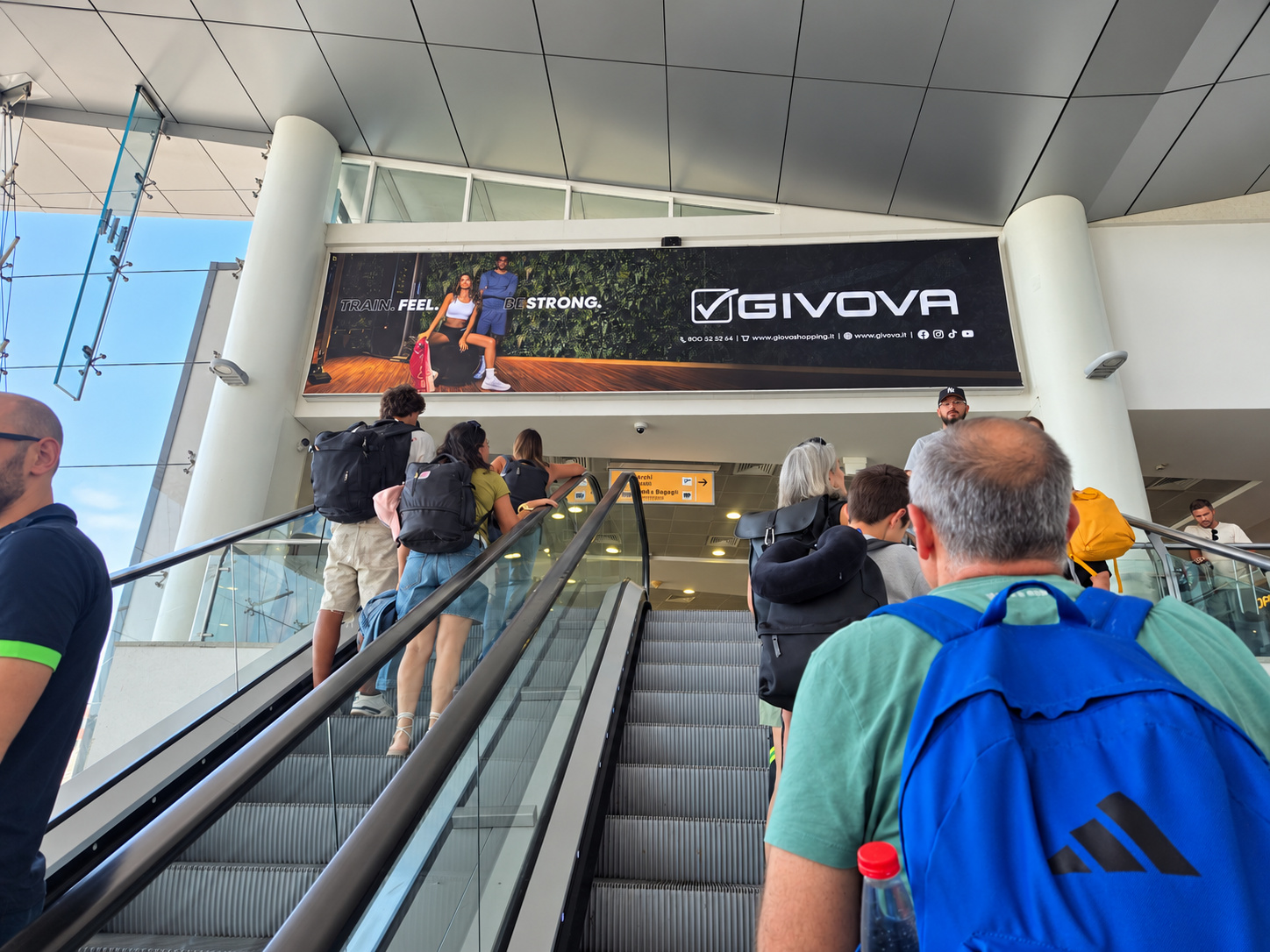
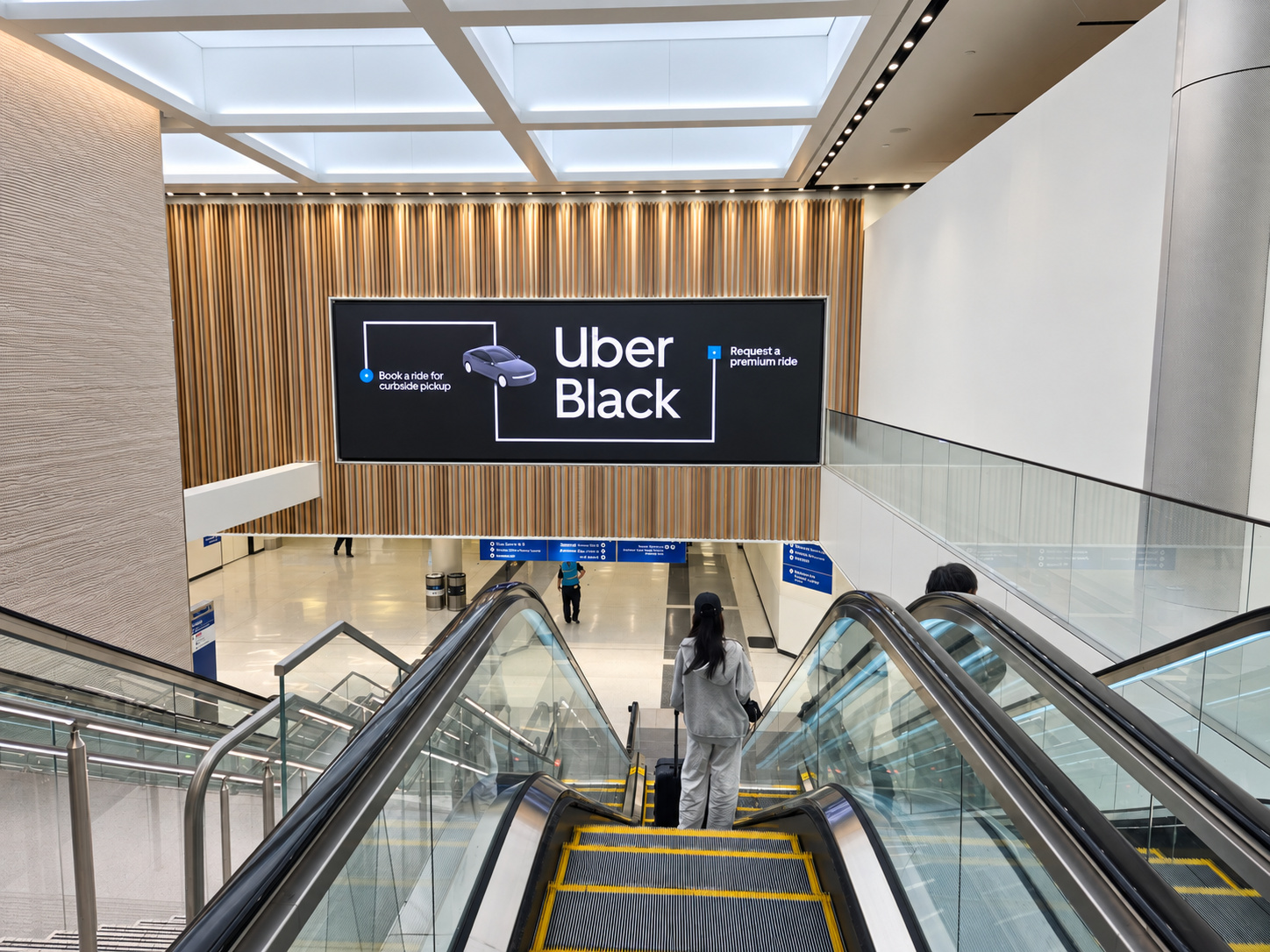
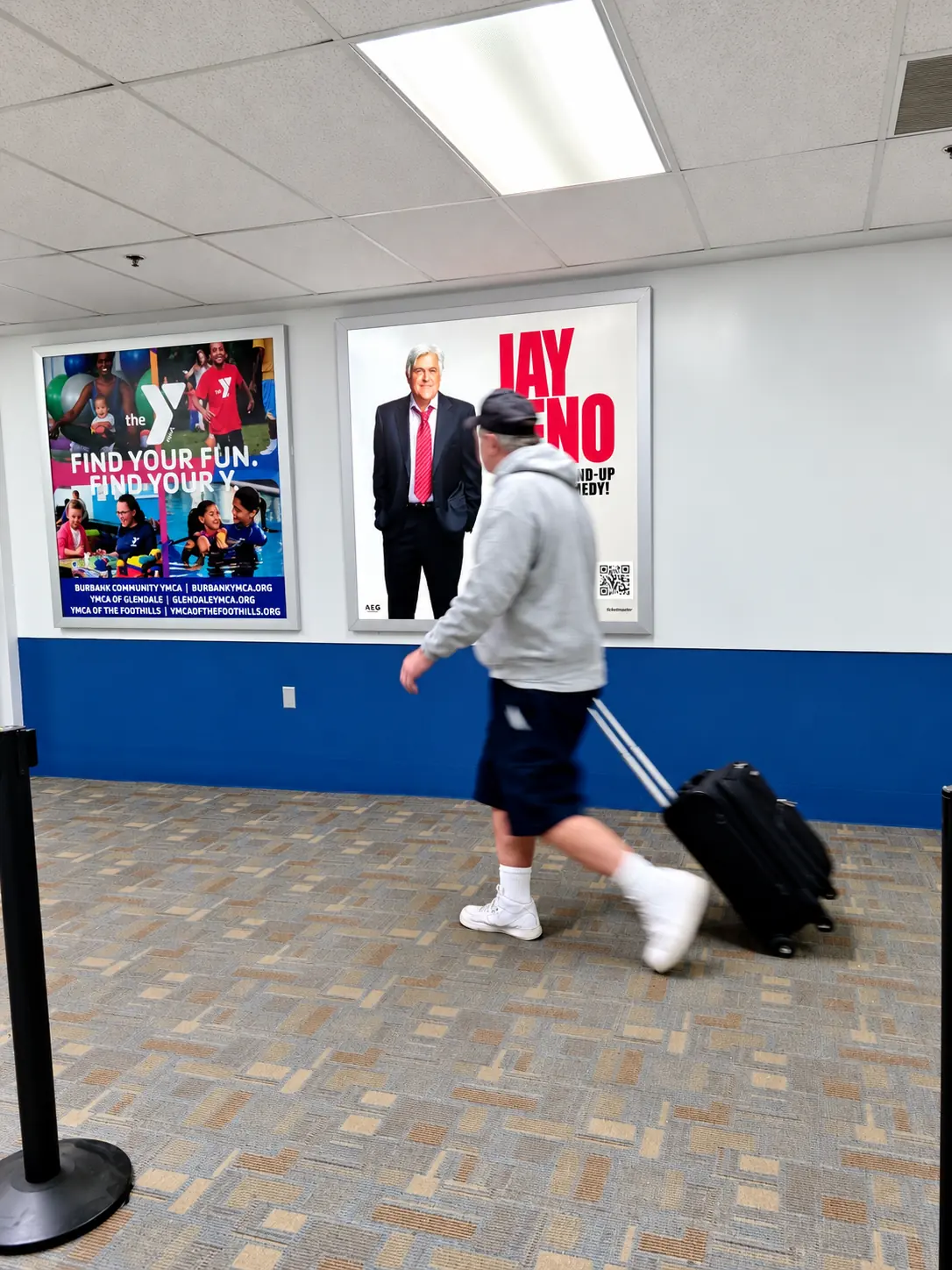
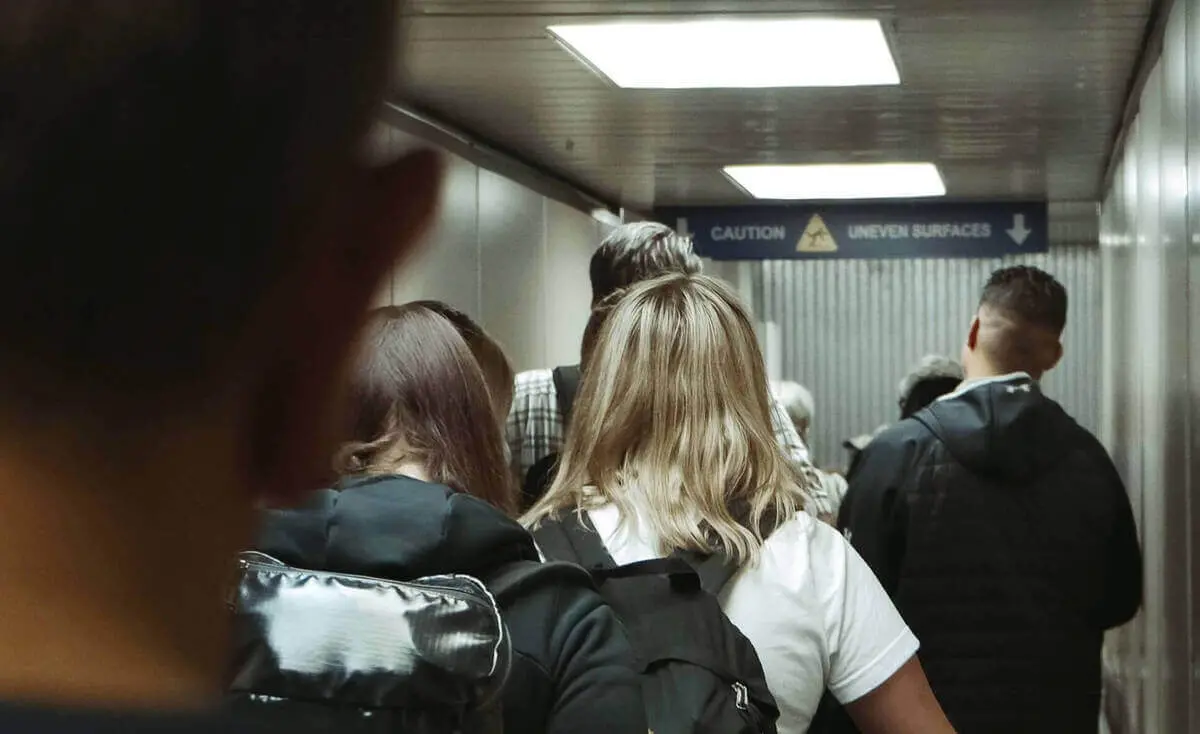
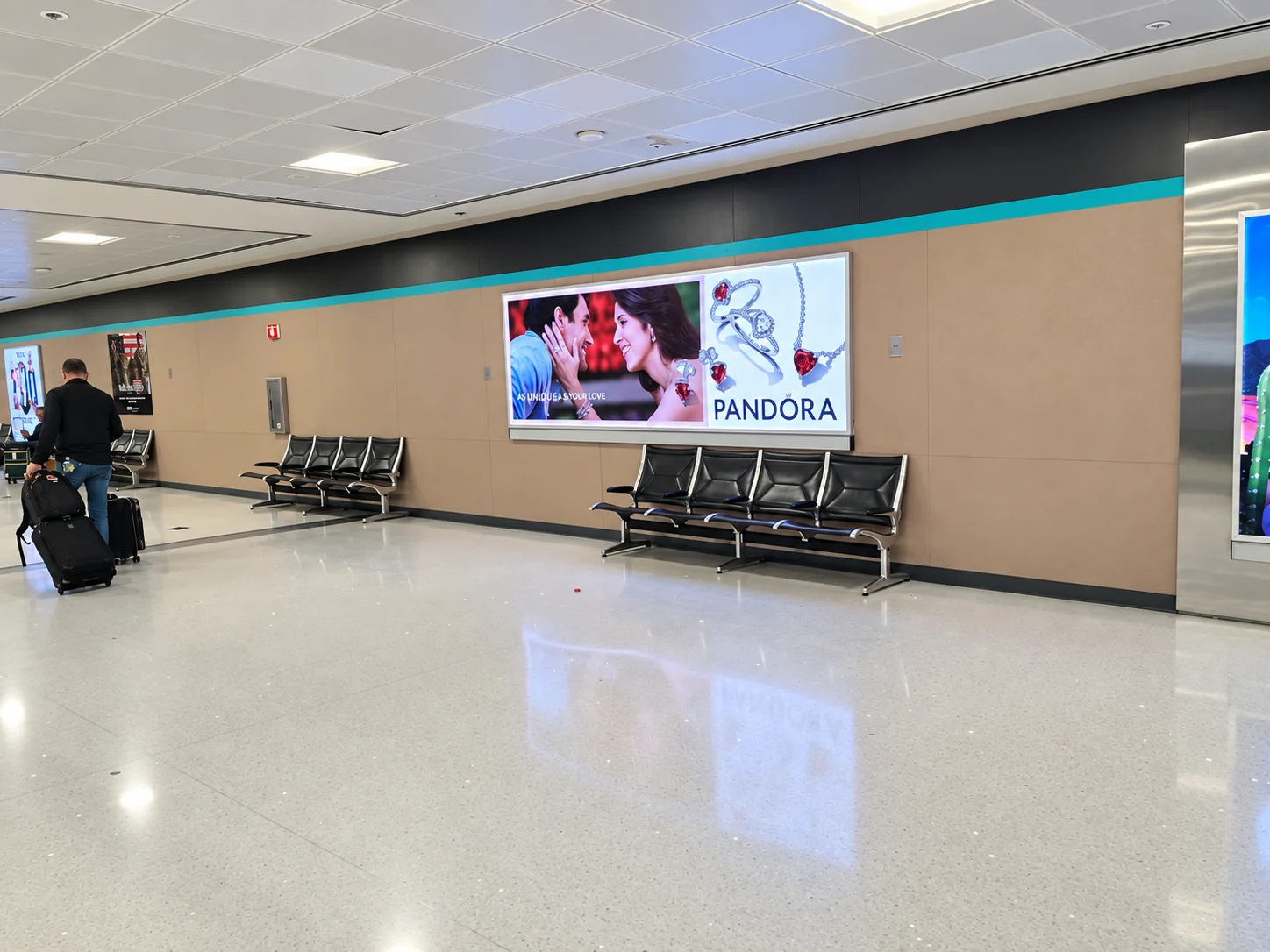
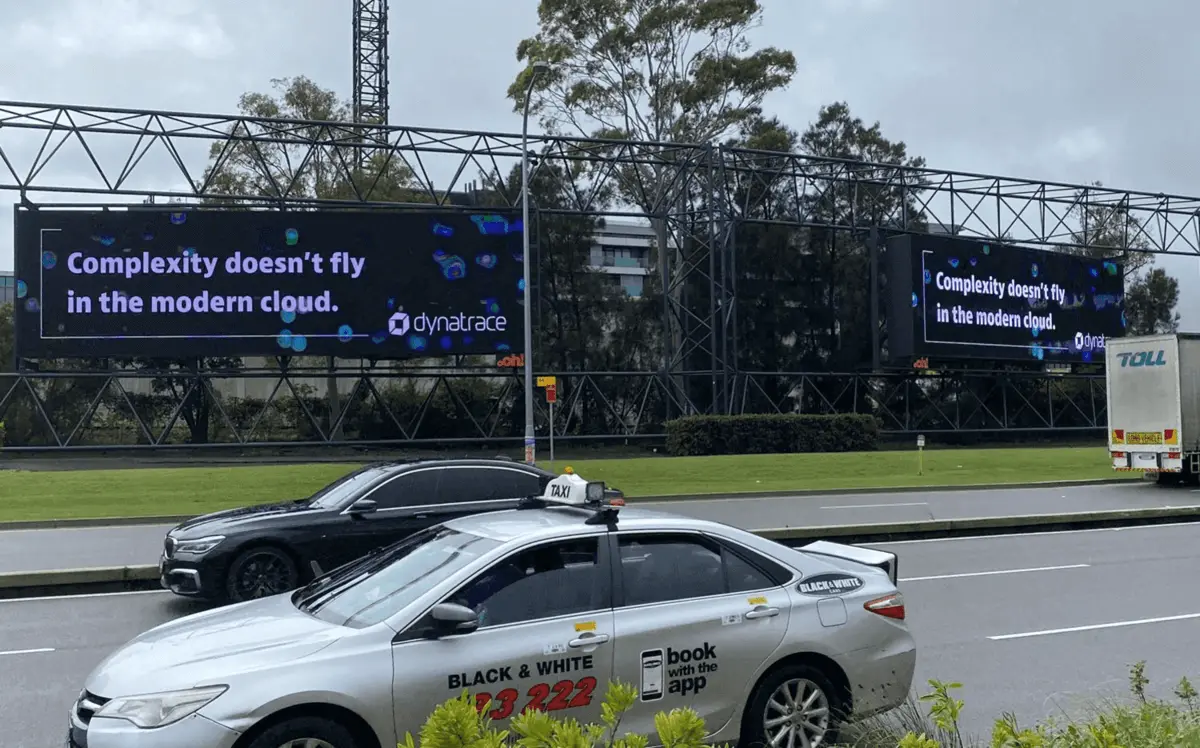
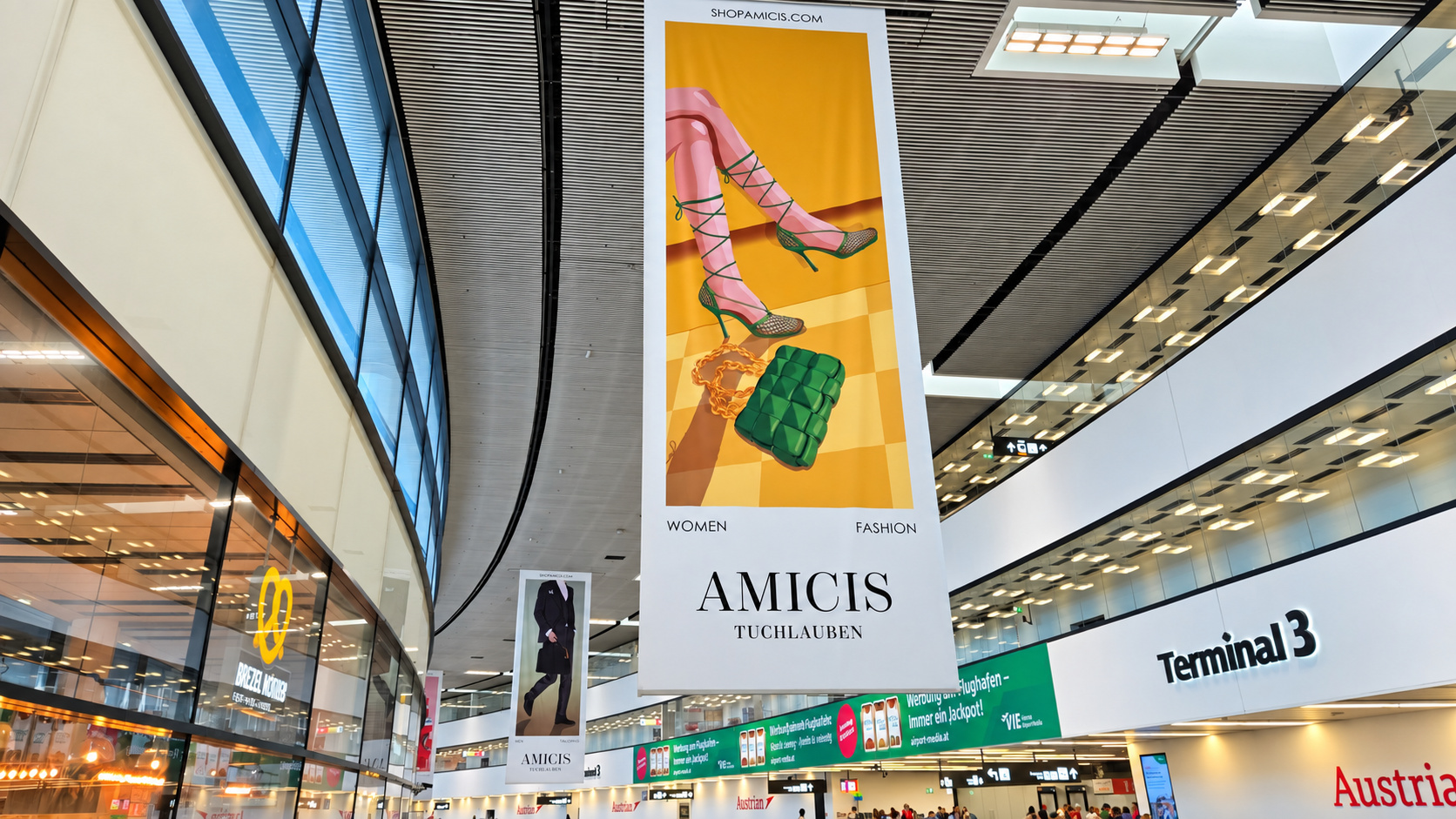
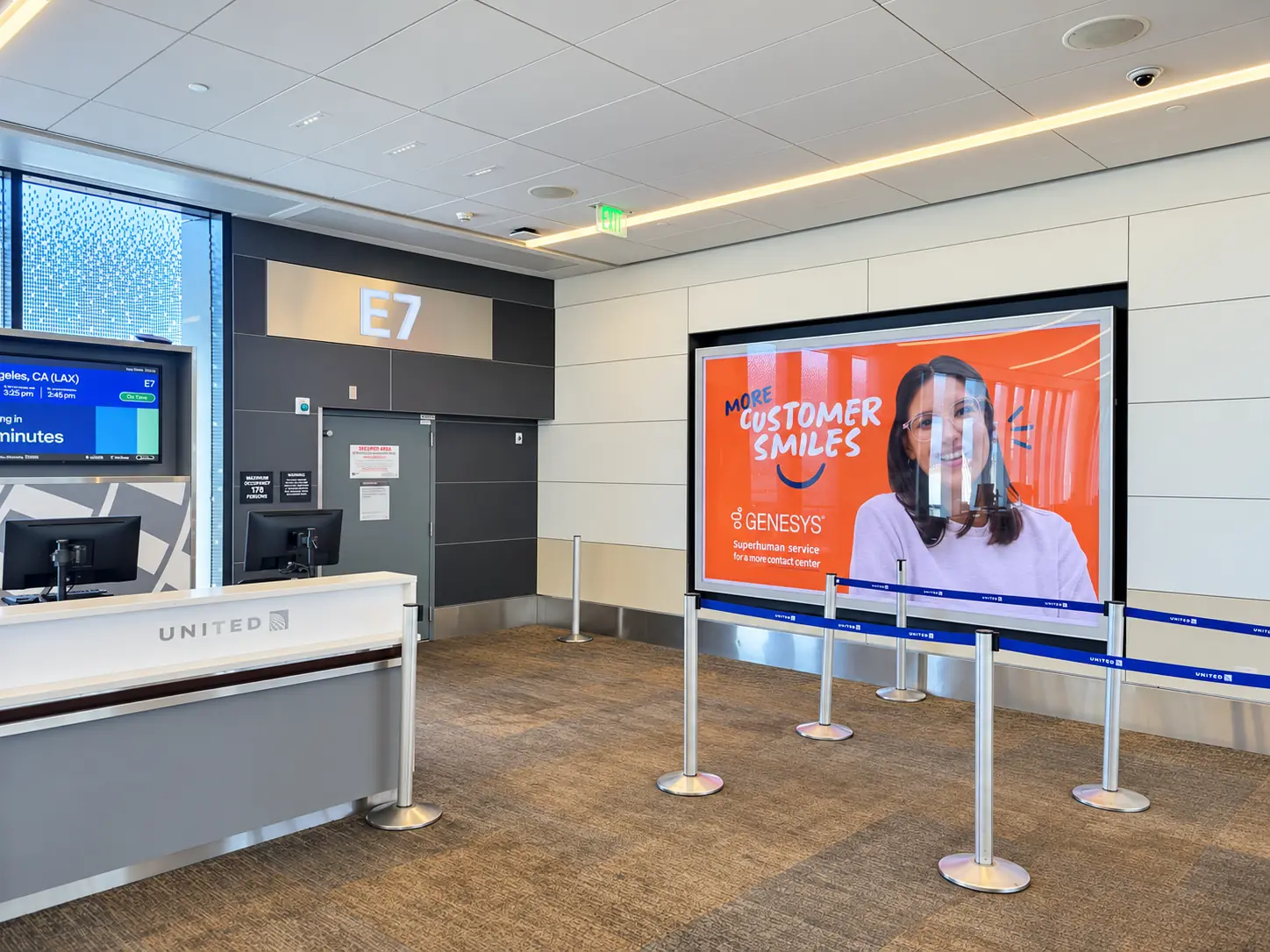
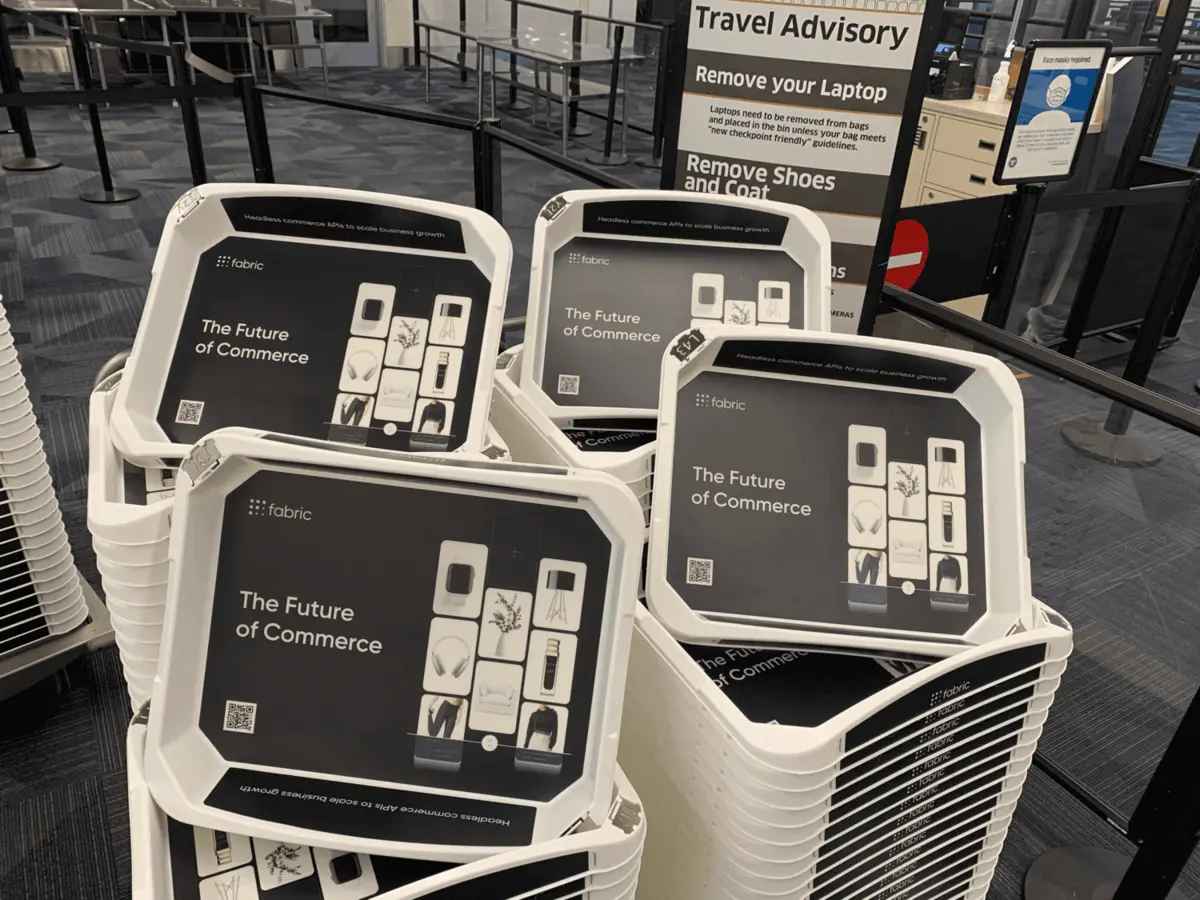
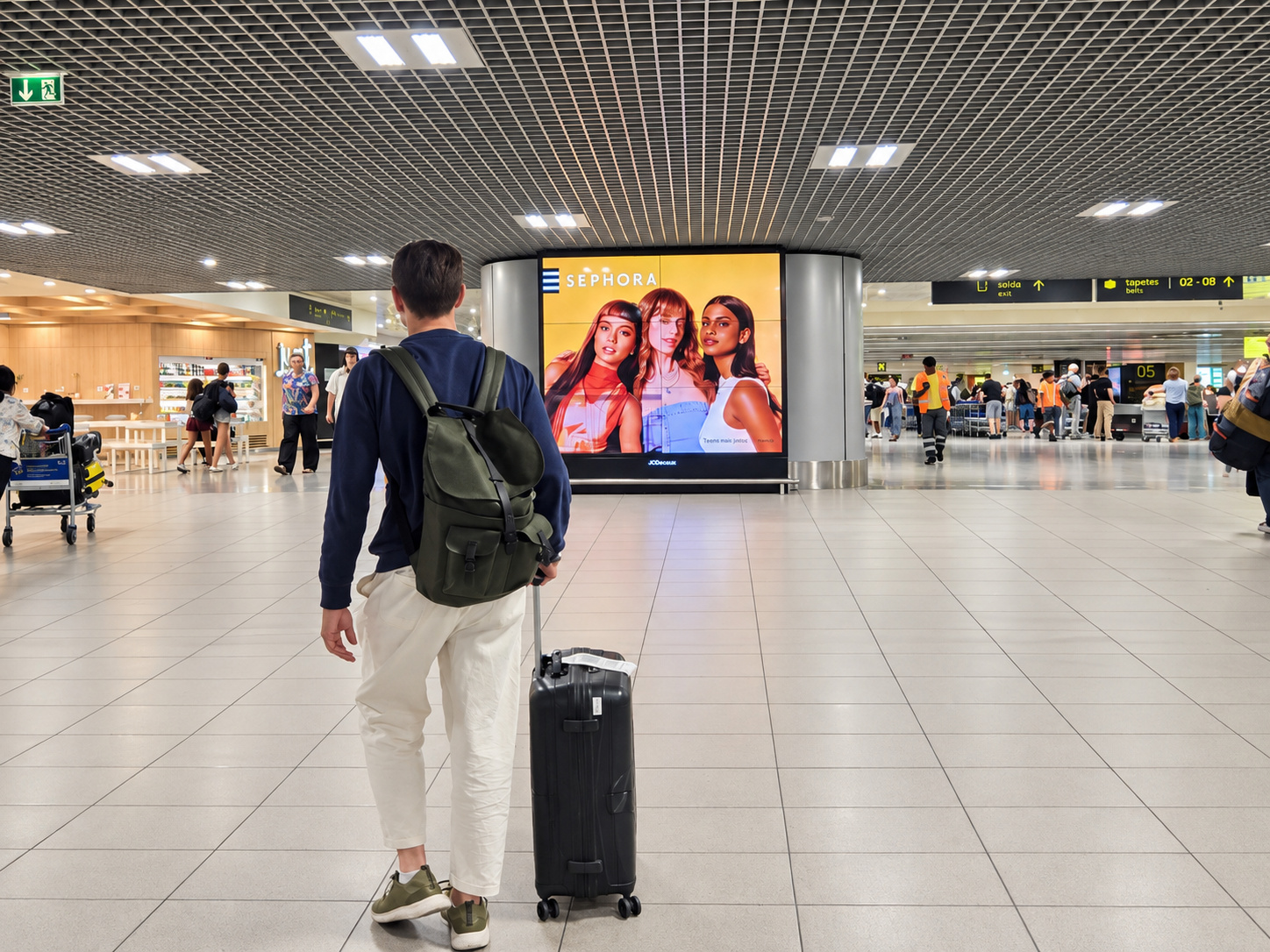
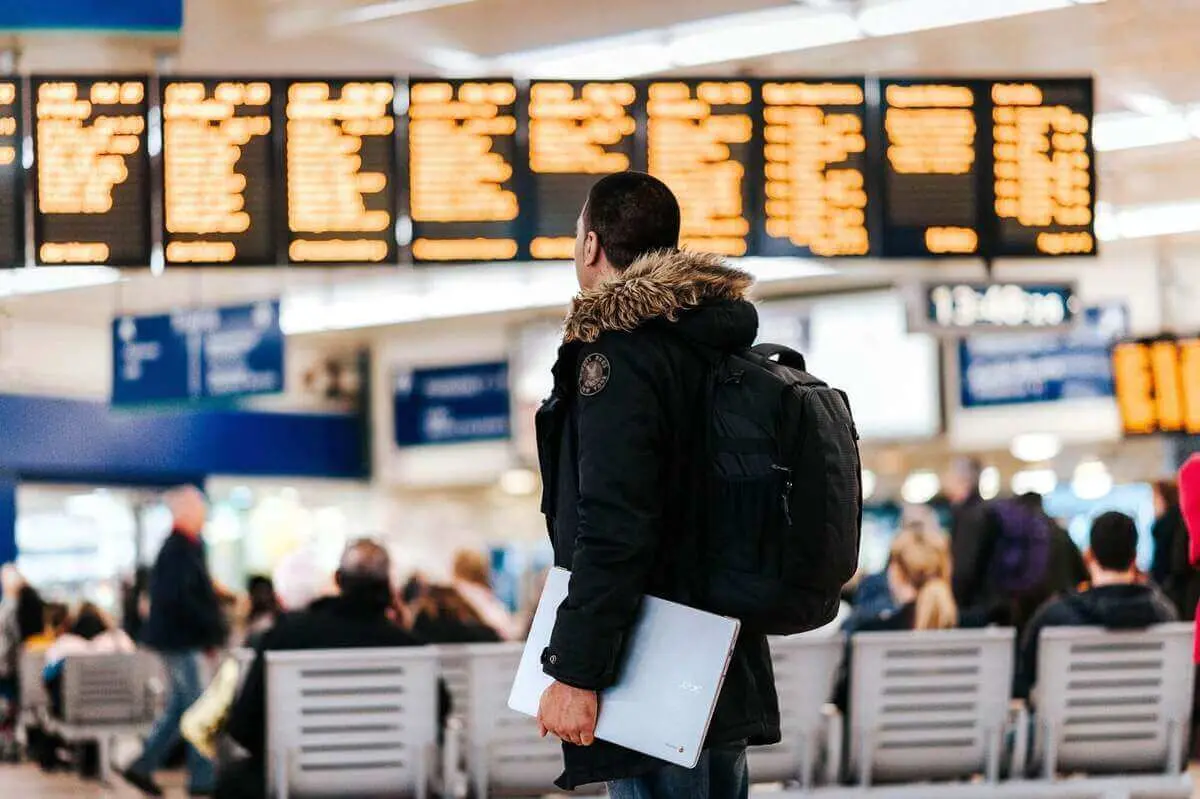
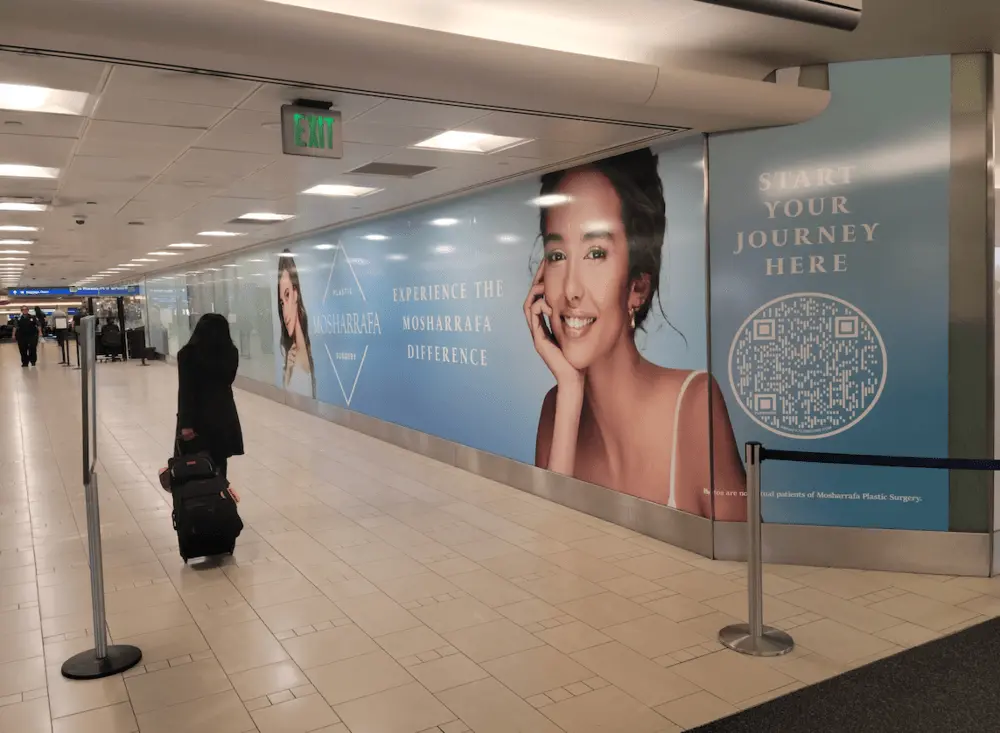
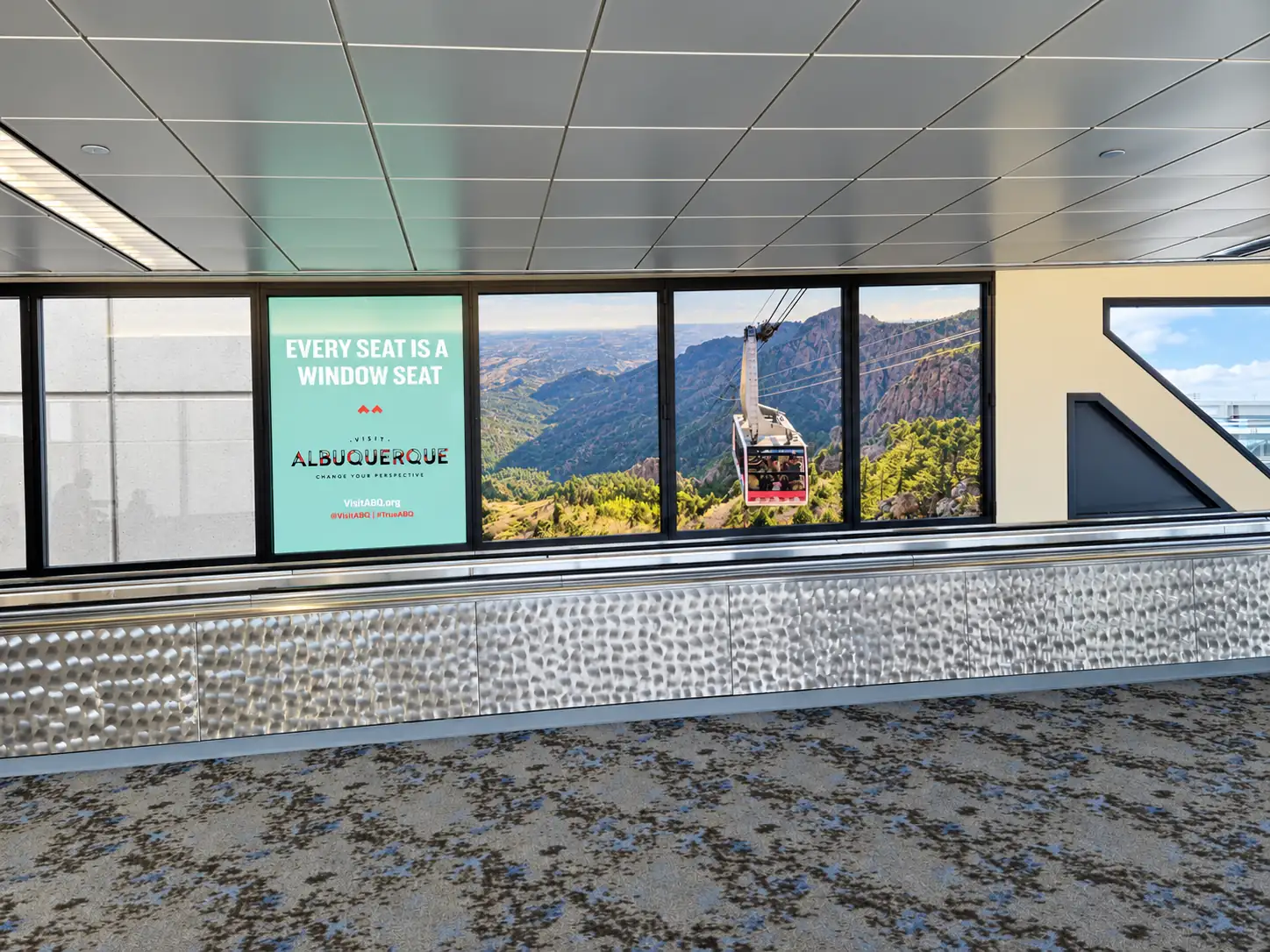
Airport advertising in practice, photographed across many airports. Availability at MCO varies by format.
What has EAM run beyond Orlando?
Other airports and multi-market campaigns. Click a card for the campaign and the result.
Sources: published campaign summaries on theairport.org/case-studies. Fabric is the takeover ceiling, labeled San Jose, not Orlando. Impressions are vendor-reported delivery, not pipeline attribution.
EAM also plans other airports. Where else does EAM run airport campaigns?
How do you measure an MCO campaign?
Proof of posting and digital play logs are factual. Delivered impressions are modeled. Brand lift is the only method that speaks to effect, and it has to be fielded before the flight. Direct pipeline attribution is not reliably available. A one-week convention buy has the cleanest measurement setup airport media offers: a defined population and a defined window.
What MCO delivers as standard. Proof photos within 5 days of posting, plus play logs on the digital networks. Delivered impressions are modeled from monthly terminal traffic (about 2 million each in A and B, about 750,000 in C) and unit position; treat them as audience sizing, not verified views.
| Measure | What it actually tells you | When to set it up | Confidence |
|---|---|---|---|
| Proof of posting | Photographic confirmation that units ran as bought. Proof photos within 5 days of posting. | Written into the contract before signing | High — factual |
| Delivered impressions | Modeled from monthly terminal traffic (about 2 million each in A and B, about 750,000 in C) and unit position. Audience sizing, not verified views. | Requested at proposal stage | Moderate — modeled |
| Digital play logs | Actual spot counts and share of voice on digital networks. The check on whether the eight-advertiser loop ran as planned. | Requested at contracting | High — logged |
| Brand lift study | Survey-based awareness or perception change against a control. The only method that measures effect rather than exposure. | Fielded pre-flight for a baseline | Moderate — needs budget and lead time |
| Direct attribution to pipeline | Not reliably available. Airport media has no click, and the same brands run other touchpoints at the same time. | — | Low — treat claims here with skepticism |
A convention week at MCO has the same measurement advantage a Las Vegas event week has: you know roughly who is arriving and exactly when, which makes a pre- and post-show survey of that audience far more meaningful than a general market study. A holiday week is the opposite: a broad population and a long tail, better measured by play logs and delivered impressions than by lift. Decide which kind of week you're buying before deciding what to measure.
The honest framing for anyone defending this spend internally: proof of posting and play logs prove the campaign ran as bought, delivered impressions size the audience, and a lift study is the only line that speaks to effect. A vendor promising attributed pipeline from airport media is overselling. EAM contracts proof of posting and delivery reporting on every campaign as standard and will tell you plainly when a proposed measurement approach won't produce a number worth presenting.
How does EAM run an MCO campaign?
One call, one plan, one contract. We follow up to learn the week and the objective, then come back with current availability and a recommended mix.
Tell us the week, the objective, and the budget range. We follow up to learn who you need to reach, then come back with current MCO availability, a recommended format mix, the terminal and direction that fit the audience, and a quoted range. Once approved, EAM handles the rest.
- Scope the week. Convention or vacation calendar; the terminal your audience's airlines use; arrival-side, departure-side, or both; one week or a run of weeks; one airport or Orlando as part of a Florida or national plan.
- Check avails and loop position. Which networks are open for the week, whether it falls in Q4, how many of the eight loop positions are taken, and by whom.
- Quote the mix. Networks, share of voice, terminal coverage, and a range, not a scraped rate card. After we know the week and the objective, we come back with current availability and a plan you can take inside.
- Contract and traffic creative. Specs across every screen shape in the buy (the columns are cylinders; the spectaculars are super-wide; the gate units are portrait), airport approval, files in 14–18 business days before the flight.
- Go live and close the loop. Confirm posting before the first arrival wave. Deliver proof of posting and play logs after the flight.
EAM Advertising is an independent airport and in-flight media agency, founded in 2015. We specialize in airport and in-flight media and nothing else, and we do not own media assets at MCO or any airport. That independence is why the recommendations hold up. We plan and buy across 125+ airports and 45+ airlines worldwide, which is the leverage and the current-availability knowledge a one-time MCO buyer does not have. Clients include Fortinet, Dynatrace, Rubrik, McGraw-Hill, and Wharton. When the event strategy extends beyond Orlando — a roadshow, a multi-city launch, an international push — the same relationship covers the other markets. See the main airport advertising hub.
Frequently Asked Questions
A single digital network runs $8,000 to $55,000 for one week outside the fourth quarter and $11,000 to $75,000 in Q4, depending on the network and the week. A two- or three-network week runs $40,000 to $130,000. A week across every digital network in the building runs north of $150,000. Those are planning ranges; specific units and weeks are quoted against current availability.
One week is the minimum. Four weeks is the standard flight. Conference campaigns targeting a show week are the case where one week is the right length. Every digital network runs ten-second spots in a loop of no more than eight advertisers, a minimum 12.5% share of voice. Pricing is quoted by quarter; the fourth quarter carries a premium of roughly a third over the rest of the year. Contracts are non-cancellable once signed.
Because the holiday travel calendar is when the airport is fullest and the attractions, travel, and consumer brands compete hardest for the loop. The premium applies to every network from October through December regardless of whether a convention is in town. IAAPA falls inside it; the PGA Show, MegaCon, and the spring and summer shows do not.
IAAPA, the PGA Show, and the Thanksgiving-to-New-Year stretch: hold inventory 4–6 months out. Mid-tier convention weeks and spring break: 10–16 weeks. Standard weeks: 4–8 weeks is usually enough. Every network costs roughly a third more in Q4; convention weeks in Q1–Q3 are priced at standard rates but sell first.
The one your audience's airlines use. Southwest and Frontier land in A; Delta, American, United, and most of the Latin American and Canadian carriers in B; long-haul international, JetBlue, and a growing domestic mix in C. Convention traffic is mostly B. Family leisure is A and B. UK, Brazilian, and long-haul inbound is C. The Prestige network covers all three; the Main Terminal domination covers every A and B departure. Confirm the current airline list at contract; Terminal C is growing.
Yes, at baggage claim and the curb. International arrivals clear federal inspection before they reach public areas, so the gate-side and concourse networks reach international departures but not international arrivals. For a UK, Brazilian, or Latin American inbound audience, the Terminal C arrivals spectaculars and the 360 columns are the units.
For one week at a time, when your industry's show is at the Orange County Convention Center. IAAPA, the PGA Show, HIMSS and InfoComm in their Orlando years, KBIS, MegaCon, and the rest of the OCCC calendar each bring an industry through Terminal B in a single week. Outside those weeks, MCO is a leisure and international airport, and a B2B message is reaching families.
They are the largest advertisers in the building, and the Main Terminal domination is where they concentrate. A brand in the same category should plan for share of voice; a brand in a different category usually finds the loop less contested than the airport's size suggests, because the attractions have taken the big units and the eight-advertiser cap leaves room.
Yes. Out-of-state universities recruiting Orlando students, executive and certificate programs reaching the Orlando professional, and alumni campaigns around commencement and homecoming. UCF is one of the largest universities in the country and Orlando sends students across the Southeast. Education brands EAM has placed in airports include Wharton, BYU, the University of Michigan, the University of Pittsburgh, and UT Dallas. The natural weeks are fall start (classes begin August 24, 2026), spring start (the week of January 11, 2027), and spring commencement (May 6–8, 2027).
14–18 business days before the flight starts. Expect at least three screen shapes in a multi-network buy: super-wide for the spectaculars, portrait for the gate units, and a cylindrical wrap for the Terminal C columns. All creative is subject to airport authority approval before it posts.
Everything after the objective. We check what's open for the week, which loops are crowded and which units will sell out, and where in the terminal your audience actually walks. We recommend the mix, secure the units, traffic the creative through airport approval, confirm posting on day one, and deliver proof of posting and play logs after. If MCO is one market in a larger plan, the same relationship covers the others.
Where else does EAM run airport campaigns?
EAM also runs campaigns in other North American and international airports.
- Atlanta - ATL
- Austin - AUS
- Baltimore - BWI
- Boston - BOS
- Burbank - BUR
- Cancun - CUN
- Charlotte - CLT
- Cincinnati - CVF
- Chicago (ORD)
- Chicago - MDW
- Cleveland - CLE
- Columbus - CMH
- Dallas - DAL
- Dallas - DFW
- Denver - DEN
- Des Moines - DSM
- Detroit - DTW
- El Paso - ELP
- Fort Lauderdale - FLL
- Guadalajara - GDL
- Honolulu - HNL
- Houston - IAH
- Houston - HOU
- Indianapolis - IND
- Jacksonville - JAX
- Kansas City - MCI
- Las Vegas - LAS
- Little Rock - LIT
- Long Beach - LGB
- Los Angeles - LAX
- Nashville - BNA
- Maui - OGG
- Memphis - MEM
- Monterrey - MTY
- Miami - MIA
- Midland - MAF
- Milwaukee - MKE
- Minneapolis - MSP
- New Orleans - MSY
- Newark - EWR
- New York - JFK
- New York - LGA
- Oakland - OAK
- Oklahoma City - OKC
- Ontario - ONT
- Orange County - SNA
- Philadelphia PHL
- Phoenix - PHX
- Pittsburgh - PIT
- Portland - PDX
- Sacramento - SMF
- Salt Lake City - SLC
- San Antonio - SAT
- San Diego - SAN
- San Francisco - SFO
- San Juan - SJU
- San Jose - SJC
- Seattle - SEA
- Tampa - TPA
- Tijuana - TIJ
- Washington DC - DCA
- Washington DC - IAD
- West Palm Beach - PBI
- Passenger statistics: Airports Council International North America 2025 traffic rankings (July 2026) and Greater Orlando Aviation Authority releases: 57,675,573 passengers in 2025; seventh in the U.S., 25th in the world; about 8.5 million international; record day January 3, 2026. [flymco.com press releases; airportscouncil.org]
- Terminal C expansion: gates 250–254 opened June 30, 2026; capacity for an additional 10–12 million passengers annually (GOAA).
- Event dates: IAAPA Expo November 16–20, 2026 (iaapa.org); PGA Show January 26–29, 2027 (pgashow.com); MegaCon Orlando May 20–23, 2027 (fanexpohq.com). Attendance: IAAPA Expo 2025 reported 43,840 registered; the 2026 PGA Show reported more than 34,000.
- Terminal assignments: Greater Orlando Aviation Authority airline list, September 2026 (flymco.com/airlines). Monthly terminal traffic, network descriptions, screen counts, loop structure, buying unit, and the Q4 premium: current MCO airport media specifications. Unit rates move with availability and are not published on this page. Terminal assignments change; verify against the airport's current map when planning.
- Pricing ranges and booking windows: EAM Advertising planning and buying data, 2015–2026.