San Francisco International Airport advertising (SFO) Where the Industry Lands. Where the Valley Takes Off.

54 million passengers a year and United's Pacific hub: the Valley flying out, the buyers flying in, and JPM, RSAC, and Dreamforce in between. Get the SFO media kit for formats, planning ranges, and booking windows. As a single-source airport media agency, we’ll follow up to learn who you need to reach, then come back with current availability and a recommended mix.

We’ll follow up with the kit and next steps for your campaign.

  • 125+Airports worldwide
  • 40+Media vendors
  • 54.4MSFO passengers in 2025

You’re in good company

  • Thomson Reuters
  • Invest in Canada
  • Dynatrace
  • Fortinet
  • Motorola
  • BYU

At a glance

San Francisco airport advertising
at a glance

  1. 1

    SFO handled about 54.4 million passengers in 2025, up about 4%, with roughly 16 million international. July was the busiest month. United carried 43.8% of the airport; Delta, American, and Alaska carried 6–7% each.

  2. 2

    It is a hub, not a pure origin-and-destination airport. United’s Terminal 3 and Concourse G carry connecting traffic between Asia-Pacific and the rest of the U.S. as well as Bay Area travelers. Baggage claim and the curb reach only people who are actually in San Francisco; the concourses reach everyone.

  3. 3

    Four terminals, and the plan starts with the airline: United in Terminal 3 (domestic) and International Terminal G; Alaska, Hawaiian, American, Delta, JetBlue, Southwest, and the rest of the non-United domestic mix in Harvey Milk Terminal 1; Air Canada, Breeze, and WestJet in Terminal 2 as of SFO’s March 2026 relocation notices; other international carriers in International Terminal A. Assignments move — confirm the current flysfo map at contract.

  4. 4

    Two conference seasons drive the B2B calendar: January through April (JPM Healthcare, GDC, RSAC April 5–8, 2027, GTC, Google I/O) and September through November (Dreamforce September 21–23, 2027; Disrupt October 13–15, 2026). The rest of the year is business travel in both directions: the Bay Area’s tech, biotech, and finance workforce flying out and the buyers, partners, and investors flying in to meet them.

  5. 5

    Planning ranges: a single print unit runs $6,000–$70,000 per 28-day period plus production — ticketing dioramas at the low end, concourse eye-level next, overhead banners and banner packages at the top; a single digital spectacular or network $20,000–$150,000 per period. Two- or three-unit plans run $60,000–$250,000 per period. Rates rose roughly a fifth between the 2025 and 2026 cards; multi-period contracts carry annual increases.

  6. 6

    Sold in 28-day periods. Conference flights have a two-week minimum: one week and two weeks cost the same at SFO, unlike Las Vegas. Holds expire five business days after confirmation. Contracts are non-cancellable once signed. Digital creative is due 14–18 business days before start, and static creative 21–28 days before start. Terminal 3’s western half is under construction through fall 2027; ask for current photos on any T3 unit.

  • 54.4MCalendar-year 2025 passengers (enplaned + deplaned), up about 4%San Francisco International Airport, 2026
  • 43.8%Share carried by United, the hub carrier; 24.3 million passengersSFO airline statistics, 2025
  • 16MInternational passengers in 2025, arriving and departingSFO, 2025

What you can run

What can you run
at SFO?

Individual video walls sold by terminal and concourse, the two-story Iconic wall in Terminal 1, the international Arrivals Digital Network, and one of the deepest print programs of any U.S. airport. Every digital spot is ten seconds; the terminal your audience’s airlines use decides which units reach them.

Digital unit

Concourse E Video Wall

Overhead in Terminal 3 Concourse E, visible from the far end of the concourse; United arrivals and departures

Screens
1 wall, about 175″ × 50″
Your spot
:10 in :100, one of ten, about 10% share of voice
Best for
United’s domestic traffic on the E side; the business traveler on the way in and out

Digital unit

Terminal 3 Video Wall

Overhead at the three-way intersection of Concourse F, where the concourses meet the food court, retail, and the corridor to arrivals and baggage claim

Screens
1 wall, about 224″ × 62″
Your spot
:10 in :100, about 10% SOV
Best for
The busiest crossing in United’s terminal; both directions

Digital unit

Iconic Digital

A two-story, floor-to-ceiling wall in the central area of Harvey Milk Terminal 1 Concourse B, just past security, beside the lounge and the concessions

Screens
1 wall, about 14′ × 27′
Your spot
:10 in :120, one of twelve, about 8% SOV
Best for
American, JetBlue, Alaska, Hawaiian, and Sun Country traffic; the biggest single read at SFO

Digital unit

Video walls

Individual walls at security checkpoints and busy concourses across Terminals 1, 2, 3, and the International Terminal. Sold by location, not as an airport-wide network

Screens
Confirm count and sizes at quote
Your spot
:10 in :100, about 10% SOV
Best for
By terminal and airline. The only digital network at SFO is international baggage claim

Digital network

Arrivals Digital Network

Twelve screens on the baggage carousels in the International Terminal

Screens
12 screens, 70″
Your spot
:10 in :240, one of 24, about 4% SOV
Best for
The only network that reaches international arrivals; long dwell, lowest cost of entry

Print

Print at SFO

Tension fabric at every scale: eye-level units in the Harvey Milk Terminal 1 baggage claim (American, JetBlue, Alaska, Hawaiian arrivals), soffit units over the Terminal 1 exit to the garage and rideshare, lit units and dioramas in the Terminal 2 baggage claim and on the walk to the AirTrain (Delta, Air Canada, Breeze), a vertical unit across from United’s baggage carousel, gate-hold units on Concourse F at F11–F14, a lit spectacular and two eye-level units at United’s Terminal 3 security queue, an upper-soffit unit in the Concourse C gate hold near the Sky Club, a diorama across from the Star Alliance lounge on Concourse G, and a large soffit unit in the connector between Terminal 3 and Concourse G aimed at connecting passengers. Media runs $6,000–$70,000 per period; production, installation, and removal add $200–$2,500 per install. On the lower end that is dioramas in the ticketing area, then eye-level signage in the concourses; the more expensive units are overhead banners and banner packages. Static creative is due 21–28 days before start.

How the loop worksEvery spot is ten seconds. A :100 loop shows your ad every 100 seconds; a :240 loop, every four minutes.

Every digital unit runs static and motion, and every spot is ten seconds. A :100 loop puts you in front of the passenger once every 100 seconds, a :240 loop once every four minutes. At international baggage claim, where arriving passengers wait through customs lines and carousel delays, a :240 loop still delivers several exposures per passenger. On a concourse, where the exposure is a walk past, a :100 loop is the difference between being seen and not.

Before you buy anything in Terminal 3The western half is under construction through fall 2027. Ask for current photos of any T3 unit before you buy.

The western half of Terminal 3 is a $2.6 billion modernization site through fall 2027: seismic retrofit, an expanded security checkpoint, 200,000 square feet of new concessions space. Gates, queues, and sightlines are moving. Ask for current photos of any T3 unit before committing, and confirm the security-queue units are on the checkpoint your audience will actually use during your period. This is the kind of thing an independent buyer asks about and a rate card does not volunteer.

Every airport format, with specs and lead times

The digital, static, experiential, and exterior units brands buy in airports. For SFO we plan specific units and dates against what is open at the time.

Examples

What does airport advertising
look like?

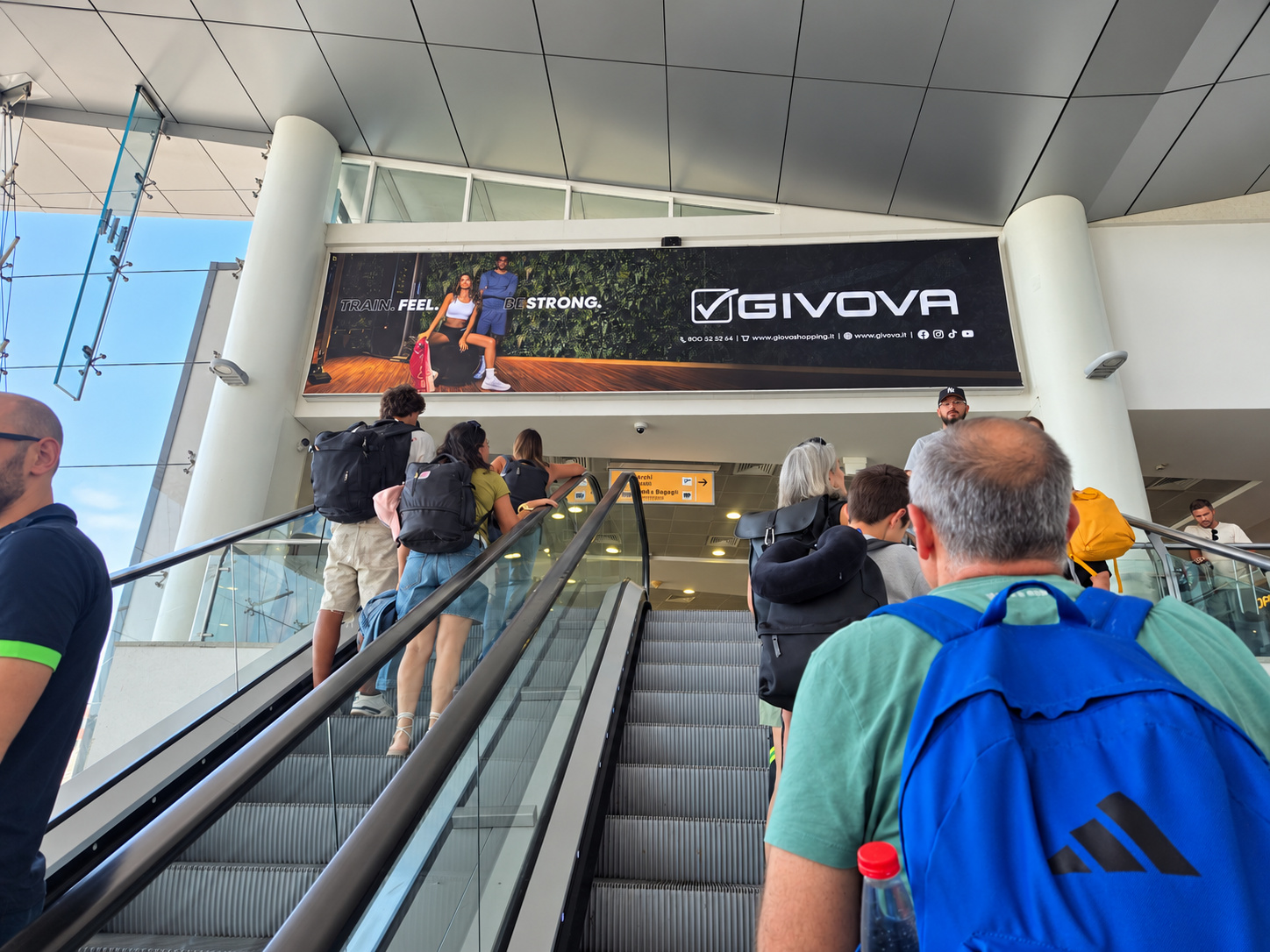
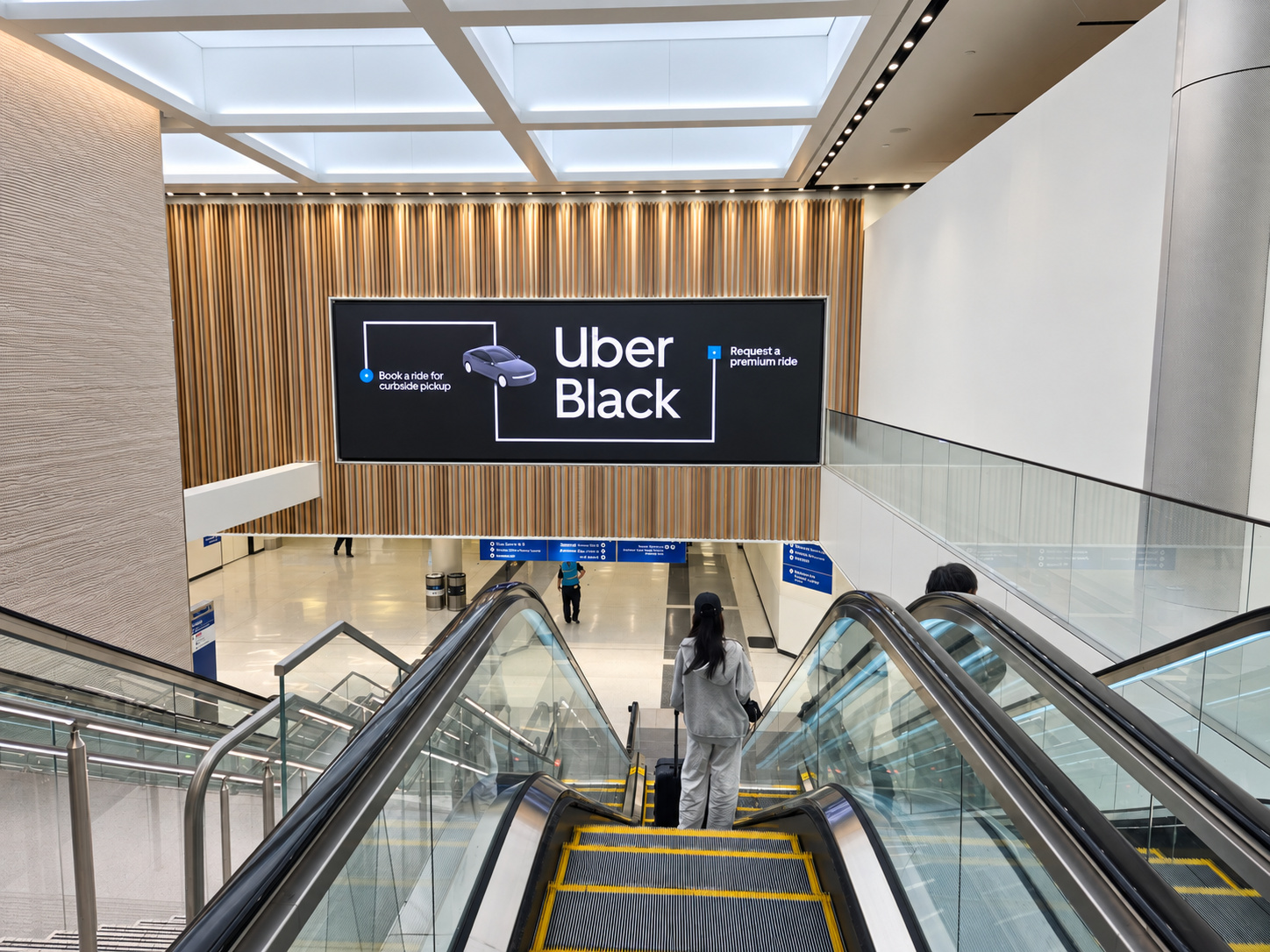
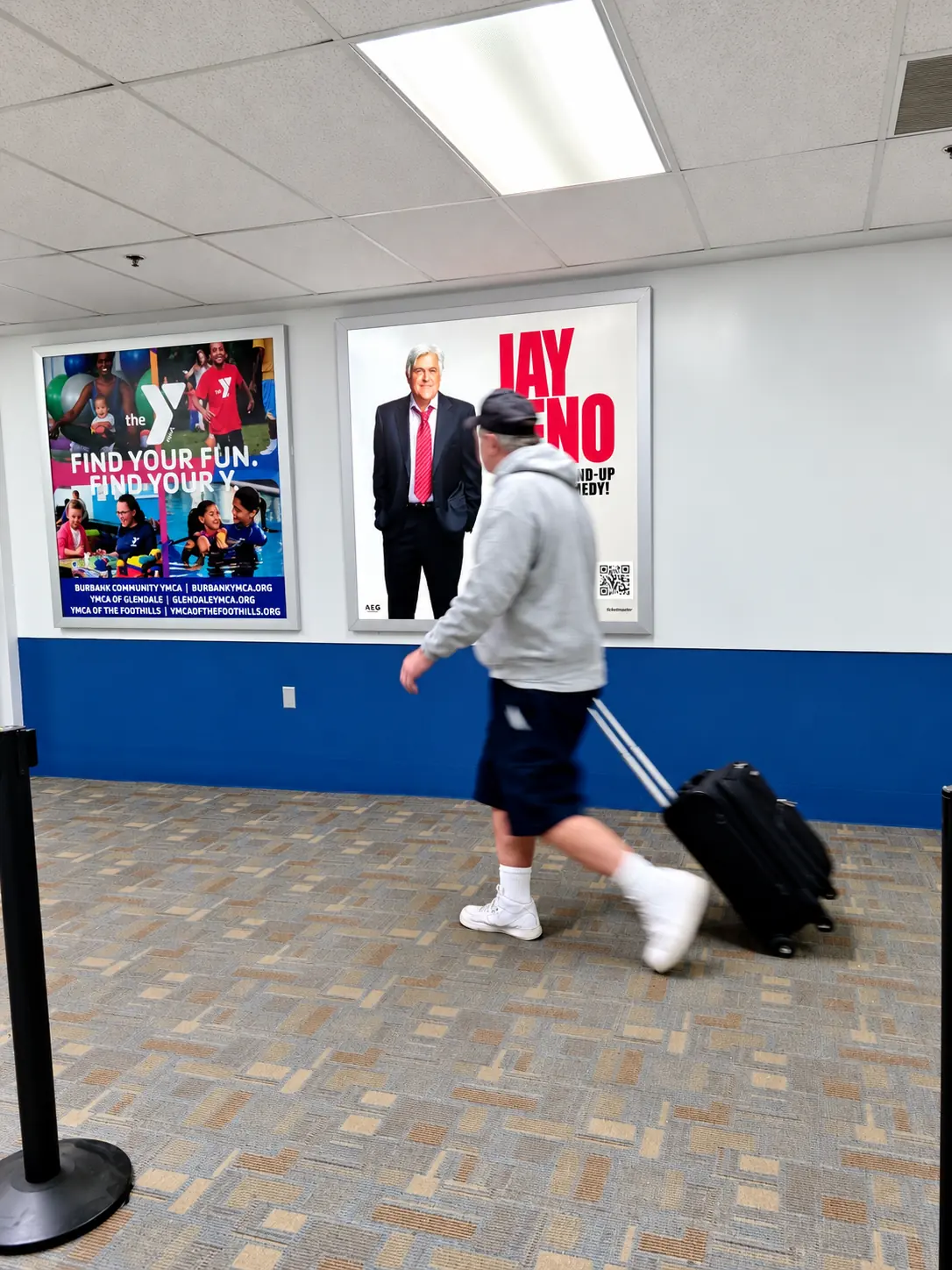
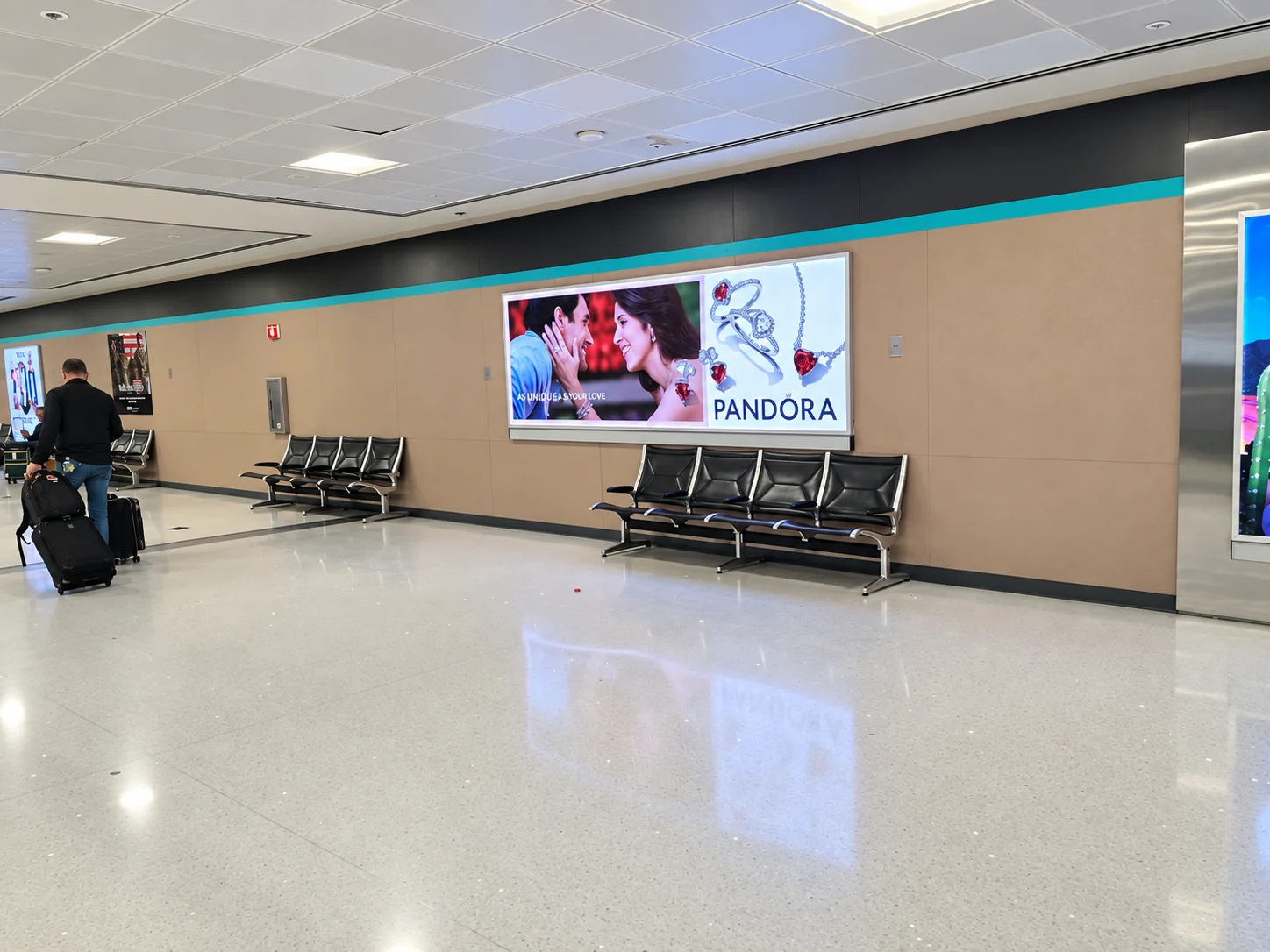
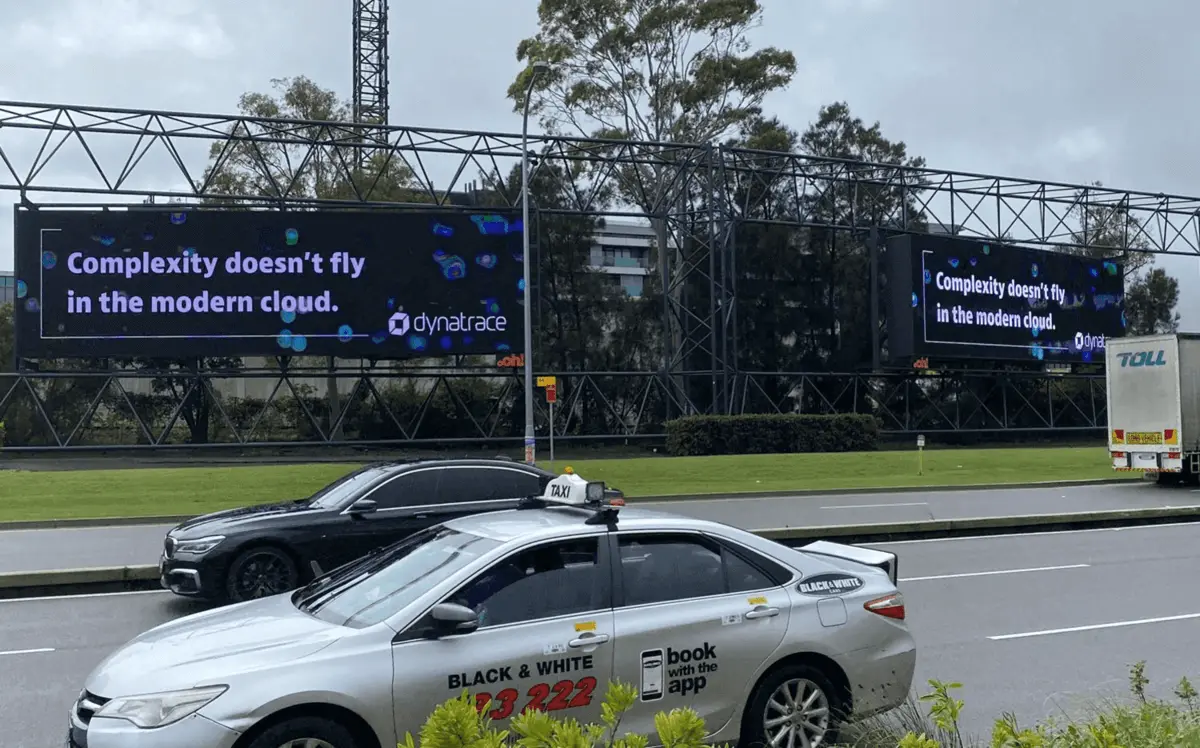
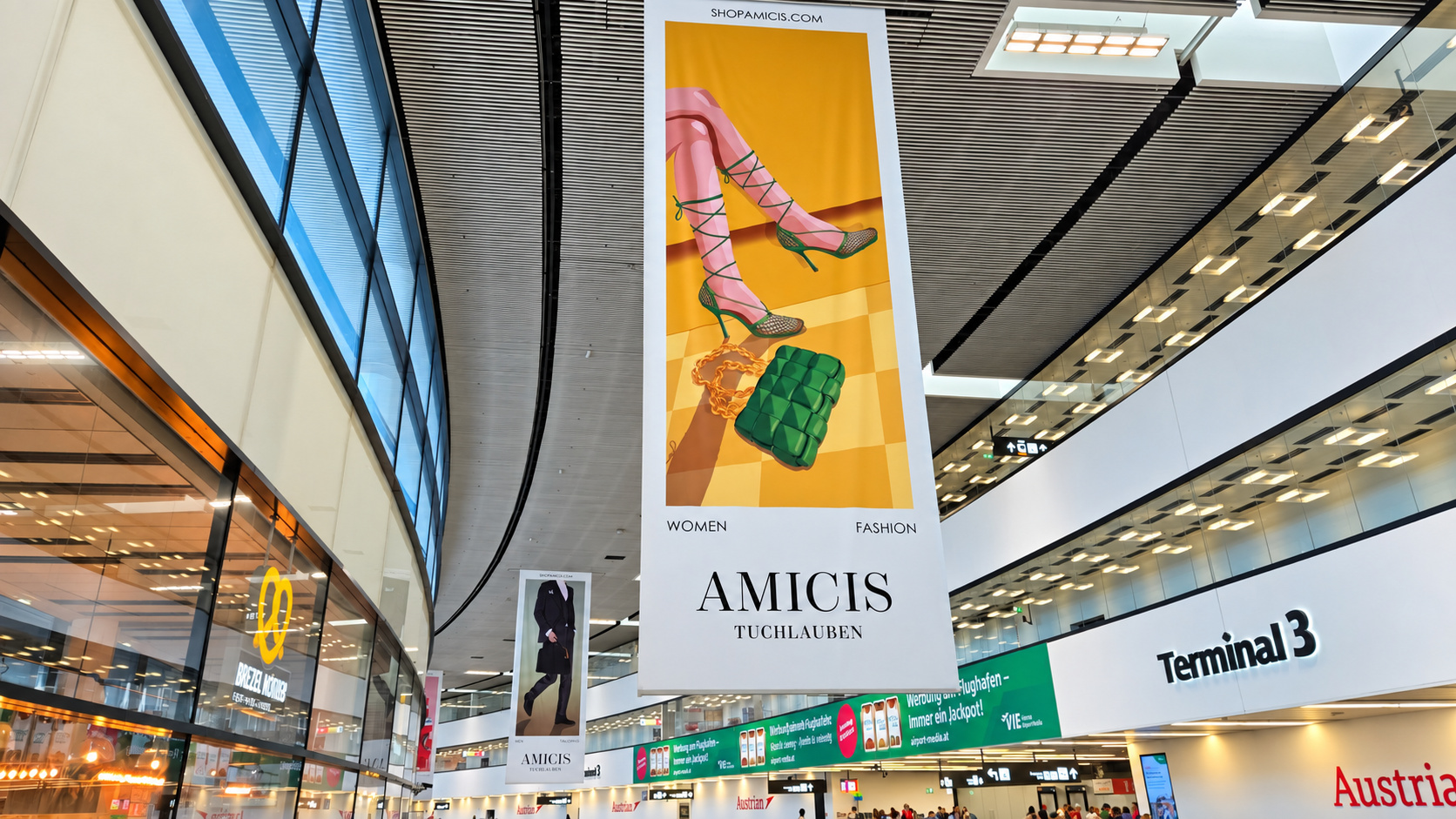
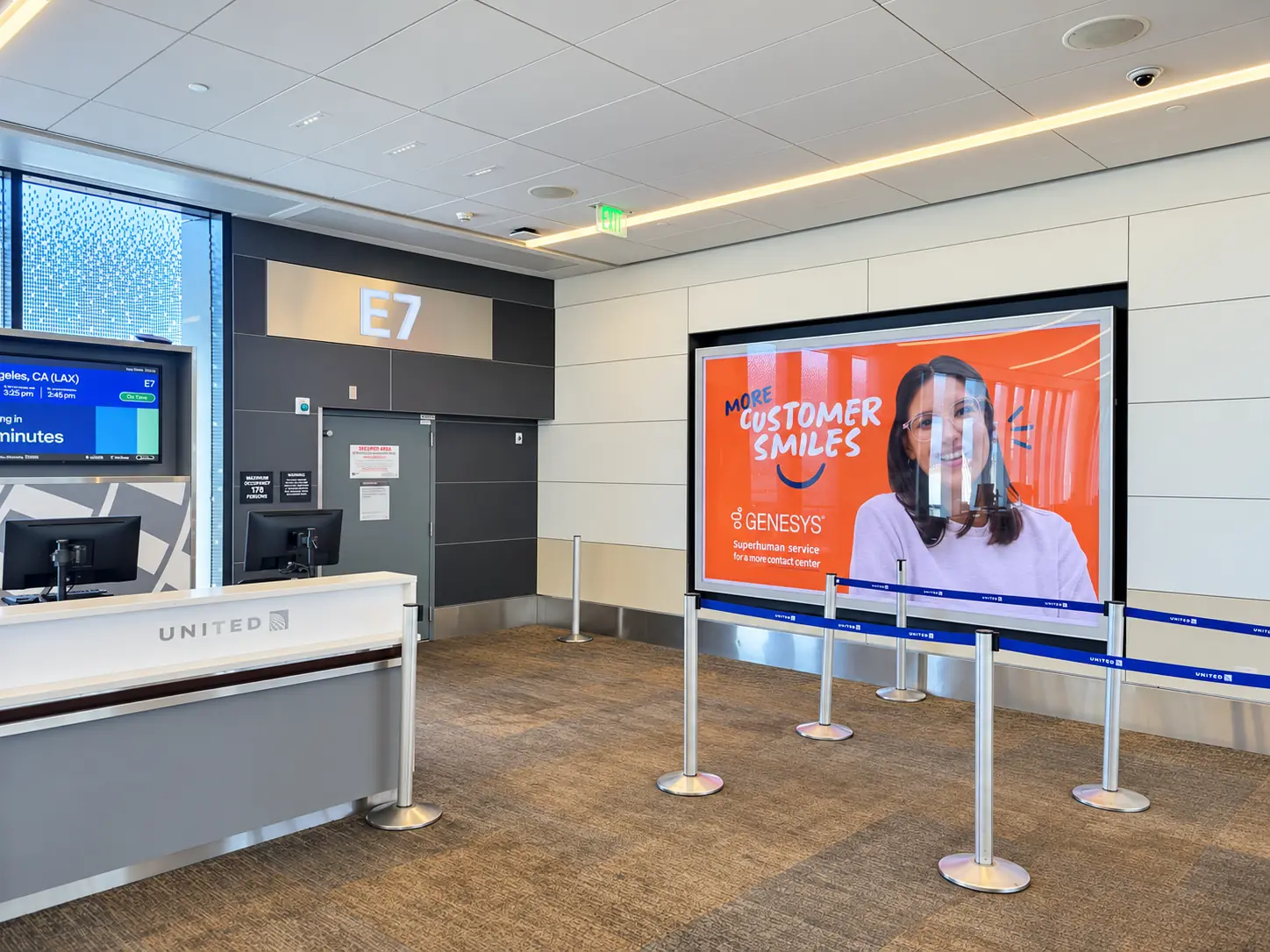
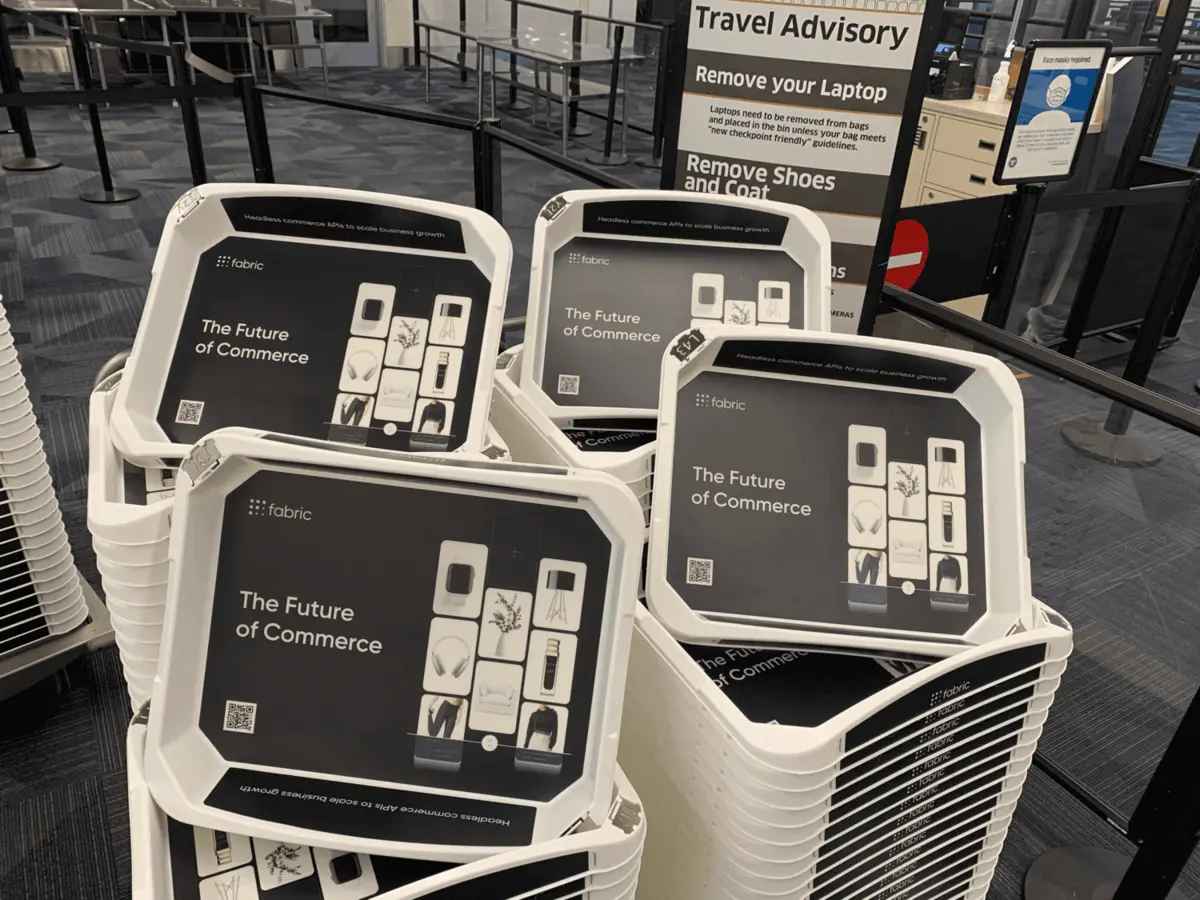
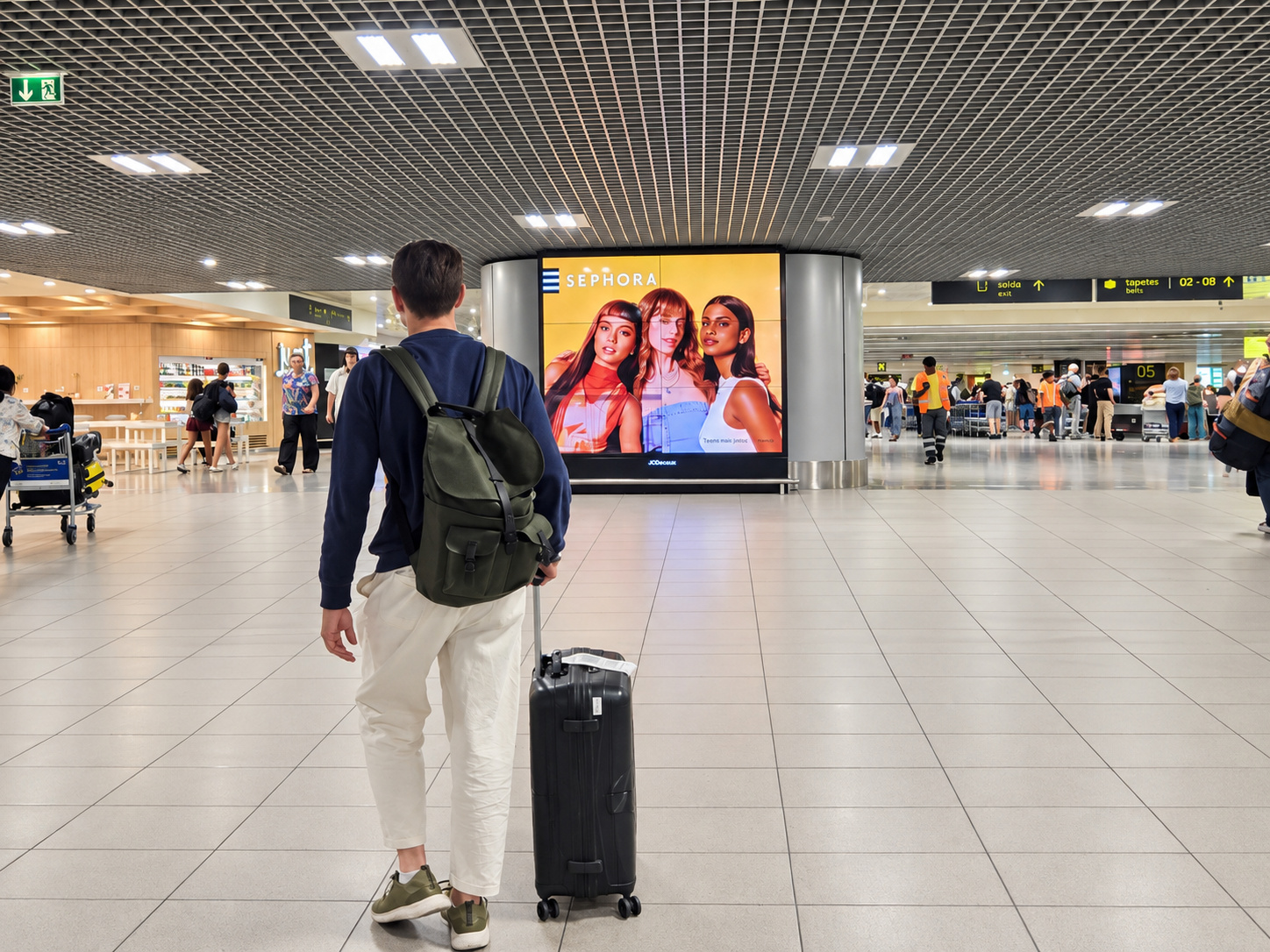
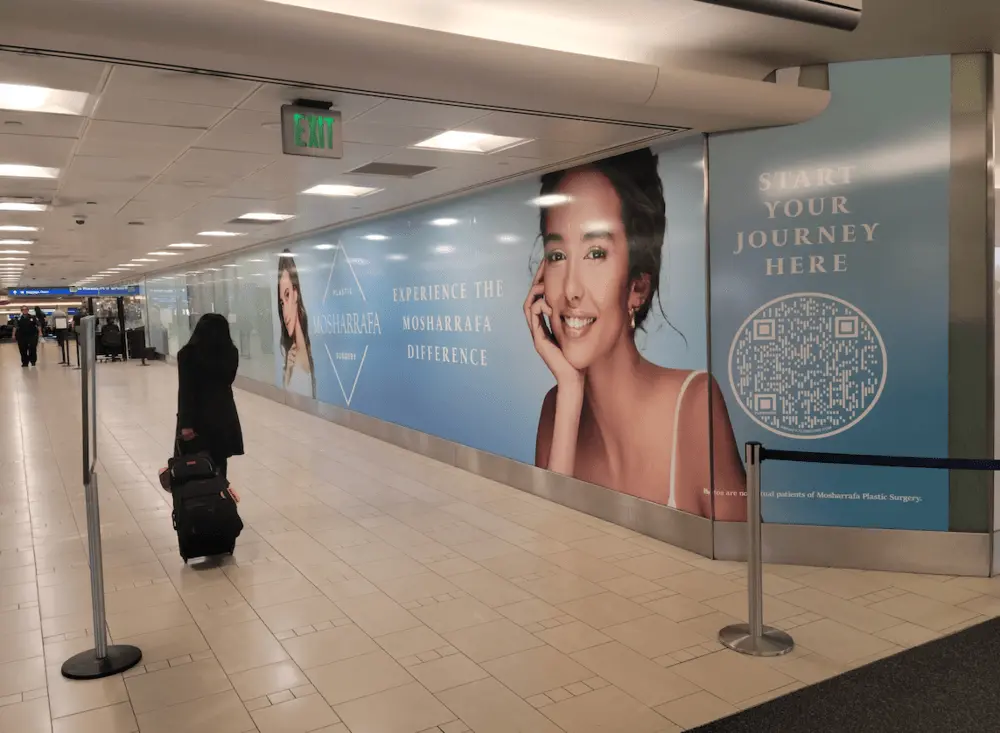
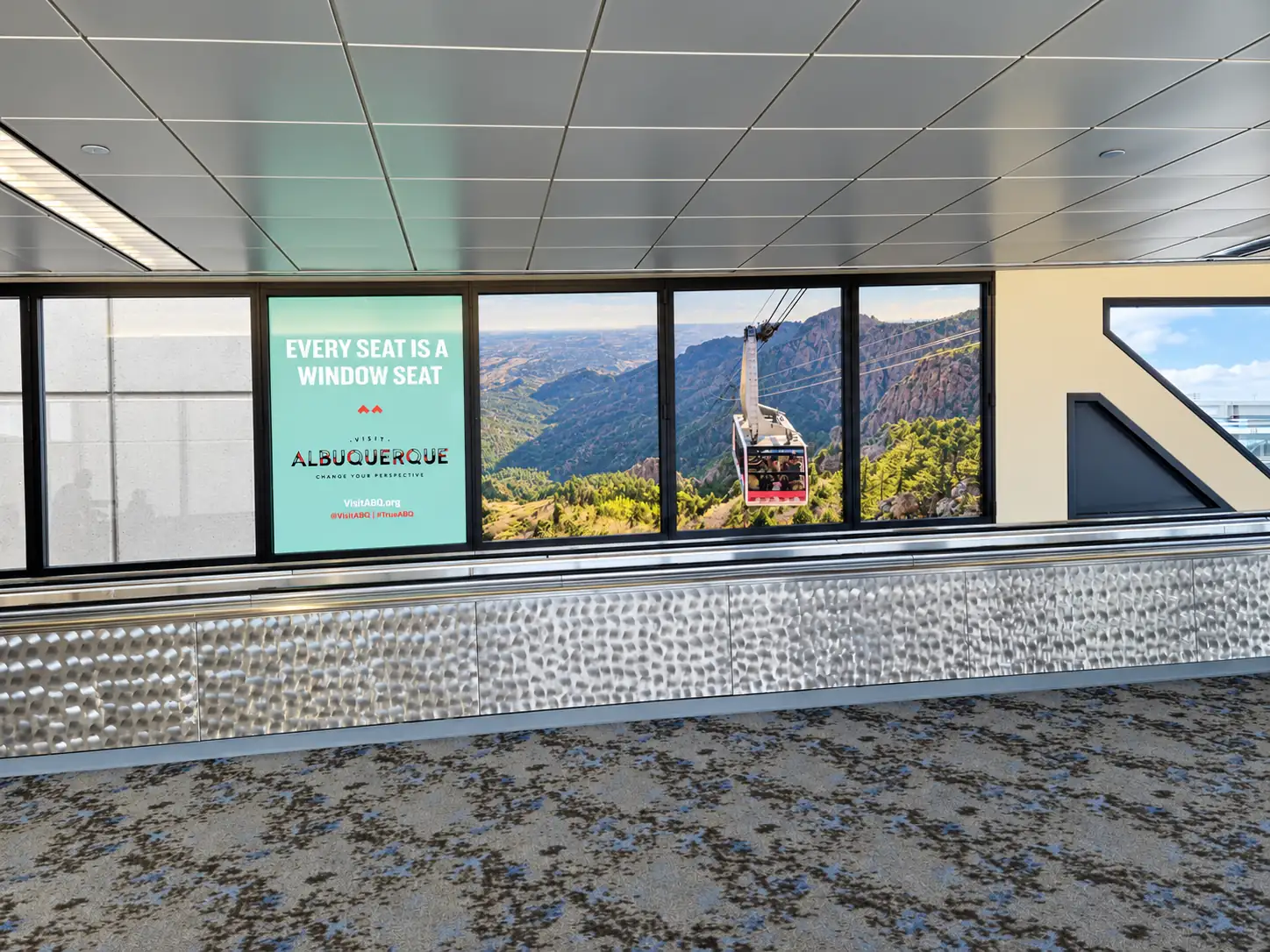
Airport advertising in practice, photographed across many airports. Availability at SFO varies by format.

Real brands. Real campaigns.

Which brands have run airport campaigns
with EAM Advertising?

Campaigns across several countries and media owners, each bought through one contract. Swipe or use the arrows for the markets, the scope, and the result.

“EAM made a nationwide airport campaign feel much easier to manage. The team was responsive, organized, and always on top of the details. They helped us make smart decisions with the budget, kept everything moving, and ultimately delivered exactly what we were looking for.”

Chief Marketing OfficerFortinet · nationwide airport campaign

These examples show past EAM campaigns—not a minimum campaign size, a forecast, or a guarantee of results. One-airport briefs are welcome, too.

Cost

What does San Francisco airport
advertising cost?

$6,000–$70,000 per 28-day period for a single print unit, plus $200–$2,500 for production, installation, and removal. On the lower end that is dioramas in the ticketing area, then eye-level signage in the concourses; the more expensive units are overhead banners and banner packages. $20,000–$150,000 per period for a single digital spectacular. The only digital network at SFO is international baggage claim. $60,000–$250,000 for a two- or three-unit plan. A one-week campaign and a two-week campaign cost the same, so conference flights book two weeks minimum — unlike Las Vegas. Those are planning ranges, not a rate card.

Sold in 28-day periodsConference flights have a two-week minimum; one week and two weeks cost the same at SFO.

SFO is sold in 28-day periods. Conference flights have a two-week minimum: one week and two weeks cost the same at SFO, unlike Las Vegas. A brand that only needs the conference burst books two weeks; a brand that wants the period books the period.

What a budget buys at SFO

Planning ranges per 28-day period. Pick the one closest to your brief and we’ll build the plan from it.

$6,000–$70,000

A single print unit

What it is
One unit for a 28-day period, plus $200–$2,500 for production, installation, and removal. Ticketing dioramas at the low end, concourse eye-level next, overhead banners and banner packages at the top
For
A fixed message in front of one airline’s passengers for a period
Plan at this budget
$20,000–$150,000

A single digital spectacular

What it is
One digital unit for a 28-day period: a concourse video wall, the Iconic wall, or the international Arrivals Digital Network
For
A big read in the terminal your audience uses
Plan at this budget
$60,000–$250,000

A two- or three-unit plan

What it is
Two or three units for a period, in the terminals and on the path your audience’s airlines use
For
Conference periods, launches, and always-on Bay Area programs
Plan at this budget

These are planning ranges, not packages or a rate card. Actual plans depend on the terminal, the period, and what is open when you book.

Contract realitiesNon-cancellable once signed, holds expire in five business days, and digital creative is due 14–18 business days before start.

28-day periods. Conference flights: two-week minimum; one week and two weeks cost the same. Non-cancellable once signed. Holds expire in five business days. All creative subject to airport authority approval before posting; digital creative is due 14–18 business days before start and static creative 21–28 days before start. Annual rate increases on multi-year agreements. Proof of performance within five business days of posting: close-up and environmental photos of every print location; a 10% sample of locations plus stacked-content photos for digital networks. Competitive separation between print and digital may be possible, but it isn’t guaranteed, and separation within a network is at the concession’s discretion. If category exclusivity matters, ask when booking and write it into the contract.

Why SFO prices high, and where print winsThe units are priced like the audience; SFO’s deep print program is the efficient buy for one airline’s passengers.

Two things about SFO pricing a first-time buyer should know. The unit prices are high because the audience is: the concourse walls in Terminal 3 reach United’s business traffic and the Iconic wall reaches every Concourse B passenger, and both are priced like it. And the print program is unusually deep. Most large airports have moved to digital; SFO still sells tension fabric at eye level in gate holds, in security queues, in baggage claims, and in the T3–G connector, with production costs in the hundreds of dollars rather than thousands. For a brand that wants a fixed message in front of one airline’s passengers for a period, print at SFO is the efficient buy.

What this page will not publishUnit rates, loop-position premiums, and period-specific quotes come back as a quote, not on this page.

Unit rates, loop-position premiums, and period-specific quotes. Those numbers move with availability and with the period. What you can plan against: 28-day periods; $6,000–$70,000 for a single print unit plus production (ticketing dioramas at the low end, concourse eye-level next, overhead banners and banner packages at the top); $20,000–$150,000 for a single digital spectacular; $60,000–$250,000 for a two- or three-unit plan. The only digital network at SFO is the International Arrivals Digital Network in international baggage claim. Specific units and periods come back as a quote.

Compare the digital units in one tableWhere, screens, spot, best for

Rather than a rate card, the table shows how the digital inventory is structured: where each unit reaches people, how many screens, and what your spot looks like inside the loop.

SFO digital units and networks, where they reach passengers
Unit or networkWhere it reaches themScreensYour spot in the loopBest for
Concourse E Video WallOverhead in Terminal 3 Concourse E, visible from the far end of the concourse; United arrivals and departures1 wall, about 175″ × 50″:10 in :100, one of ten, about 10% share of voiceUnited’s domestic traffic on the E side; the business traveler on the way in and out
Terminal 3 Video WallOverhead at the three-way intersection of Concourse F, where the concourses meet the food court, retail, and the corridor to arrivals and baggage claim1 wall, about 224″ × 62″:10 in :100, about 10% SOVThe busiest crossing in United’s terminal; both directions
Iconic DigitalA two-story, floor-to-ceiling wall in the central area of Harvey Milk Terminal 1 Concourse B, just past security, beside the lounge and the concessions1 wall, about 14′ × 27′:10 in :120, one of twelve, about 8% SOVAmerican, JetBlue, Alaska, Hawaiian, and Sun Country traffic; the biggest single read at SFO
Video wallsIndividual walls at security checkpoints and busy concourses across Terminals 1, 2, 3, and the International Terminal. Sold by location, not as an airport-wide networkConfirm count and sizes at quote:10 in :100, about 10% SOVBy terminal and airline. The only digital network at SFO is international baggage claim
Arrivals Digital NetworkTwelve screens on the baggage carousels in the International Terminal12 screens, 70″:10 in :240, one of 24, about 4% SOVThe only network that reaches international arrivals; long dwell, lowest cost of entry

Timing

When should you buy SFO,
and how far ahead?

Two seasons. January through April: JPM Healthcare, GDC, RSAC, GTC, and the spring developer conferences. September through November: Dreamforce, Disrupt, and the fall product launches. Outside them, SFO is bought for business travel in both directions, in 28-day periods, and it’s less contested. JPM and Dreamforce periods: hold inventory 4–6 months out.

The Bay Area’s conference calendar is dense in the shoulders and quiet in the middle. Summer is the airport’s busiest season for passengers and the quietest for B2B, because the audience is on vacation. The table covers the weeks that change who is in the building.

San Francisco weeks and what they mean for the buy
EventTimingWho arrivesWhat it means for the buy
JPM Healthcare ConferenceJanuary 11–14, 2027Biotech, pharma, and health-tech executives and investors; the entire industry’s deal weekThe most concentrated executive audience of the year. United and international, so Terminal 3 and Concourse G. The period that contains it sells first
GDCMarch 1–5, 2027Game developers and publishers, about 30,000Moscone; younger, developer-heavy; every carrier
NVIDIA GTCMarch 14–18, 2027, San JoseAI and infrastructure; some fly SJC, many fly SFOThe AI buyer’s week; Terminal 3 and G for the international share
RSACApril 5–8, 2027Cybersecurity, about 45,000The security industry’s week; the SFO equivalent of Black Hat at LAS
Google I/O, WWDC, Databricks and Snowflake summitsMay–June window; 2027 I/O and WWDC dates not postedDevelopers and data teamsMid-tier weeks; the Peninsula events split between SFO and SJC
SummerJune–AugustLeisure and international visitors; the busiest passenger monthsConsumer and destination brands; B2B goes quiet
DreamforceSeptember 21–23, 2027Salesforce ecosystem, 40,000-plus in personThe largest conference on the calendar; the city and the airport both fill. Multi-terminal
TechCrunch DisruptOctober 13–15, 2026Startups, founders, ventureFounder-heavy; the venture audience that lives here is also in the building
OpenAI DevDay and fall launchesSeptember 29, 2026, San Francisco; later fall launches varyAI developers and partnersSmaller inbound, dense composition
EAM’s takeThe conference audience and the resident audience are the same industry, which is the argument for buying the period.

SFO is the one airport where the conference audience and the resident audience are the same industry. A security brand buying RSAC week reaches the RSAC attendees and the Bay Area security buyers who didn’t need to fly in. That’s the argument for buying the period, not the week: the seven days around the conference reach the same people at home. If the brief is the conference burst only, book two weeks — one week and two weeks cost the same at SFO, unlike Las Vegas. The mistake on an always-on brief is buying only the show and skipping the other days at an airport where the audience never leaves.

How far in advance do you need to book, and what do conference periods cost?

JPM week and Dreamforce week: hold inventory 4–6 months out. RSAC, GDC, and Disrupt: 8–12 weeks. Standard periods: 6–8 weeks is usually enough. SFO does not price by event; the premium is in availability, not the rate card. The period that contains a major conference sells out on the units that face the right terminal, and what’s left is the wrong terminal.

The rate is the same; availability is notEvery period is priced the same within a year; the conference periods sell out on the right-terminal units.

SFO is sold in 28-day periods, and the media kit prices every period the same within a year. The difference between a Dreamforce period and a July period is not the rate; it’s whether the Terminal 3 walls and the Concourse B Iconic wall are still open. A brand that wants the conference period books the period.

Two-week minimum for conference flightsOne week and two weeks cost the same at SFO, so the minimum conference campaign is two weeks.

Short conference flights are a separate rule. One week and two weeks cost the same at SFO, so the minimum conference campaign is two weeks. Las Vegas will sell a single week; SFO will not, because the second week is already in the price.

Rates rise every yearThe digital card rose roughly a fifth between 2025 and 2026; ask for the rate held across an always-on run.

One more thing the rate cards show: the digital rate card rose roughly a fifth between the 2025 and 2026 grids, and multi-year agreements carry annual increases. A brand planning an always-on program at SFO should ask for the rate held across the run at contract, because the next card will be higher.

A hold is a decision windowHolds expire five business days after confirmation, and contracts are non-cancellable once signed.

A hold at SFO expires five business days after it’s confirmed unless extended, and extensions are at the concession’s discretion. In a conference period that means a hold is a decision window, not a reservation. Contracts are non-cancellable once signed.

SFO booking windows by period
TierExamplesHold byWhat sells firstPricing character
PeakThe periods containing JPM week and Dreamforce week4–6 monthsTerminal 3 video walls, Concourse G units, Iconic DigitalStandard rate; contested by availability, not price
HighRSAC, GDC, GTC, Disrupt periods8–12 weeksTerminal 3 video walls and the terminal that fits the audienceStandard rate; the right-terminal units go first
StandardAll other periods, including summer6–8 weeksMost units openStandard rate; 28-day minimum; multi-period programs carry annual increases

Ready to plan?

Start your SFO plan.
Send the brief.

Tell us who you need to reach, where, and when. We come back with current availability at every airport in the plan and a recommended mix.

Airports, start date and duration, campaign goal, budget range, and anything else you can share. A few lines is plenty.

We come back with current availability and a recommended mix.

Placement

Where should your ads run
inside SFO?

In the terminal your audience’s airlines use, along the path they take. United traffic: Terminal 3 concourses, the F-intersection wall, the security queue, and Concourse G. Non-United domestic: the Iconic wall in Terminal 1 and the baggage claims in Terminals 1 and 2. International arrivals: the International Terminal baggage claim. Connecting passengers: the T3–G corridor. No single unit reaches everyone.

SFO’s four terminals sit around a ring, connected airside and by the AirTrain. Passengers do not cross between them unless they’re connecting, so a placement plan is a terminal plan first.

Terminal 3 (United)The E or F concourse, the F-intersection wall, the security queue, the gate holds, and the connector to Concourse G.

Arriving passengers walk the E or F concourse toward the central rotunda, pass the F intersection (the video wall), and take the corridor down to baggage claim and the exit to the curb and the garage. Departing passengers clear the Terminal 3 security checkpoint (the print units and the lit spectacular), pass the same intersection, and walk out to the gates (the F11–F14 gate-hold units, the E wall). Connecting passengers walk the corridor to Concourse G (the connector unit) without leaving the secure side.

Harvey Milk Terminal 1Concourse B and C, the two-story Iconic wall past security, then baggage claim and the exit to the garage.

Arriving passengers come off Concourse B or C, pass the central area (the Iconic wall, two stories, past security), and go down to baggage claim (the tension fabric units) and out toward the garage and rideshare (the soffit unit over the exit). Departing passengers clear security into the same central area.

Terminal 2Delta, Air Canada, and Breeze: baggage claim lit units and the dioramas on the walk to the AirTrain.

Delta, Air Canada, and Breeze. Baggage claim lit units and the eye-level dioramas on the walk to the garage, AirTrain, and rideshare.

International TerminalConcourse G (United, Star Alliance) and Concourse A feed international baggage claim and its twelve-screen network.

Concourse G is United and Star Alliance, with the diorama across from the lounge and the connector back to Terminal 3. Concourse A is everyone else. Both feed the international baggage claim, where the twelve-screen Arrivals Digital Network hangs over the carousels; that is the only advertising an international arrival sees before the curb.

The SFO arrival and departure sequence, by terminal
StepTerminal 3 (United)Terminal 1 and 2 (other domestic)International TerminalPriority
Off the planeConcourse E wall; F gate-hold printConcourse B central area: Iconic wallConcourse G diorama; Concourse AHigh for the business audience; both directions
The crossingF-intersection video wall; corridor to bag claimCentral area past securityConnector to Terminal 3 (connecting United passengers)Highest in T3; the one point every T3 passenger passes
Baggage claimVertical unit across from the United carouselTerminal 1 tension fabric; Terminal 2 lit units and dioramasArrivals Digital Network, 12 screensHighest for a local audience; the only place you know the passenger is in San Francisco
The curbExit to garage and rideshareSoffit over the Terminal 1 exit; Terminal 2 walk to AirTrain and rideshareCurbHigh; last read before the city
Departure sideSecurity-queue print and spectacular; F intersection; E wall; gate holdsIconic wall; Concourse C gate hold near the Sky ClubConcourse G diorama; connectorHigh for resident, recruiting, and conference-outbound buys
Direction follows the objectiveAccount-based and recruiting buys run both directions in T3; local buys weight baggage claim and the curb.

An account-based or recruiting buy is both directions in Terminal 3, because the resident audience commutes. A conference buy is arrival-side on the inbound day across every terminal the audience’s airlines use, then departure-side in Terminal 3 on the way home. A Bay Area consumer or destination buy is baggage claim and the curb only, because that’s where the local audience is certain. A transpacific buy is Concourse G and the connector, where the passenger may never leave the building and doesn’t need to.

Terminal 3 West constructionThrough fall 2027. Confirm unit locations at contract and ask what happens if a unit is obstructed.

Through fall 2027. Gates, the security checkpoint, and the concessions on the western half are changing. Confirm unit locations against the current map at contract, and ask what happens if a unit is obstructed or relocated during your period.

Why SFO

Why do brands advertise at
San Francisco International (SFO)?

Because the people who decide what enterprise technology, AI, cloud, security, and biotech get bought fly through here more than through any other airport, and twice a year the rest of their industry flies in to meet them. SFO is the Bay Area’s international gateway and United’s Pacific hub: sixteen million international passengers, a business audience that commutes by air, and a conference calendar with two peaks.

The Bay Area flies out of SFOThe densest concentration of technology decision-makers in the world, flying United out of Terminal 3 every week.

The Bay Area is the densest concentration of technology decision-makers in the world, and most of it flies out of SFO. Founders and executives on the Peninsula, the AI labs and the venture firms in the city, the biotech corridor in South San Francisco, and the companies that grew up around Stanford and Berkeley. On a Monday morning United flight to Newark, Denver, or Tokyo, the passenger next to your ad is the Bay Area tech workforce, and a meaningful share of them buy enterprise software, infrastructure, and services for a living.

Two conference peaksJPM in January, RSAC in April, Dreamforce in September, Disrupt in October, with developer weeks in between.

Then the calendar turns the building into a conference airport. JPM Healthcare in January fills Concourse G and Terminal 3 with biotech and health investors. RSAC in April brings the security industry. Dreamforce in September brings 40,000-plus of the Salesforce ecosystem. Disrupt in October brings the startup world. Between those weeks, GTC, Google I/O, WWDC, and the developer conferences on the Peninsula send their audiences through the same terminals.

A hub, with four terminalsA share of United’s passengers are connecting, and the airline decides which terminal your audience uses.

Two facts shape every SFO plan. First, it’s a hub: United carries nearly half the airport and a share of its passengers are connecting between Asia-Pacific and the rest of the country without entering San Francisco. A brand targeting the Bay Area weights baggage claim and the curb; a brand targeting the transpacific business traveler weights the concourses and the Concourse G side of the International Terminal. Second, it’s four terminals, and the airline decides which one your audience uses. There is no unit at SFO that reaches everyone, and the page says so.

Audience

Who actually flies
through SFO?

About 54.4 million passengers in 2025, sixteen million of them international. United is the hub carrier at 43.8% and lives in Terminal 3 and International Terminal G. Delta, American, Alaska, JetBlue, Hawaiian, and Southwest share Harvey Milk Terminal 1 and Terminal 2. Every other international airline uses International Terminal A. The useful audience is the Bay Area business traveler most weeks and the conference inbound during the two peaks.

Carriers and trafficAbout 54.4 million passengers in 2025; United carried 24.31 million (43.8%), with Delta, American, and Alaska behind.

SFO enplaned about 27.25 million passengers in 2025 and deplaned about 27.11 million, a total near 54.4 million, up roughly 4% on 2024. About 19.3 million of the enplanements were domestic and 7.95 million international. United carried 24.31 million passengers, 43.8% of the airport, and announced its largest-ever SFO schedule for summer 2026: more than 300 daily departures to over 100 destinations, including 50-plus daily international flights. SkyWest (flying as United Express and for others) and Delta each carried about 4 million; American 3.6 million; Alaska 3.3 million. July was the busiest month at 5.3 million passengers.

Terminal by airline, as published on flysfo.com airline pages and the March 2026 relocation notices. Terminal 3 West construction is moving gates through fall 2027. Confirm assignments against the current airport map at contract.

SFO terminals and who uses them
TerminalConcoursesAirlinesWhat it means for the buy
Harvey Milk Terminal 1B and CAlaska and Hawaiian, American, Delta, JetBlue, Southwest, Sun Country, Frontier, Porter. Concourse B and C. Confirm the live gate map at contract.The newest domestic terminal; the two-story Iconic Digital wall is here. Non-United domestic arrivals and departures
Terminal 2DAir Canada, Breeze, WestJet (WestJet moved here March 3, 2026). Confirm the live gate map at contract.Smaller domestic hall; Air Canada, Breeze, and WestJet as of the 2026 notices
Terminal 3E and FUnited domestic, United ExpressNearly half the airport. Concourse E and F video walls, the F-intersection wall, the security-queue units. Western half under construction through fall 2027
International TerminalA and GG: United international and Star Alliance partners (Lufthansa, ANA, Singapore, and others). A: other international carriers (Emirates, British Airways, Air France, Cathay, and others). Air Canada also uses Terminal 2. Confirm the live map at contract.Sixteen million international passengers. G is the transpacific business audience and the Polaris lounge; A is everyone else. The Arrivals Digital Network at international baggage claim is the only network that reaches international arrivals
The T3–G connectorA corridor between Terminal 3 and Concourse G carries United’s connecting passengers, with its own units.

All four terminals connect airside and by the AirTrain, and Terminal 3 connects directly to International Terminal G through a corridor that carries United’s connecting passengers between domestic and international flights. That corridor has its own advertising units, sold specifically for connecting traffic.

What matters for advertisers is not the annual total. It is who is in which terminal on a given week, and whether they’re leaving the building.

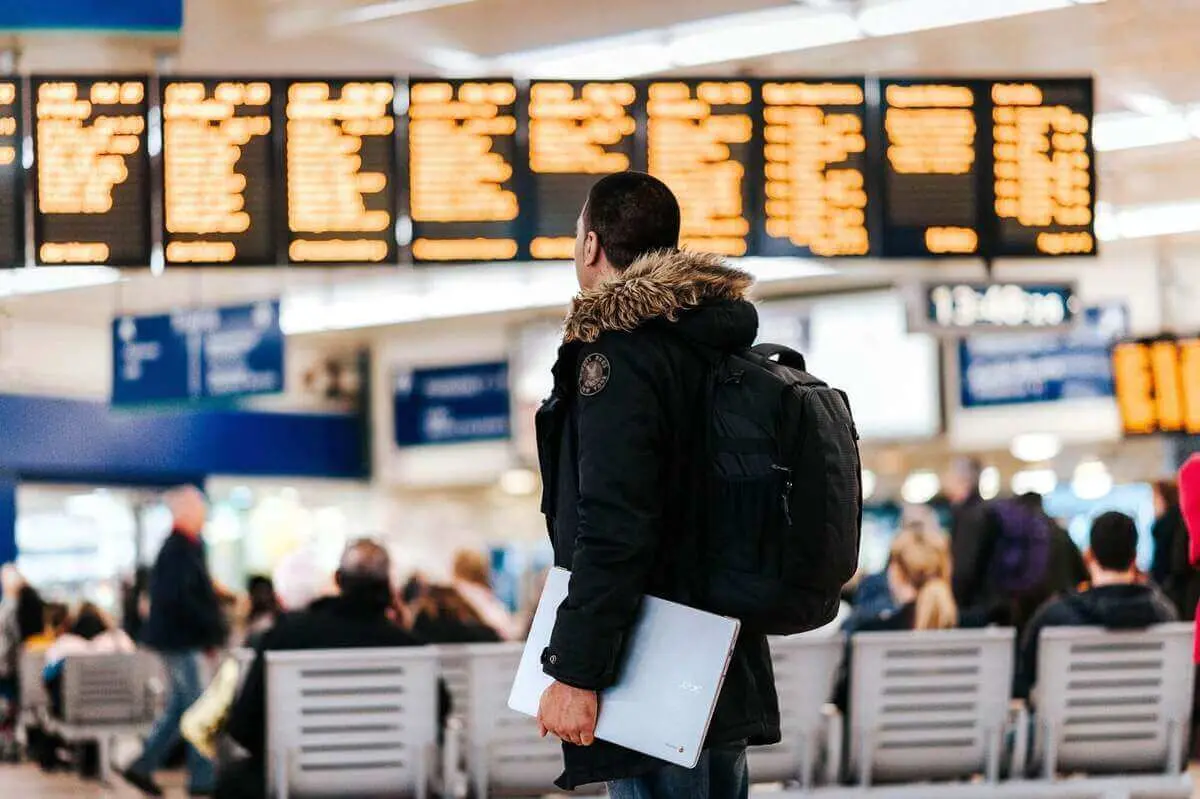
Business travelers in an airport terminal, the year-round Bay Area audience at SFO

The Bay Area business traveler, year-round

Technology, AI, venture, and biotech executives and their teams, flying to customers, investors, and the East Coast and Asia. Heaviest Monday and Thursday. Mostly United, which means Terminal 3 and Concourse G. This is the audience an always-on B2B, account-based, or recruiting buy at SFO is for.

Passengers arriving for a conference, the inbound audience that fills SFO during JPM, RSAC, and Dreamforce weeks

Conference inbound, two seasons

JPM Healthcare in January (biotech, pharma, investors). GDC in March. RSAC in April (security). Dreamforce in September (the Salesforce ecosystem). Disrupt in October (startups and venture). They arrive on every carrier, which is why a conference buy at SFO is multi-terminal or it’s incomplete.

International travelers in an airport arrivals hall, the transpacific and overseas audience at SFO

International and transpacific

Sixteen million a year. Asia-Pacific is the largest market: Tokyo, Seoul, Taipei, Singapore, Hong Kong, Shanghai. Europe and Canada follow. United and Star Alliance in G; everyone else in A. Some of this traffic connects onward and never enters the city; the rest is the international business and leisure audience for the Bay Area.

Students and university travelers in an airport terminal, the campus and alumni audience at SFO

Universities and students

Stanford, Berkeley, UCSF, USF, Santa Clara, and San Jose State send students and faculty through SFO, and out-of-state and international programs recruit Bay Area students through it. Executive programs reach the working professional on the concourses. The natural windows are semester starts, commencement, and the alumni weekends. Education brands EAM has placed in airports include Wharton, BYU, the University of Michigan, the University of Pittsburgh, and UT Dallas.

Leisure and visitorsVisitors sit at baggage claim and the curb, the two places where only people actually in San Francisco stand.

Leisure and visitors sit at baggage claim and the curb: San Francisco’s visitor economy, Napa and Sonoma, Yosemite and Tahoe, the cruise terminal. Consumer, hospitality, and destination brands reach them in the two places where only people who are actually here are standing.

Who advertises

What kinds of brands advertise at SFO,
and what are they trying to do?

Enterprise technology, AI, cloud, and security brands reaching the companies headquartered here and the industry that flies in for JPM, RSAC, and Dreamforce; biotech and pharma around JPM week; employers recruiting the Bay Area workforce; universities reaching students, alumni, and working professionals; international and transpacific brands reaching the Asia-Pacific audience in Concourse G; financial and wealth brands reaching founders and investors; and consumer and destination brands reaching visitors at baggage claim. The objective picks the terminal and the direction.

The useful way to think about SFO is by objective, and then by terminal. The table below is how EAM scopes a San Francisco brief.

How brands use SFO, by objective
ObjectiveWho buys itWho it reachesWhat the buy usually looks like
Account-based presenceEnterprise software, cloud, security, infrastructure, and AI brands selling into the Bay Area’s technology companiesTheir buyers, commuting through Terminal 3 on United weeklyTerminal 3 walls and the F-intersection wall, always-on, multi-period; print at the United security queue for a fixed message
Conference inboundSponsors and exhibitors at JPM, RSAC, GDC, Dreamforce, DisruptTheir industry, arriving Sunday and Monday of show week on every carrierThe period containing the show; individual video walls in the terminal that fits the audience’s airlines. No airport-wide digital network except international baggage claim
Biotech and pharmaCompanies presenting or meeting at JPM; the South San Francisco corridor year-roundInvestors and executives on United and international carriersConcourse G and Terminal 3 for JPM week; the Iconic wall for non-United traffic
Recruiting and employer brandCompanies opening or growing a Bay Area office, and the ones competing with them for engineersThe resident tech workforce on the way out; candidates flying inDeparture-side: security-queue print in Terminal 3, the F-intersection wall, Concourse C gate hold
Universities and executive educationExecutive MBA and certificate programs, out-of-state and international universities recruiting Bay Area students, alumni campaignsWorking professionals on business flights; students and families at semester startsConcourse walls for professionals; baggage claim print for families in August and January
International and transpacificAirlines, banks, telecom, luxury, and destination brands targeting the Asia-Pacific business audience or Bay Area travelers headed thereConcourse G departures; international arrivals at baggage claimThe Concourse G diorama and the T3–G connector unit for departures; the Arrivals Digital Network for inbound
Financial, wealth, and fintechPrivate banks, wealth managers, fintech targeting founders, investors, and the venture communityBusiness decision makers year-round; the Disrupt and Dreamforce audiencesTerminal 3 and the Iconic wall; the period containing Disrupt
Launch or brand momentA product launch timed to a conference, a funding announcement, a headquarters moveEveryone in the building for a periodThe Iconic wall plus individual video walls in the right terminal; one period
Consumer, hospitality, and destinationVisitor bureaus, Napa and Sonoma, hotels, rideshare, rental carsArriving visitors, domestic and internationalBaggage claim print in Terminals 1 and 2, the International Arrivals Digital Network, curb-adjacent soffits
On the hubConcourse walls also reach connecting passengers; baggage claim and the curb reach only people in San Francisco.

A brand targeting the Bay Area should know that a share of the passengers on the Terminal 3 concourses are connecting and will never see San Francisco. The concourse walls reach them; baggage claim and the curb don’t. For a local audience, weight the arrivals side. For the transpacific business traveler, the concourses and Concourse G are the point, and the T3–G connector unit is sold for exactly that person.

On UnitedA United audience can be reached without leaving Terminal 3 and Concourse G; everyone else needs other terminals.

Nearly half the airport is one airline, and a brand whose audience flies United can build a plan that never leaves Terminal 3 and Concourse G: the E wall, the F wall, the security-queue print, the F11–F14 gate-hold units, the G diorama, the connector. A brand whose audience flies everyone else needs the Iconic wall in Terminal 1, the Terminal 2 baggage claim units, and International Terminal A. There is no airport-wide digital network except international baggage claim; cover the other terminals with individual units.

On universitiesSemester starts and commencement are the natural windows, for Bay Area and out-of-state programs alike.

The Bay Area sends students to programs across the country and the world, and its own universities recruit globally. Out-of-state and international programs recruiting here, executive education reaching the Bay Area professional, and alumni campaigns around commencement all use SFO. The natural windows are semester starts and commencement: Berkeley instruction begins August 26, 2026 and January 19, 2027, with spring commencement May 15, 2027; Stanford autumn classes September 22, 2026, winter January 4, 2027, commencement June 13, 2027.

A West Coast or national planSJC, OAK, LAX, and SEA add reach, and EAM buys them as one plan when a brief needs it.

For a West Coast or national plan, SJC, OAK, LAX, and SEA add reach, and EAM buys them as one plan when a brief needs it. That is a scoping conversation, not something this page needs to argue.

How EAM works

How does EAM run
an SFO campaign?

One call, one plan, one contract. We follow up to learn who you need to reach, then come back with current availability and a recommended mix. EAM does not own inventory at SFO, so the plan is not a package that has to be sold.

  1. Step 01

    Scope the period and the terminal.

    Always-on, a conference period, or a launch; which airlines the audience flies and therefore which terminal; arrival-side, departure-side, or both; whether the audience is local or in transit; one airport or SFO as part of a West Coast or national plan.

    You getThe period, the terminal, and the direction

  2. Step 02

    Check avails and loop position.

    Which walls and units are open for the period, how crowded the loops are, whether Terminal 3 construction affects the units you want, and whether category separation is possible.

    You getAvailability, loop crowding, and construction status

  3. Step 03

    Quote the mix.

    Units, share of voice, terminal coverage, and a range, not a scraped rate card.

    You getA quoted plan you can take inside

  4. Step 04

    Hold, contract, and traffic creative.

    Holds expire in five business days, so the decision is made inside that window. Specs across every screen shape in the buy (the Iconic wall is a tall portrait; individual video walls have multiple sizes), airport authority approval, digital creative 14–18 business days and static 21–28 days before start.

    You getOne contract and one spec sheet

  5. Step 05

    Go live and close the loop.

    Confirm posting before the period starts. Proof of performance within five business days; play logs after.

    You getProof of posting and play logs in one report

Why an independent agency

EAM Advertising is an independent airport and in-flight media agency, founded in 2015. We specialize in airport and in-flight media and nothing else, and we do not own media assets at SFO or any airport. That independence is why the recommendations hold up. We plan and buy across 125+ airports and 45+ airlines worldwide, which is the leverage and the current-availability knowledge a one-time SFO buyer does not have. Clients include Fortinet, Dynatrace, Rubrik, McGraw-Hill, and Wharton. When the plan extends beyond San Francisco — a roadshow, a multi-city launch, an international push — the same relationship covers the other markets.

For agencies and consultants

Your client. Your plan.
We handle the airports.

Agencies and consultants bring EAM Advertising in as the airport specialist behind a client’s plan. The client relationship stays with you. We plan, buy, and report under NDA, and can work white-label.

Get our media kit
  • Your client stays yours.We work behind your team, not around it.
  • White-label and NDA.Plans and reporting can go out under your name.
  • One contract, one invoice.Every airport and media owner in the plan, under one set of terms.
  • Numbers before the client commits.Current availability and planning ranges at the proposal stage.

Measurement

How do you measure
an SFO campaign?

Proof of posting and digital play logs are factual. Delivered impressions are modeled. Brand lift is the only method that speaks to effect, and it has to be fielded before the flight. Direct pipeline attribution is not reliably available. SFO has one measurement advantage and one complication: the Bay Area workforce is stable enough to survey in advance, and the connecting share means delivered impressions overstate the Bay Area audience on concourse units.

Airport advertising is measurable, but not in the way digital media is measurable, and the gap between those two things is where most internal arguments about this channel happen. Decide what you are measuring before the buy; retrofitting measurement after a period has ended rarely produces anything defensible.

What can and can’t be measured on an airport campaign
MeasureWhat it actually tells youWhen to set it upConfidence
Proof of postingPhotographic confirmation that every unit ran, in the right place, for the full period. At SFO: close-up and environmental photos of every print location, and a 10% sample of screens plus stacked-content photos for digital networks, within five business days of posting.Written into the contract before signingHigh — factual
Delivered impressionsModeled from terminal traffic and unit position. On Terminal 3 concourse units, ask for the estimate net of connecting passengers if the brief is the Bay Area, because a share of the people the model counts are changing planes.Requested at proposal stageModerate — modeled
Digital play logsActual spot counts and share of voice on digital networks. Play logs on request.Requested at contractingHigh — logged
Brand lift studySurvey-based awareness or perception change against a control. The only method that measures effect rather than exposure.Fielded pre-flight for a baselineModerate — needs budget and lead time
Direct attribution to pipelineNot reliably available. Airport media has no click, and the same brands run other touchpoints at the same time.—Low — treat claims here with skepticism
What a Bay Area audience and a conference week make possibleA resident panel for always-on buys, or a defined conference population for a clean lift study.

For an always-on Bay Area buy, the audience lives here, which means a pre- and post-period survey can be fielded against a geo-targeted panel of technology professionals rather than a general travel sample. For a JPM or Dreamforce period, the population is defined and the window is short, which is the cleanest opportunity airport media offers for a lift study. Decide which you’re buying before deciding what to measure.

The honest framingProof of posting and play logs prove delivery, impressions size the audience, and only a lift study speaks to effect.

The honest framing for anyone defending this spend internally: proof of posting and play logs prove the campaign ran as bought, delivered impressions size the audience, and a lift study is the only line that speaks to effect. A vendor promising attributed pipeline from airport media is overselling. EAM contracts proof of posting and delivery reporting on every campaign as standard and will tell you plainly when a proposed measurement approach won’t produce a number worth presenting.

Questions

Frequently asked
questions about SFO

How much does it cost to advertise at San Francisco airport (SFO)?

A single print unit runs $6,000 to $70,000 per 28-day period plus $200 to $2,500 for production, installation, and removal. On the lower end: dioramas in the ticketing area, then eye-level signage in the concourses; overhead banners and banner packages sit at the top of the range. A single digital spectacular runs $20,000 to $150,000 per period. The only digital network at SFO is the International Arrivals Digital Network in international baggage claim. A two- or three-unit plan runs $60,000 to $250,000. Those are planning ranges; specific units and periods are quoted against current availability.

How is SFO airport advertising sold?

In 28-day periods. Conference campaigns have a two-week minimum, because one week and two weeks cost the same — unlike Las Vegas. Every digital unit runs ten-second spots; loops are ten spots on the concourse walls, twelve on the Iconic wall, and 24 on the international arrivals network — the only digital network at SFO. Holds expire five business days after confirmation. Contracts are non-cancellable once signed, and multi-year agreements carry annual increases; the digital rate card rose roughly a fifth between 2025 and 2026.

Which terminal should I advertise in at SFO?

The one your audience’s airlines use. United, nearly half the airport, is Terminal 3 for domestic and Concourse G for international. American, JetBlue, Alaska, Hawaiian, Southwest, and Delta are across Harvey Milk Terminal 1 and Terminal 2. Every other international carrier is Concourse A. Confirm the current list at contract; Terminal 3 construction and airline moves change it.

Does SFO advertising reach the Bay Area, or people connecting through?

Both, and it depends on the unit. Concourse walls in Terminal 3 and Concourse G reach connecting passengers along with local ones; a share of them never leave the airport. Baggage claim and the curb reach only people who are actually in San Francisco. If the brief is local, weight the arrivals side. If the brief is the transpacific business traveler, the concourses and the T3–G connector are the point.

Can I reach international arrivals at SFO?

At the International Terminal baggage claim, on the twelve-screen Arrivals Digital Network. International arrivals clear federal inspection before they reach public areas, so the concourse units reach international departures but not arrivals. For a UK, European, or Asia-Pacific inbound audience, that network is the unit.

How far in advance should I book SFO for JPM week or Dreamforce?

Four to six months for the periods that contain them; the Terminal 3 walls and Concourse G units sell first. RSAC, GDC, and Disrupt periods are workable at eight to twelve weeks. Standard periods at six to eight. A hold lasts five business days, so a hold is a decision window rather than a reservation.

Is SFO good for B2B advertising?

For enterprise technology, AI, cloud, security, and biotech, it is the most concentrated executive audience of any U.S. airport, because the industry that buys those things is headquartered here and flies United through Terminal 3 every week. Add JPM, RSAC, and Dreamforce and the same building carries the rest of the industry twice a year.

Can I reach United passengers specifically?

Yes; SFO is one of the few airports where a single-airline plan is practical. The Concourse E wall, the F-intersection wall, the security-queue print, the F11–F14 gate-hold units, the Concourse G diorama, and the T3–G connector reach United and Star Alliance traffic and almost nothing else. A non-United audience needs the Iconic wall, the Terminal 1 and 2 baggage claims, or individual video walls in those terminals.

Do universities advertise at SFO?

Yes. Out-of-state and international programs recruiting Bay Area students, executive and certificate programs reaching the working professional on the concourses, and alumni campaigns around commencement. Education brands EAM has placed in airports include Wharton, BYU, the University of Michigan, the University of Pittsburgh, and UT Dallas. The natural windows are late August, mid-January, and May and June.

When is creative due for an SFO flight?

Digital creative is due 14–18 business days before start, and static creative 21–28 days before start. The Iconic wall is a tall portrait; individual video walls have multiple pixel sizes. Count the shapes before you brief. All creative is subject to airport authority approval before it posts.

Can I get category exclusivity at SFO?

Possibly. Competitive separation between print and digital may be possible at SFO, but it isn’t guaranteed, and separation within a network is at the concession’s discretion. If exclusivity matters, ask when booking and write it into the contract; that is one of the things EAM asks for when it buys SFO.

What does EAM handle on an SFO campaign?

Everything after the objective. We check what’s open for the period, which loops are crowded and which units will sell out, and where on the arrival path your audience actually walks. We recommend the mix, secure the units, traffic the creative through airport approval, confirm posting on day one, and deliver proof of posting and play logs after. If SFO is one market in a larger plan, the same relationship covers the others.

Independent airport advertising media agency. Est. 2015.

One airport or twelve.
Start with the media kit.

Send your work email for the media kit: formats, planning ranges, and how EAM works. We’ll follow up to learn who you need to reach and when, then come back with current availability and a recommended mix.

We’ll follow up to learn who you need to reach and when.

Independent since 2015 · 125+ airports · 40+ media vendors

Sources

Sources and
methodology

  1. Passenger statistics: SFO monthly air-traffic reports for calendar year 2025 total about 27.25 million enplaned and 27.11 million deplaned (54.4 million combined; about +4% vs. 2024); United 24.31 million passengers (43.8%). Official SFO Fact Sheet FY 2025 (July 2024–June 2025): 54,118,814 enplaned and deplaned passengers (+5.5%); international 15,989,470; United 48.7% of seats. SFO Fact Sheet; FY 2025 Annual Report — Connecting the World; DataSF monthly passenger statistics.
  2. United summer 2026 schedule: 300-plus daily departures, 100-plus destinations, 50-plus daily international flights (SFO press release with United).
  3. Terminal 3 West Modernization: $2.6 billion, western half of Terminal 3, expanded checkpoint, opening fall 2027 (SFO).
  4. Event dates: Dreamforce September 21–23, 2027; TechCrunch Disrupt October 13–15, 2026; RSAC April 5–8, 2027 (rsaconference.com); J.P. Morgan Healthcare Conference January 11–14, 2027 (jpmorgan.com); GDC Festival of Gaming March 1–5, 2027, Moscone (gdconf.com); NVIDIA GTC March 14–18, 2027, San Jose (nvidia.com/gtc/faq); OpenAI DevDay September 29, 2026, San Francisco. Google I/O and WWDC 2027 dates not posted by the organizers as of September 2026. Attendance figures approximate, from organizer reporting.
  5. Unit and network descriptions, screen counts, loop lengths, airline and concourse targeting, contract terms, and proof-of-performance terms: current SFO airport media specifications, September 2025 through July 2026. Unit rates move with availability and are not published on this page; the year-over-year movement is stated as an approximate percentage only. Terminal assignments change; verify against the airport’s current map when planning.
  6. Pricing ranges and booking windows: EAM Advertising planning and buying data, 2015–2026.