- AUS handled 21.67 million passengers in 2025, its third-busiest year (2023 remains the record), roughly 1.8 million a month. Southwest carried 41%. Delta is the fastest-growing carrier and is set to become the anchor tenant after the expansion.
- Every commercial flight now uses one building. The South Terminal closed March 31, 2026, and Frontier and Allegiant moved into the Barbara Jordan Terminal's new West gates. One terminal means one arrival path and no terminal-selection decision.
- The audience is business travel in both directions. AUS is an airport almost nobody connects through, in a metro where Tesla, Dell, Apple, Samsung, AMD, Indeed, and NXP have major operations and the University of Texas sends 50,000-plus students and their families through one building. The person walking past your ad most weeks is either flying in to meet with an Austin company or works at one and is flying out.
- Three windows change the composition of arrivals: SXSW (March 15–21, 2027), the October run (ACL October 2–4 and 9–11, F1 October 22–25, UT home football), and Spring Break. Nine of the airport's ten busiest days on record are in October.
- Planning ranges: a single digital network or print unit runs $7,000–$50,000 per 28-day period; a two- or three-network arrival-path package $15,000–$110,000; a concourse domination or multi-period program north of $150,000. Print adds production and installation on top of media. SXSW and F1 periods carry a premium and sell first.
- AUS is sold in 28-day periods, contracts are non-cancellable once signed, holds expire five business days after confirmation, and print materials must be in market seven business days before posting. Two arrival-side locations sit beside active construction through roughly late 2026; ask for current photos before buying them.
- Why do brands advertise at Austin-Bergstrom (AUS)?
- Who actually flies through AUS?
- Which Austin events matter for airport advertising?
- What does Austin airport advertising cost?
- What airport advertising formats do brands use?
- How far in advance do you need to book, and what do SXSW and F1 periods cost?
- What kinds of brands advertise at AUS, and what are they trying to do?
- Where should your ads run inside AUS?
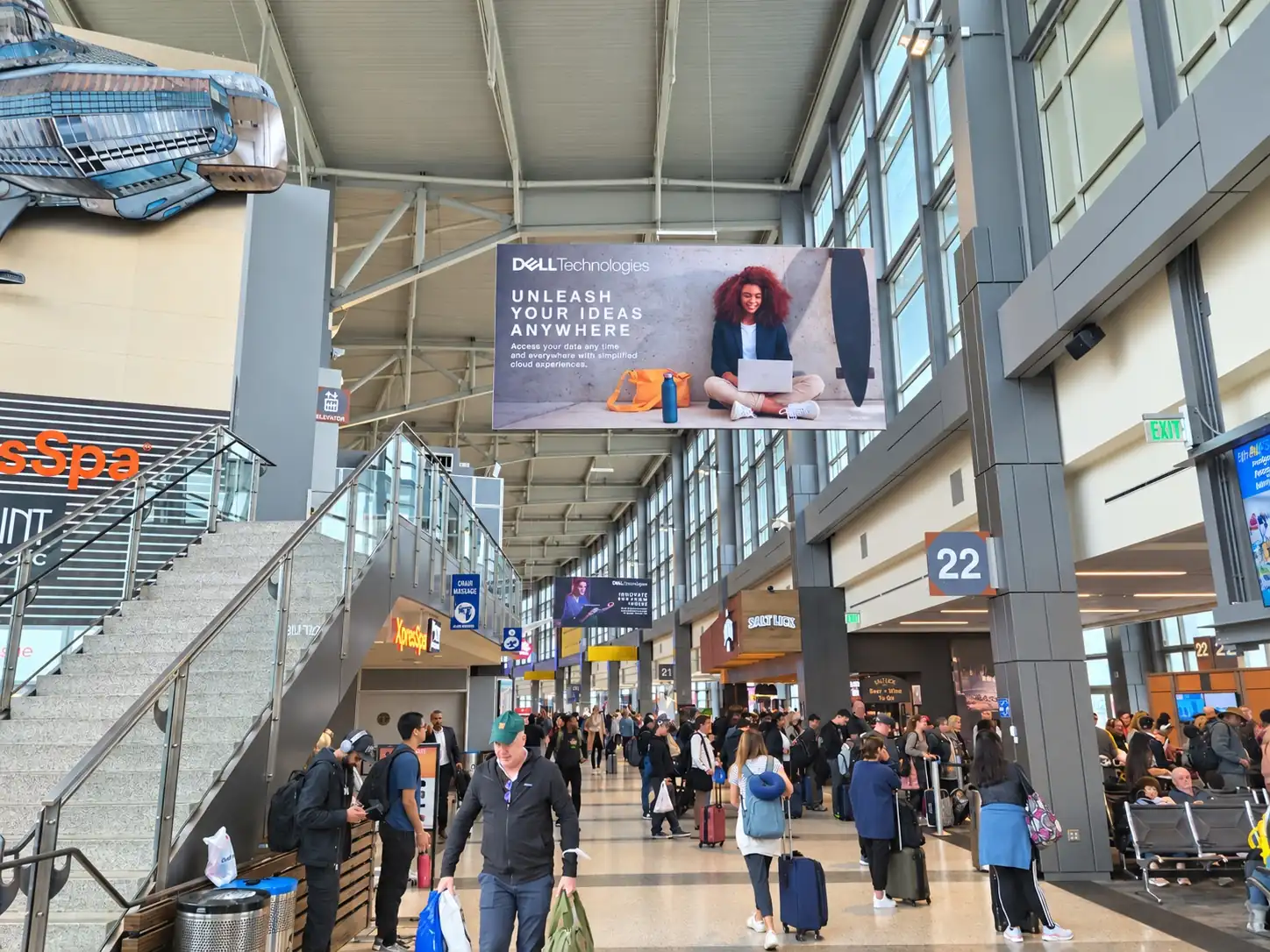
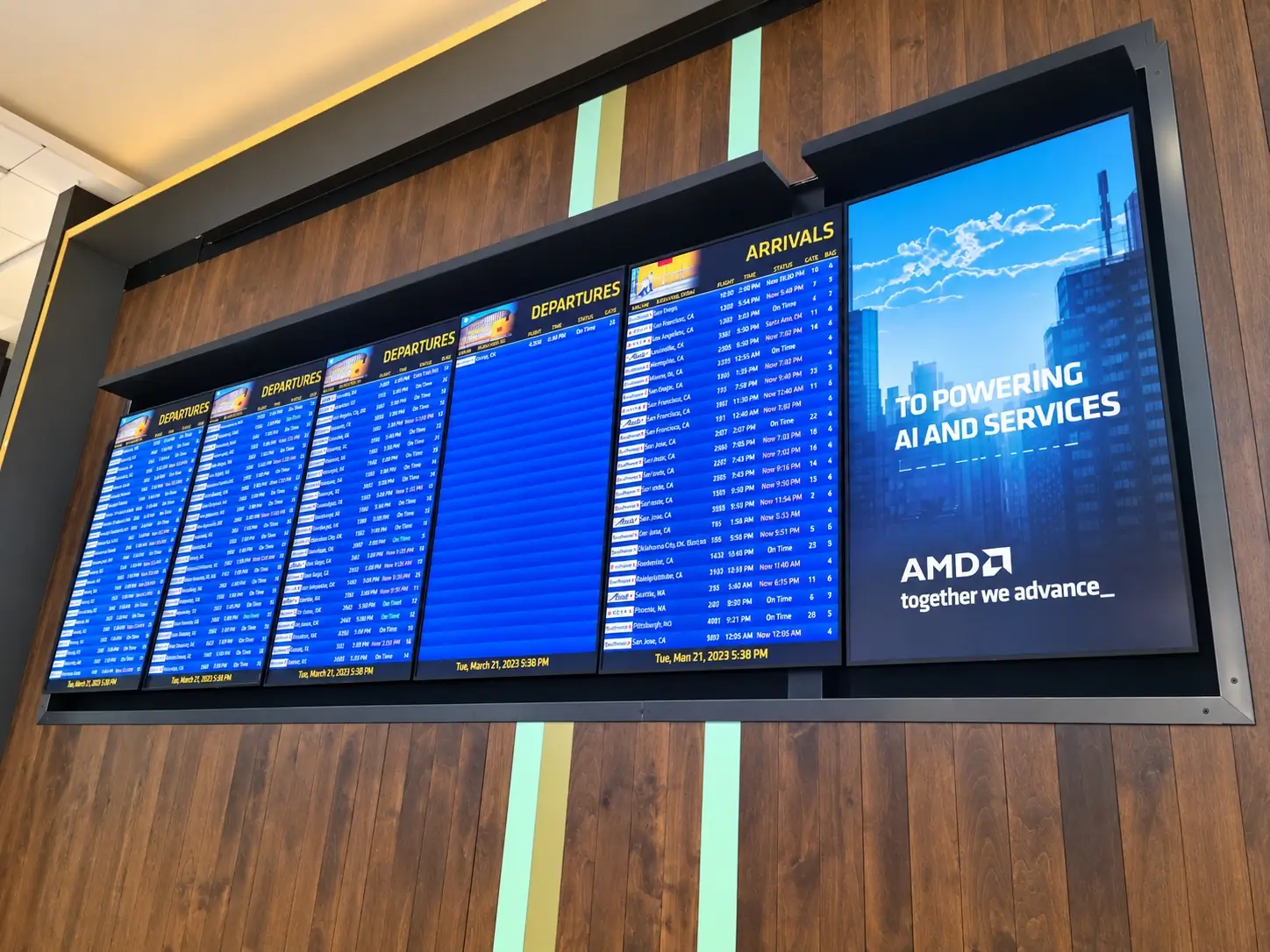
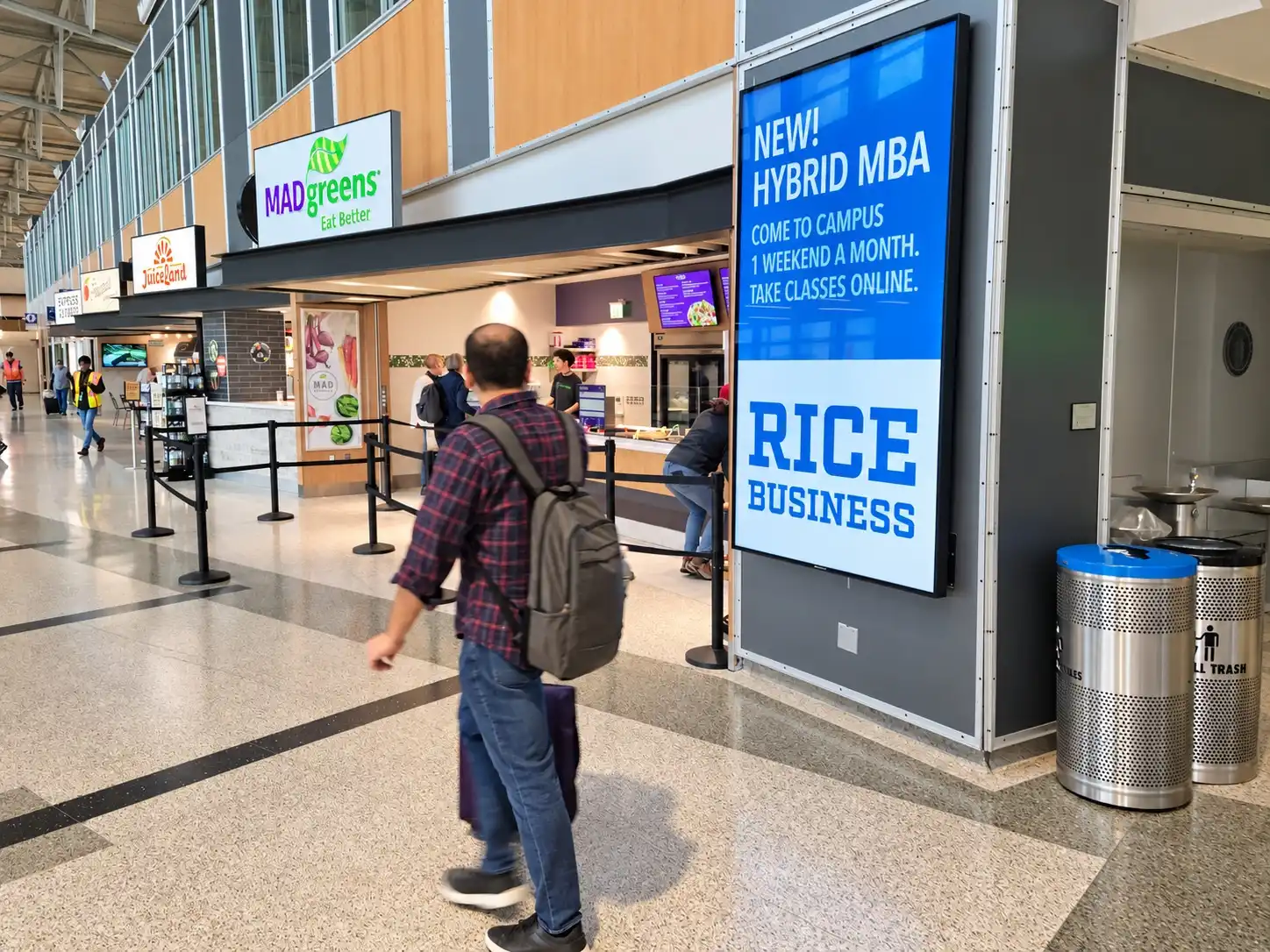
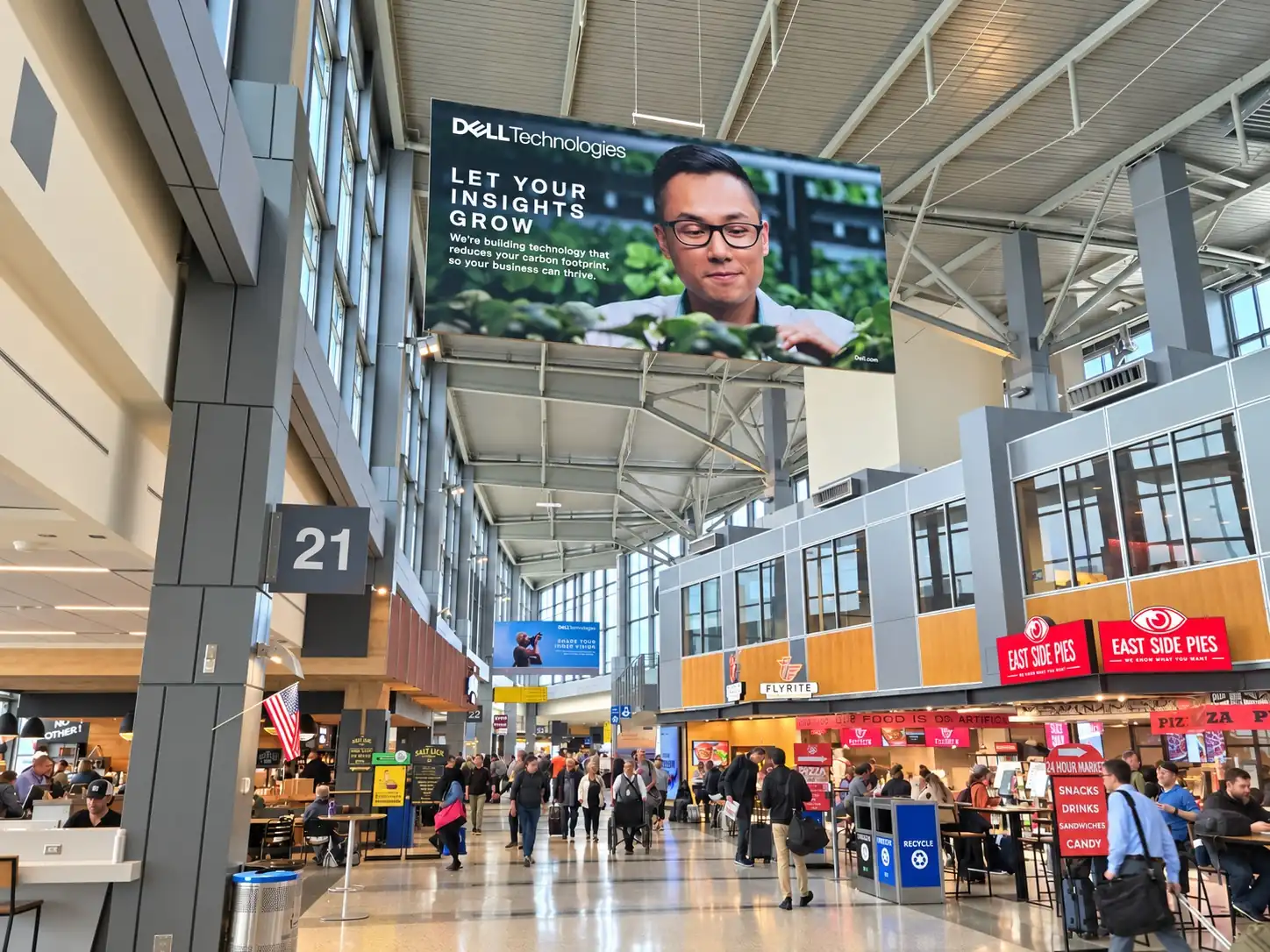
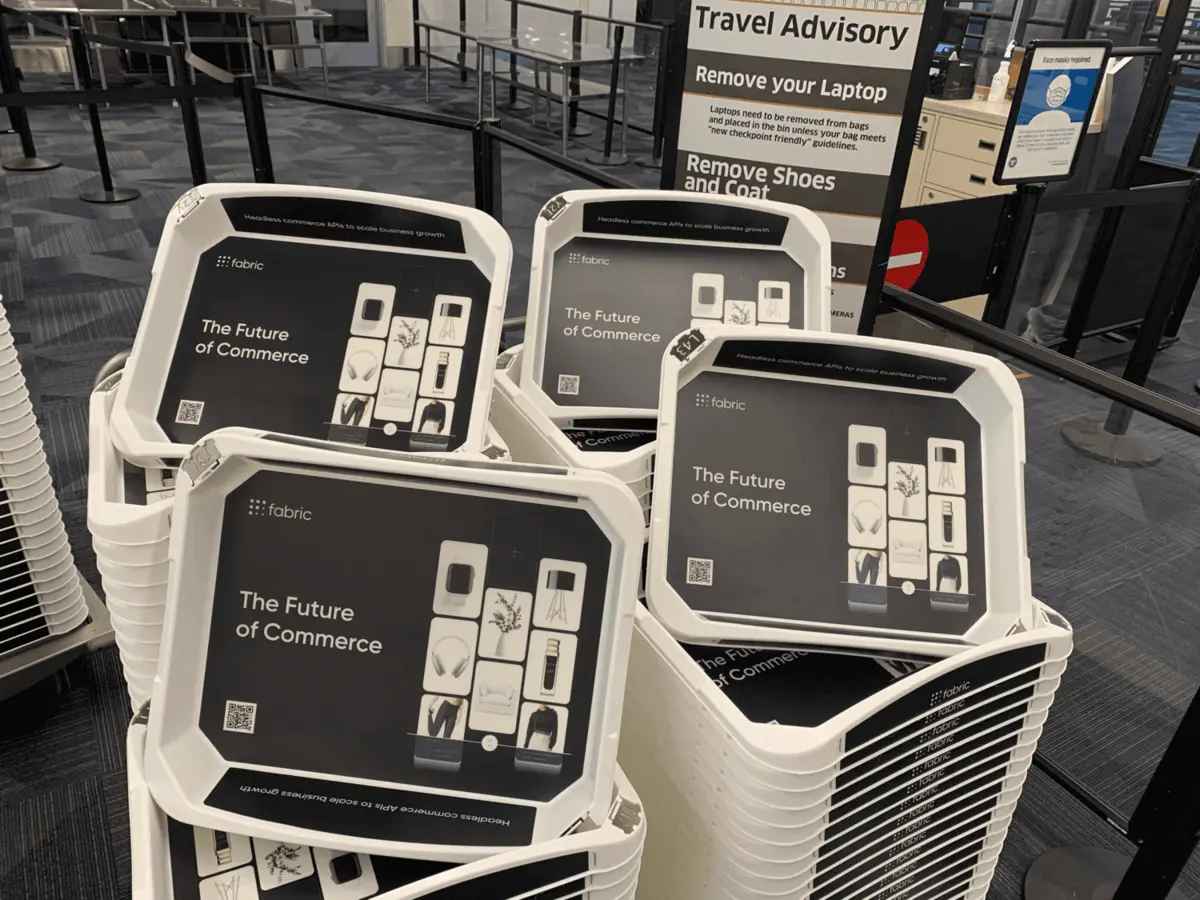
- What does airport advertising look like in practice?
- What has EAM run beyond Austin?
- How do you measure an AUS campaign?
- How does EAM run an AUS campaign?
- Frequently asked questions
- Related reading
- Where else does EAM run airport campaigns?
Why do brands advertise at Austin-Bergstrom (AUS)?
Because everyone in the building is here for Austin. AUS is a single-terminal airport almost nobody connects through, in a metro built on technology, a flagship university, and a fast-growing professional class. The person walking past your ad is either based in Austin or flying in for a reason: a meeting, a hire, a show. Most of the year that is the Austin tech workforce; three times a year the rest of the industry joins them.
Almost everyone walking through the Barbara Jordan Terminal is starting or ending a trip in Austin. Nobody is connecting. That makes AUS one of the few airports where the annual passenger count and the audience you care about are close to the same thing.
Who that audience is follows from who does business here. Tesla's headquarters and Gigafactory, Dell in Round Rock, Apple's second-largest campus, Samsung's fab in north Austin and the new one in Taylor, AMD, NXP, Indeed, Bumble, Silicon Labs, and the hundreds of software and semiconductor companies that grew up around them. The University of Texas, with more than 50,000 students, the Dell Medical School, and an alumni base that flies home through one airport. The business traveler on a Tuesday morning flight to San Jose or Seattle is the Austin tech workforce, and a meaningful share of them buy enterprise software, cloud, security, and hardware for a living. The one landing Monday night is the executive, buyer, partner, or candidate flying in to meet with those companies. Both walk the same concourse.
Then three times a year the composition flips. During SXSW, arrivals are the technology, media, and startup industry. During the October run, they are F1's international audience, ACL's two weekends, and SEC football. Those are the weeks a specific audience arrives all at once, through one building.
One more structural fact: since April 1, 2026, there is one terminal. The South Terminal closed and its two airlines moved into the main building's new West gates. There is no "which terminal" question at AUS. Every arriving passenger descends to the same baggage claim level and exits to the same curb. For a placement plan, that is a simpler and more complete arrival path than a multi-terminal airport offers.
Who actually flies through AUS?
21.67 million passengers in 2025, almost all beginning or ending in Austin. Southwest is the largest carrier at 8.9 million, Delta is growing fastest and is set to become the anchor tenant after the expansion, and international arrivals come through the East Concourse. For B2B advertisers the useful audience is business travel in both directions most weeks, and the SXSW and October inbound waves three times a year.
AUS served 21,666,852 passengers in 2025 across more than 20 airlines, roughly 1.8 million a month. That was the third-busiest year on record and 0.4% below 2024. Southwest carried 8,904,277 of them. Delta carried 3.8 million and grew 15%; American carried 3.5 million and declined about 19%; United carried 2.2 million. British Airways, Lufthansa, KLM, Air Canada, Aeromexico, and Copa serve the international gates. A one-day record of 45,048 departing passengers was set on October 20, 2025, the Monday after F1. June 2026 was the busiest month in the airport's history at over 2.1 million passengers.
Gate position follows the airline. The Barbara Jordan Terminal is one continuous concourse running east to west, with 34 gates in three zones. The East Concourse handles international and widebody flights and is where Delta's arrivals concentrate. The central section, gates 15–23, is the original core; Security Checkpoint 2 feeds it and the three airline lounges sit on the mezzanine across from gate 22. The West Concourse, gates 25–34, includes the three gates added in early 2026, where Frontier and Allegiant moved in April. Confirm against the current AUS map when planning; assignments will shift as Delta consolidates toward its 15-gate footprint.
What matters for advertisers is not the annual total. It is who is in the building on a given week.
Business decision makers, year-round
Two streams on the same days: executives, buyers, partners, and candidates flying in to meet with Austin's companies, and the people at those companies flying out to customers, partners, and headquarters. Heaviest Monday through Thursday, lightest on weekends. This is the audience an always-on B2B, account-based, or recruiting buy at AUS is for.
SXSW arrivals, March
Technology, media, film, and startup founders and their investors. The week AUS looks most like a conference airport. Arrivals concentrate Thursday through Saturday of opening weekend, and the loops fill with technology brands that have an Austin presence.
The October run
F1's international and affluent audience, ACL's two weekends, and UT SEC home games. Nine of the ten busiest days in the airport's history are in October. Consumer, hospitality, and luxury brands compete for ACL and football weekends; F1 is different, because the race brings sponsors, partners, and the executives they host, and a B2B brand meeting customers that week is buying its own audience.
Students, faculty, and alumni
UT Austin's 50,000-plus students and a faculty and alumni base that flies through one airport. AUS works for an executive program, graduate recruiting, or a reunion-timed campaign aimed at a city people fly into.
Which Austin events matter for airport advertising?
For B2B, SXSW. For consumer, luxury, and hospitality, the October run. Everything else at AUS is bought for the business traveler, in both directions, not the calendar.
Austin has a handful of marquee weeks and steady business travel into and out of its companies the rest of the year. Most AUS campaigns EAM plans are always-on or multi-period, timed to a product cycle, a hiring push, or an academic calendar rather than an event. The table covers the weeks that do change who is in the building.
| Event | Timing | What It Means for the Buy |
|---|---|---|
| SXSW | March 15–21, 2027 (SXSW EDU March 13–16) | The one week AUS is a B2B conference airport. Tech, media, and startup arrivals concentrate on opening weekend. Most contested period for arrival-side digital. |
| Spring Break | Mid-March | Overlaps SXSW. Leisure volume on top of conference volume; loops crowd. |
| UT football, SEC home games | September–November, select Saturdays | Alumni and fan inbound Friday, outbound Sunday. Consumer and regional brands. |
| Texas Tribune Festival | September | Policy, government, and media audience. Small inbound, dense composition. |
| ACL Music Festival | October 2–4 and 9–11, 2026 | Two weekends of national leisure inbound. Consumer, beverage, hospitality. |
| F1 United States Grand Prix | October 22–25, 2026 | International and affluent audience; 430,000-plus across the weekend, including team partners, sponsors, and the executives and clients they host. The busiest single day in airport history was the Monday after the 2025 race. Enterprise technology, financial, luxury, automotive, and hospitality. |
Outside SXSW and October, the AUS audience is business travel in both directions: executives, buyers, and partners flying in to meet with Austin's companies, and the people at those companies flying out to meet everyone else. Add the university community and the professionals who serve both. That traffic runs every week, which is a reason to buy AUS always-on, not a reason to wait for an event. A 28-day period in a quiet month reaches the same decision-makers as a contested period, without the premium and without the loop crowding.
What does Austin airport advertising cost?
$7,000–$50,000 per 28-day period for a single digital network or print unit. $15,000–$110,000 for a two- or three-network arrival-path package. North of $150,000 for a concourse domination or a multi-period program. Print adds production, installation, and removal on top of media, typically $1,000–$15,000 per install. SXSW and F1 periods add a premium. Those are planning ranges, not a rate card.
AUS is sold in 28-day periods, not weeks. There is no one-week SXSW product. A SXSW buy is a 28-day period that contains SXSW week, which means the three weeks on either side of the conference are part of what you are paying for. For an always-on business audience, that is a feature. For a brand that only cares about the seven days, it is a cost to plan around.
Rather than a rate card, the table below shows how AUS inventory is structured: where each network reaches people, how many screens it runs on, and what your spot looks like inside the loop. That last column is the one most buyers never see before they sign.
| Network | Where it reaches them | Screens | Your spot in the loop | Best for |
|---|---|---|---|---|
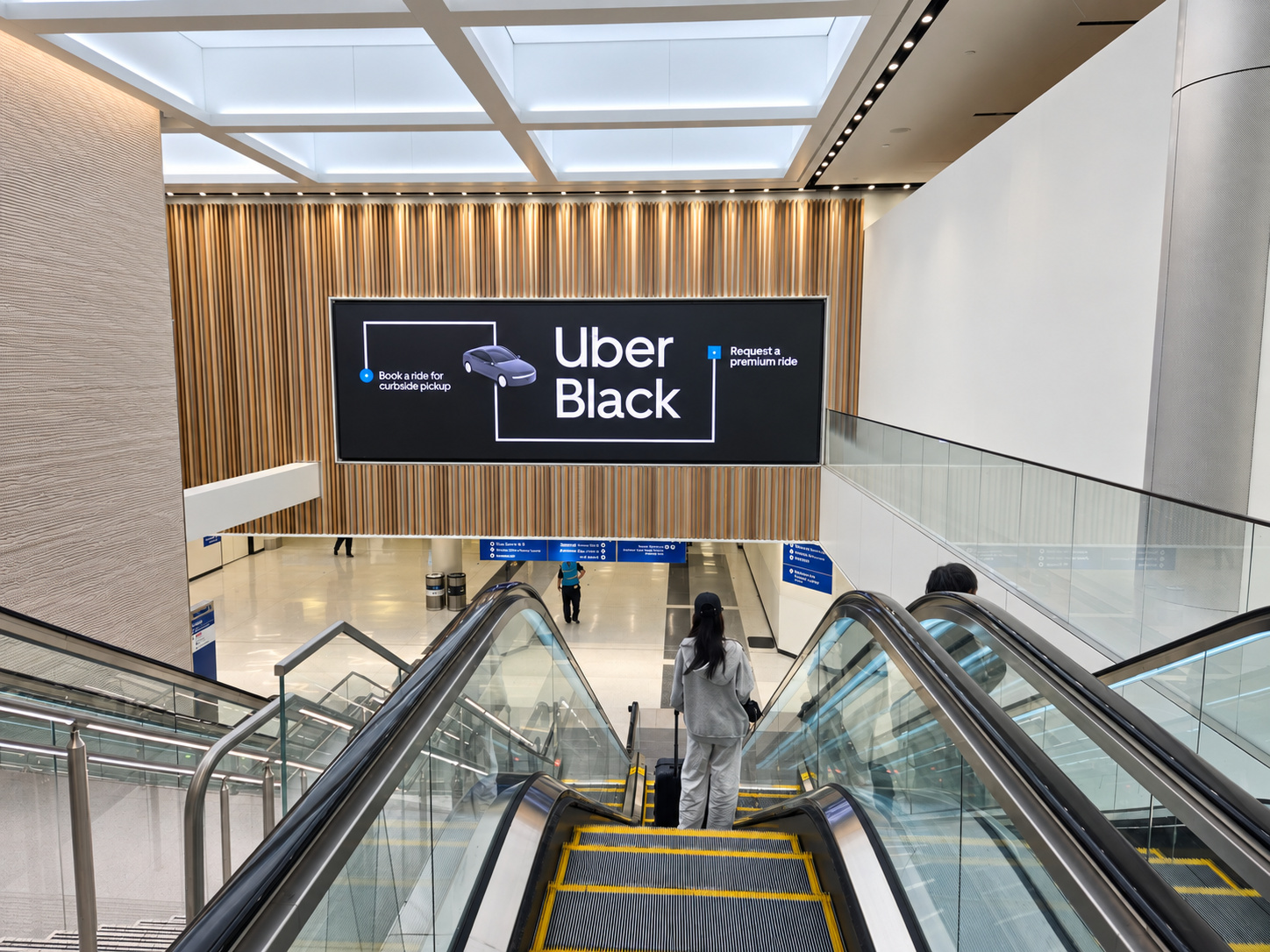
| Arrivals escalator video walls | Above the escalators every arriving passenger rides down to baggage claim; both concourse exits lead here | 2 LED walls, roughly 24 ft wide | :10 spot in a :100 loop; one of 10 advertisers, about 10% share of voice | The first arrival-side impression, and the biggest |
| Direct View Network | Four LED walls: one facing the West Concourse near gates 25–26, a double-sided wall at the center of the main concourse where Security 2 feeds in, one facing East Concourse arrivals heading to the exit | 4 LED walls, about 25 ft wide | :10 in :100, about 10% SOV | Both directions, both concourses; the network that covers the resident departing traveler and the arriving visitor |
| Digital Banner Network | Four double-sided vertical units through the central concourse, on the arrivals path to the exit and the departure path to the gates | 8 faces, vertical, about 8 ft tall | :10 in :120; one of 12, about 8% SOV | Frequency through the center of the building |
| Premier Digital Network, vertical | Extra-large vertical LCDs at the busiest points of the concourse | 6 screens, 85″–98″ | :10 in :120, about 8% SOV | Arrivals and departures equally; the efficient always-on network |
| Arrivals Digital Network | Above the baggage carousels and on columns on the lower level; the dwell moment | 8 screens, 50″–75″ | :10 in :240; one of 24, about 4% SOV | Longest attention on the arrival path; lowest cost of entry |
| Flight Information Display network | Beside the FID boards where departing passengers stop to check status; arrivals pass on the way out | 9 screens, 55″ | :10 in :120, about 8% SOV | Departure-side dwell for the resident audience |
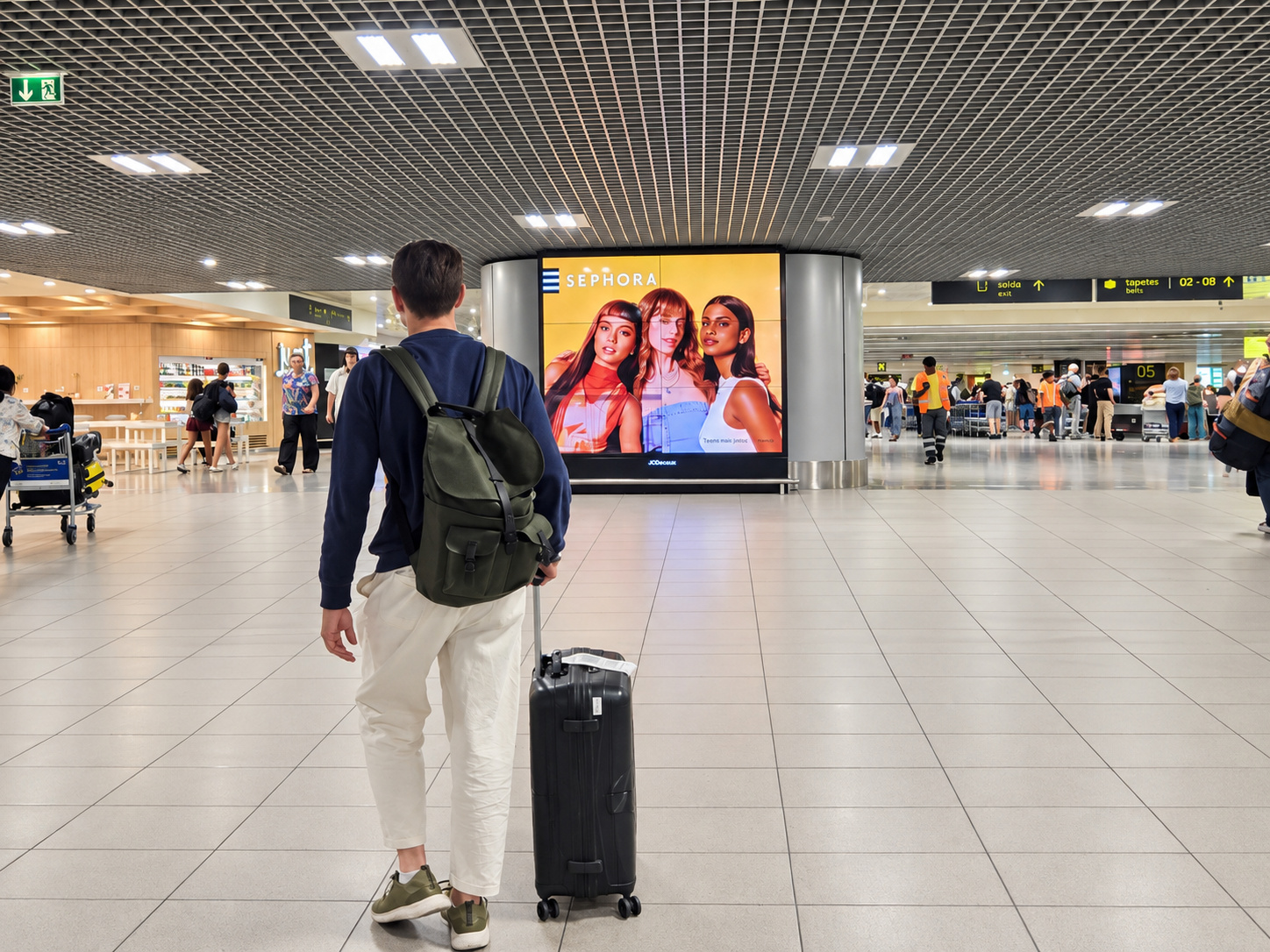
Every digital network at AUS runs static and motion, and every spot is ten seconds. What changes is the loop: a :100 loop puts you in front of the passenger once every 100 seconds; a :240 loop, once every four minutes. At baggage claim, where people wait 15–25 minutes, a :240 loop still delivers three to six exposures per passenger. On an escalator, where the exposure is one ride, a :100 loop is the difference between being seen and not.
Both sit beside active construction under the Journey With AUS expansion, and the airport's own media grid flags that the space may not match its photos and that screen visibility on the baggage claim network may be affected. The construction window began August 2025 and was scheduled for roughly 14 months. Ask for current site photos, not the media kit's, before committing to either network for a period before late 2026. This is the kind of thing an independent buyer asks about and a rate card does not volunteer.
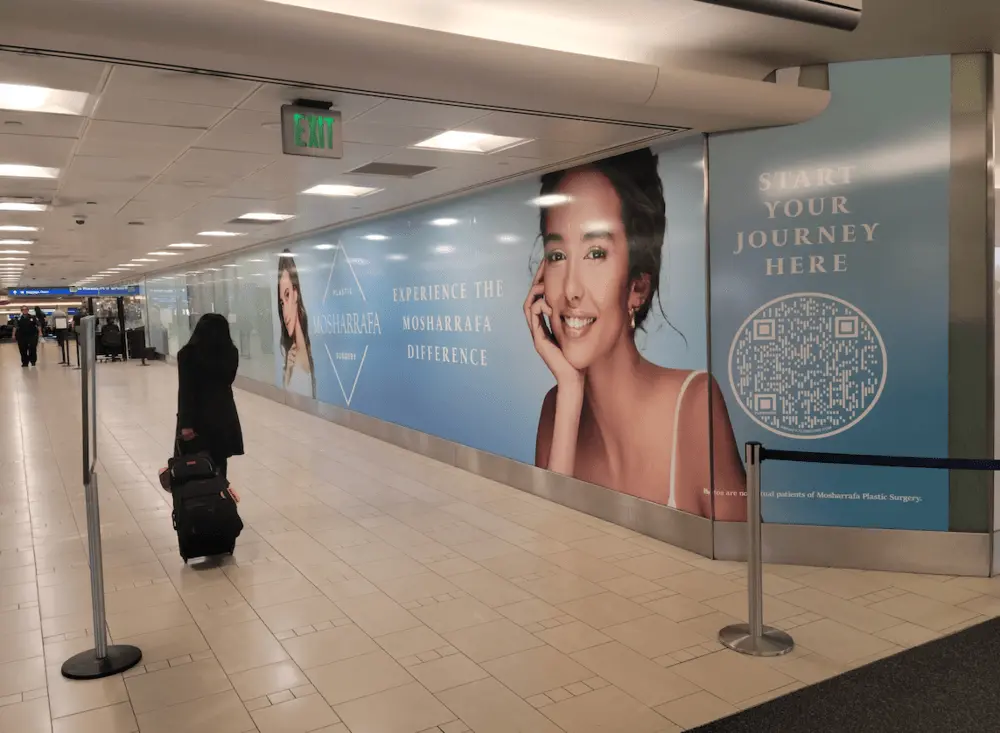
Print at AUS. Tension fabric displays are the dominant print format, from eye-level units in the East Concourse to soffit-mounted banners over 50 feet wide in the West Concourse and a 38-foot raised unit ahead of Security 2 East. There are lit tension fabric units at the arrivals escalators and baggage claim, a tension-fabric-plus-window-cling package aimed at international arrivals in the East Concourse, and a column-and-wall-wrap combination near gate 26. Media for print runs across the same $7,000–$50,000 per-period range as digital; production, installation, and removal add $1,000–$15,000 per install depending on size, and materials must be in market seven business days before posting. Print is the right choice for a multi-period program where the same message runs for months; digital is the right choice for a single period, a SXSW flight, or anything that needs to change mid-run.
Contract realities. 28-day periods, non-cancellable once signed, holds expire in five business days, all creative subject to airport authority approval before posting, and annual rate increases on multi-year agreements. Proof of performance is delivered within five business days of posting: close-up and environmental photos of every print location, and a 10% sample of locations plus stacked-content photos for digital networks. One more, easy to miss: competitive separation is not offered between print and digital. A competitor can be on the tension fabric unit next to your video wall. If category exclusivity matters, it has to be written into the contract, not assumed.
| Budget | Networks | Direction | Who it reaches | What it is for |
|---|---|---|---|---|
| $15,000–$20,000 | Arrivals Digital Network (baggage claim) plus the Flight Information Display network | Arrivals at bag claim; departures at the flight boards | Every arriving passenger at the dwell moment; the resident audience on the way out | A first AUS test for a B2B, education, or healthcare brand. Frequency over impact. |
| $60,000–$75,000 | Arrivals escalator video walls plus Digital Banner Network or Premier vertical network | Arrival-side heavy, with concourse frequency both ways | Nearly every arrival on the escalators; most of the concourse traffic | A SXSW period, a launch, or an always-on program that needs to be seen, not just present |
| $80,000–$110,000 | Direct View Network plus escalator walls plus baggage claim; or two networks across two periods | Both directions, or one direction for longer | Everyone in the building, repeatedly | A brand moment, a quarter-long recruiting or account-based program, or an international-arrivals push around F1 |
| $150,000 and up | Three or more networks plus print, or a multi-period program with production | Full arrival path plus departure side | The airport, for a period or a season | A headquarters announcement, a category-leader statement, or a year-long presence for a brand headquartered in Austin |
These are planning scenarios, not packages. Actual mixes depend on availability, the period, and whether print is in the plan; SXSW and F1 periods sit at the top of each range or above it.
What airport advertising formats do brands use?
These are examples of digital, static, experiential, and exterior units brands buy in airports. For AUS we plan specific units and dates against what is open at the time.

Digital screens and video walls in airline business club lounges reach affluent business decision-makers and high-net-worth travelers in a captive setting.
Travelers often spend 90 minutes or more in the club. Screens in dining and seated areas and larger video walls (about 84–100 inches) give the brand both frequency and a dominant face.
Full motion or static creative can rotate through the loop while the audience is already seated.
- Spot30 seconds
- LoopRanges from 5 to 6 minutes
- TypeFull motion animation and static. Use different rotating ads.
- Lead time14–18 business days
* Differs depending on the airport.

Target high-level decision-makers and affluent individuals with entrance banners in airport business club lounges.
Engage with a discerning audience in a premium, brand-safe environment.
Showcase innovations for business-to-business brands or emphasize luxury for high-end brands.
- SizesVarious sizes
- Production costPrinting, shipping, install, and removal
- Lead time18–21 business days
* Differs depending on the airport.

Baggage claim digital network screens provide a unique opportunity to connect with travelers at a prime moment.
Strategically placed in high-traffic areas throughout the baggage claim area, these screens ensure maximum exposure for your brand.
By using baggage claim digital network screens, you can deliver your message to travelers multiple times, building frequency and driving engagement.
- SpotRanges from 8 to 30 seconds
- LoopRanges from 30 to 240 seconds
- TypeFull motion animation and static. Use different rotating ads.
- Lead time14–18 business days
* Differs depending on the airport.

Packages can range in screen size and quantity. Strategically positioned throughout central airport concourses.
These screens can target 100% of arriving and departing traffic as passengers move towards airport exits and a large percentage of departing traffic as passengers move through the concourses and frequent favorite concessions in the area.
- SpotRanges from 8 to 30 seconds
- LoopRanges from 30 to 240 seconds
- TypeFull motion animation and static. Use different rotating ads.
- Lead time14–18 business days
* Differs depending on the airport.

Large format banners offer a large, eye-catching space that can capture the attention of everyone walking through the airport.
They can be strategically placed on walls or hung from ceilings throughout the airport, ensuring maximum exposure for your brand.
With large format banners, you have the opportunity to own 100% of the share of voice in that area.
- SizesVarious sizes
- Production costPrinting, shipping, install, and removal
- Lead time18–21 business days
* Differs depending on the airport.

Experiential advertising at airports lets the brand interact with a captive audience through immersive installations.
Activations can include brand ambassadors, tech-focused displays, and product sampling.
Exhibit space is the same idea: a physical footprint where travelers can engage face-to-face.
- SizesVarious sizes
- Production costFabrication, printing, shipping, install, materials, and removal
- Lead time2–4 months
* Differs depending on the airport.

Digital charging network screens are a highly effective advertising tool for brand marketers looking to reach a captive audience of travelers.
Travelers engage with the screens while charging devices, which adds dwell to the impression.
- SpotRanges from 8 to 30 seconds
- LoopRanges from 30 to 240 seconds
- TypeFull motion animation and static. Use different rotating ads.
- Lead time14–18 business days
* Differs depending on the airport.

Digital spectacular screens offer a powerful advertising tool to capture significant attention in airports.
Strategically located in high-traffic areas, these screens provide maximum visibility and impact for your brand.
With their attention-grabbing size and creative flexibility, digital spectacular screens hold the attention of travelers and drive engagement.
- SpotRanges from 8 to 30 seconds
- LoopRanges from 30 to 240 seconds
- TypeFull motion animation and static. Use different rotating ads.
- Lead time14–18 business days
* Differs depending on the airport.

By using digital network screens, you can deliver your message to travelers multiple times throughout their journey.
Strategically placed in high-traffic areas, these screens ensure maximum exposure for your brand.
These screens build frequency and drive engagement, making them an effective advertising option.
- SpotRanges from 8 to 30 seconds
- LoopRanges from 30 to 240 seconds
- TypeFull motion animation and static. Use different rotating ads.
- Lead time14–18 business days
* Differs depending on the airport.

Dioramas are backlit displays at eye level in corridors and holdrooms.
They offer a lit, poster-scale face with 100% share of voice on that unit.
- SizesVarious sizes
- Production costPrinting, shipping, install, and removal
- Lead time18–21 business days
* Differs depending on the airport.

Leverage exterior signage to engage airport visitors as they arrive or depart, keeping the brand visible on the campus.
High-impact banners on the building or approach create a lasting impression before travelers enter the terminal.
- Production costPrinting, shipping, install, and removal
- Lead time18–21 business days
* Differs depending on the airport.

Flight information screens are some of the most frequently viewed screens in the airport, where passengers already look for gate and time updates.
Advertising on these screens puts the message next to information travelers are actively reading.
- SpotRanges from 8 to 30 seconds
- LoopRanges from 30 to 240 seconds
- TypeFull motion animation and static. Use different rotating ads.
- Lead time14–18 business days
* Differs depending on the airport.

Jet bridge wraps put the brand on the walk between gate and aircraft.
The space is captive and sequential: every boarded passenger on that gate walks the length of the wrap.
- SizesVarious sizes
- Production costPrinting, shipping, install, and removal
- Lead time18–21 business days
* Differs depending on the airport.

Large format digital screens offer a unique opportunity to make a lasting impression on travelers.
These screens have the wow factor needed to capture your target audience's attention and inspire them to engage with your brand.
Large format digital screens offer creative flexibility to showcase your brand's messaging and art in a way that resonates with your target audience.
- SpotRanges from 8 to 30 seconds
- LoopRanges from 30 to 240 seconds
- TypeFull motion animation and static. Use different rotating ads.
- Lead time14–18 business days
* Differs depending on the airport.

Large format banners offer a large, eye-catching space that can capture the attention of everyone walking through the airport.
They can be strategically placed on walls or hung from ceilings throughout the airport, ensuring maximum exposure for your brand.
With large format banners, you have the opportunity to own 100% of the share of voice in that area.
- SizesVarious sizes
- Production costPrinting, shipping, install, and removal
- Lead time18–21 business days
* Differs depending on the airport.

Mini-spectaculars are smaller spectacular units that still dominate a sightline without a full-wall takeover.
They own share of voice on that face and work in tighter terminal pockets.
- SizesVarious sizes
- Production costPrinting, shipping, install, and removal
- Lead time18–21 business days
* Differs depending on the airport.

Exterior digital billboards at the airport engage a wide mix of travelers on the approach and campus roads.
Creative on digital billboards can run full motion or static.
- Spot5–10 seconds
- TypeFull motion animation and static
- Lead time14–18 business days
* Differs depending on the airport.

Large format banners offer a large, eye-catching space that can capture the attention of everyone walking through the airport.
An overhead banner package is sequenced across multiple faces so the brand owns a stretch of the travel journey and a specific airport area, which is what creates the wow effect.
They can be placed on walls or hung from ceilings, with 100% share of voice in that zone.
- SizesVarious sizes
- Production costPrinting, shipping, install, and removal
- Lead time14–18 business days
* Differs depending on the airport.

Spectaculars are large-format displays built for a single dominant face in a high-traffic terminal space.
With the ability to own 100% of the share of voice, your message is the only one being seen by travelers in that area.
- SizesVarious sizes
- Production costPrinting, shipping, install, and removal
- Lead time18–21 business days
* Differs depending on the airport.

Tension fabric displays are a visually stunning way to showcase your brand or product in the airport.
They command attention in a crowded terminal and offer a cost-effective way to reach a large audience.
With tension fabric displays, you have the opportunity to own 100% of the share of voice in that area.
- SizesVarious sizes
- Production costPrinting, shipping, install, and removal
- Lead time18–21 business days
* Differs depending on the airport.

By using vertical digital network screens, you can deliver your message to travelers multiple times throughout their journey.
These are vertical units with a different view profile: most sit at eye level and read with a poster feel.
Strategically placed in high-traffic areas, they build frequency as passengers walk the concourse.
- SpotRanges from 8 to 30 seconds
- LoopRanges from 30 to 240 seconds
- TypeFull motion animation and static. Use different rotating ads.
- Lead time14–18 business days
* Differs depending on the airport.

Video walls are strategically positioned in high-traffic areas of the airport, ensuring maximum visibility and engagement for your brand.
These high-impact screens provide maximum visibility for your brand, making a lasting impression on travelers.
- SpotRanges from 8 to 30 seconds
- LoopRanges from 30 to 240 seconds
- TypeFull motion animation and static. Use different rotating ads.
- Lead time14–18 business days
* Differs depending on the airport.

Wall wraps offer a visually striking and modern way to showcase your brand in the airport, with the ability to customize them to your brand.
Strategically placed in high-traffic areas, wall wraps capture attention and own 100% of the share of voice on that surface.
- SizesVarious sizes
- Production costPrinting, shipping, install, and removal
- Lead time18–21 business days
* Differs depending on the airport.

Sponsoring Wi-Fi access at airports engages travelers on their personal devices.
Call-to-action pages can be video or static, which is what turns access into a media placement.
- Spot30 seconds
- TypeVideo and static. Choose from a variety of call-to-action pages.
- Lead time2–4 months
* Differs depending on the airport.

Window wraps offer a visually striking and modern way to showcase your brand on terminal glass, with the ability to customize them to your brand.
Strategically placed on windows in high-traffic areas, they capture attention from the interior walkway or the curb and own 100% of the share of voice on that glass.
- SizesVarious sizes
- Production costPrinting, shipping, install, and removal
- Lead time18–21 business days
* Differs depending on the airport.
How far in advance do you need to book, and what do SXSW and F1 periods cost?
SXSW and F1: hold inventory 3–4 months out. Everything else: 6–8 weeks is usually enough, and a 28-day period in a standard month can often start within 4 weeks of contract. SXSW and F1 carry a premium over standard-period rates; the rest of the year AUS prices like the mid-size origin-and-destination airport it is.
AUS is not a heavily contested airport most of the year. That is a practical advantage: the best arrival-side units are usually available on reasonable notice, and an advertiser is rarely competing for position inside someone else's week. The exceptions are SXSW, when every technology brand with a presence in Austin wants the airport, and F1, when sponsors, enterprise technology and financial brands, and luxury and automotive brands all do.
A hold at AUS expires five business days after it is confirmed unless extended, and extensions are at the concession's discretion. In a peak month that means a hold is a decision window, not a reservation. Contracts are non-cancellable once signed. Multi-year agreements carry annual rate increases.
| Period | Examples | Hold by | What sells first | Pricing character |
|---|---|---|---|---|
| Peak | SXSW period, F1 period | 3–4 months | Arrivals escalator video walls, baggage claim network, East Concourse arrivals print | Premium over standard period; loops crowd with tech (March) and with sponsors, enterprise, and luxury brands (October) |
| Busy | ACL weekends, UT home games, Spring Break | 6–10 weeks | Arrivals-side digital | Modest premium; consumer competition, little B2B |
| Standard | All other periods | 4–8 weeks | Most networks open | Standard-period rates; 28-day minimum applies |
Unit rates, loop-position premiums, and period-specific quotes. Those numbers move with availability and with the period. What you can plan against: 28-day periods; $7,000–$50,000 for a single network or print unit; $15,000–$110,000 for a two- or three-network arrival-path package; north of $150,000 for a concourse domination or a multi-period program. Specific units and periods come back as a quote.
What kinds of brands advertise at AUS, and what are they trying to do?
Enterprise technology brands reaching the companies headquartered here, employers recruiting the Austin tech workforce, universities and executive programs reaching students, alumni, and working professionals, healthcare systems, financial and wealth brands, and consumer and hospitality brands around SXSW and the October run. Most of it is always-on. The event weeks are the exception, not the rule.
The useful way to think about AUS is by objective, not by industry. The same network reaches a different audience depending on what you are trying to do with it, and the table below is how EAM scopes most Austin briefs.
| Objective | Who buys it | Who it reaches at AUS | What the buy usually looks like |
|---|---|---|---|
| Account-based presence | Enterprise software, cloud, security, and infrastructure brands selling into Tesla, Dell, Apple, Samsung, AMD, Oracle's Austin campus, and the companies around them | Their buyers, on the way out on Monday and the way home on Thursday | Always-on, both directions: Direct View walls, Premier vertical network, FID network. Multi-period, so print earns its production cost |
| Recruiting and employer brand | Companies opening or growing an Austin office, and the ones competing with them for engineers | The resident tech workforce; relocating candidates flying in for interviews and house-hunting | Departure-side weight: Security 2 East tension fabric, FID network, Digital Banner Network. Runs for a quarter or a hiring push |
| Universities and executive education | Executive MBA and certificate programs, graduate recruiting, out-of-state universities recruiting Texas students, alumni and reunion campaigns | Working professionals on business flights; students and families at the start and end of semesters; alumni around UT home games | Concourse digital for professionals; arrival-side around move-in, graduation, and game weekends. Wharton, BYU, Michigan, Pitt, and UT Dallas have all run airport campaigns with EAM elsewhere |
| Healthcare systems and specialty care | Hospital systems, cancer centers, orthopedics, fertility, and concierge practices competing for Central Texas patients | Residents and the Texas regional audience flying through Austin | Print for permanence at baggage claim and the East Concourse; a digital network for reach. Always-on |
| Financial, wealth, and fintech | Private banks, wealth managers, and fintech brands targeting Austin's founder and executive population | Business decision makers year-round; the F1 audience in October | Concourse digital always-on; add East Concourse arrivals print for F1 and international |
| Launch or brand moment | A product launch, a rebrand, a company moving its headquarters to Austin, a funding announcement | Everyone in the building for a period | Two or three networks along the arrival path, sometimes a domination. One or two periods |
| Event inbound | Technology brands during SXSW; F1 sponsors and the enterprise, financial, luxury, and automotive brands meeting clients that week; hospitality, beverage, and consumer brands during ACL and UT football | The industry or fan base arriving that week | Arrival-side: escalator video walls, baggage claim network, lit tension fabric at arrivals. The 28-day period that contains the event |
| Destination, tourism, and civic | Convention bureaus, economic development, state and city agencies, public health | Arriving visitors and residents alike | Arrivals-side print and digital, often multi-period |
Universities are a bigger part of this airport than most planners expect. The University of Texas is one of the largest universities in the country, Austin is a top destination for out-of-state graduate students and executive-education candidates, and a large share of the professionals flying out on business are the same people an executive MBA program is trying to reach. Education brands already use airport media for exactly this: Wharton in airline club lounges, BYU on digital rotations, Michigan, Pitt, and UT Dallas in airport campaigns EAM has planned. At AUS the natural windows are the start and end of semesters, graduation weekend, UT home football Saturdays for alumni, and the always-on concourse networks for the working professional.
| Window | 2026–27 dates | Who is in the building | What to buy |
|---|---|---|---|
| Fall move-in and first week of classes | Late August 2026 | Students and families flying in; out-of-state and international freshmen | Arrivals-side digital and baggage claim; one period |
| UT home football Saturdays | Sep 5 Texas State · Sep 12 Ohio State · Sep 19 UTSA Florida, Ole Miss, and Mississippi State in October Nov 21 Arkansas |
Alumni and fans inbound Friday, outbound Sunday | Arrivals Friday, departures Sunday: escalator walls plus FID network. Ohio State and Arkansas weekends draw the largest inbound |
| SXSW EDU | March 13–16, 2027 | Education technology, administrators, and policy audience arriving ahead of SXSW proper | Concourse digital for the period that contains SXSW |
| Spring commencement | Mid-May 2027 | Graduates' families inbound; graduates outbound to first jobs and graduate programs | Both directions for one period; a natural window for graduate-program recruiting |
| Executive and working-professional programs | Any standard period | Business travelers Monday through Thursday | Direct View Network, Premier vertical network, FID network, always-on |
For technology brands, the question is almost never whether the audience is here. It is which direction to buy. A brand selling into the companies headquartered in Austin wants both directions and a long run, because the buyer flies out weekly and the message needs frequency. A brand recruiting engineers wants the departure side, where the resident audience has dwell in the security queue and at the flight boards. A brand launching at SXSW wants the arrival side for one period. The networks are the same; the weighting is the plan.
For Texas-wide reach, DFW and IAH add volume, and EAM buys all three as one plan when a brief needs it. That is a scoping conversation, not something this page needs to argue.
Where should your ads run inside AUS?
Along the arrival path: concourse digital at gate level, the escalator video walls every arrival rides down, the baggage claim network on the lower level, and the curb. One terminal means every arriving passenger walks the same sequence. Concourse-zone selection follows the airline mix; the escalators and baggage claim catch everyone.
The Barbara Jordan Terminal is a single east-west building. Gates, ticketing, and security are on the upper level; baggage claim and ground transportation are on the lower level. Every arriving passenger walks from their gate toward the central hall, exits the concourse through one of two exits, rides the arrivals escalators down, collects bags or walks past the carousels, and leaves through the same curb. There is no tram and no terminal transfer. That gives a placement plan four steps and no branches.
| Step | Zone | What the passenger is doing | Priority for B2B |
|---|---|---|---|
| 1. Off the plane | East, Central, or West Concourse: Direct View walls, Digital Banner Network, Premier vertical LCDs, tension fabric | Walking toward the central hall; brief exposure per screen, high frequency across the walk | Medium-high; the zone that also reaches departing business travelers |
| 2. The descent | Arrivals escalator video walls; lit tension fabric at the escalators | Every arriving passenger, single file, looking forward | High; first arrival-side impression. Construction caveat through late 2026 |
| 3. Baggage claim | Arrivals Digital Network above the carousels; lit tension fabric | 15–25 minutes waiting; passengers without checked bags still exit through this hall | Highest; dwell and attention peak. Lowest cost of entry on the page |
| 4. The curb | Ground transportation and rideshare pickup | Waiting for a car | Last impression before downtown |
| Departure side | FID network, Security 2 East tension fabric, Direct View center wall, gate-area tension fabric | Business travelers with time to kill | Medium to high for an always-on B2B buy; Austin's workforce departs here every week |
That last row matters more at AUS than at a conference airport. Austin's tech workforce departs from this building weekly, and the FID network and the Security 2 units reach them on the way out with real dwell; the executives and buyers flying in to meet them arrive through the same escalators and baggage claim. An always-on B2B or recruiting buy at AUS should weight both directions; a SXSW buy should weight arrivals.
Targeting by airline. Delta and international arrivals come through the East Concourse, which is why the eye-level tension fabric near gate 9 and the East arrivals print package are the units for a brand targeting Delta's business traveler or inbound international. The West Concourse, gates 25–34, is where Frontier and Allegiant board, and the large soffit units over gates 27–34 are departure-weighted. The Direct View Network and the Digital Banner Network cover the center, where everyone passes.
Journey With AUS is the largest expansion in the airport's history. Concourse B, with 26 gates and a connecting tunnel, is planned for the early 2030s; a temporary Concourse M and new midfield taxiways come first. Construction will change wayfinding and inventory locations for several years. Confirm unit locations against the current map at contract, not against last year's plan.
What does airport advertising look like in practice?
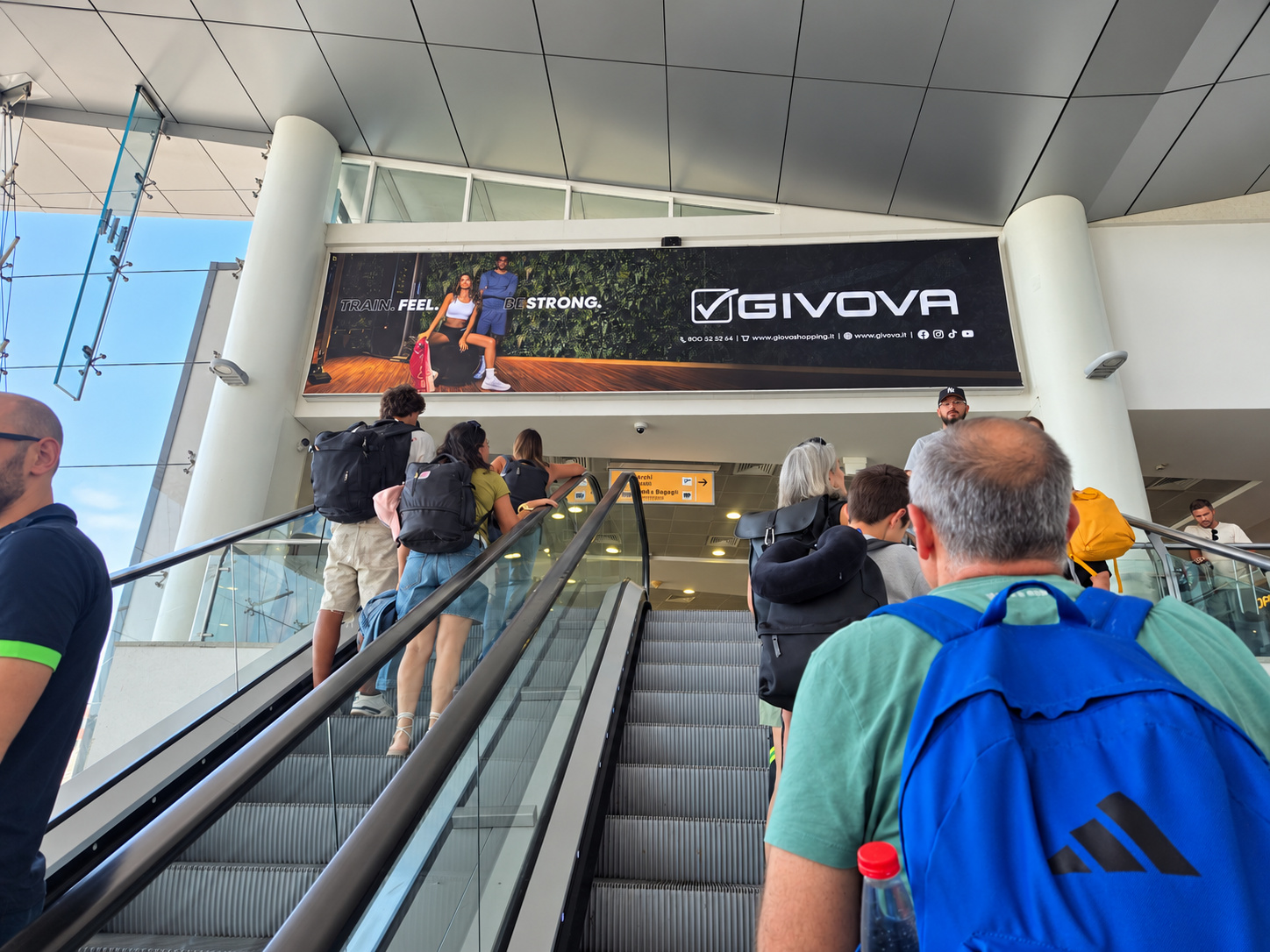
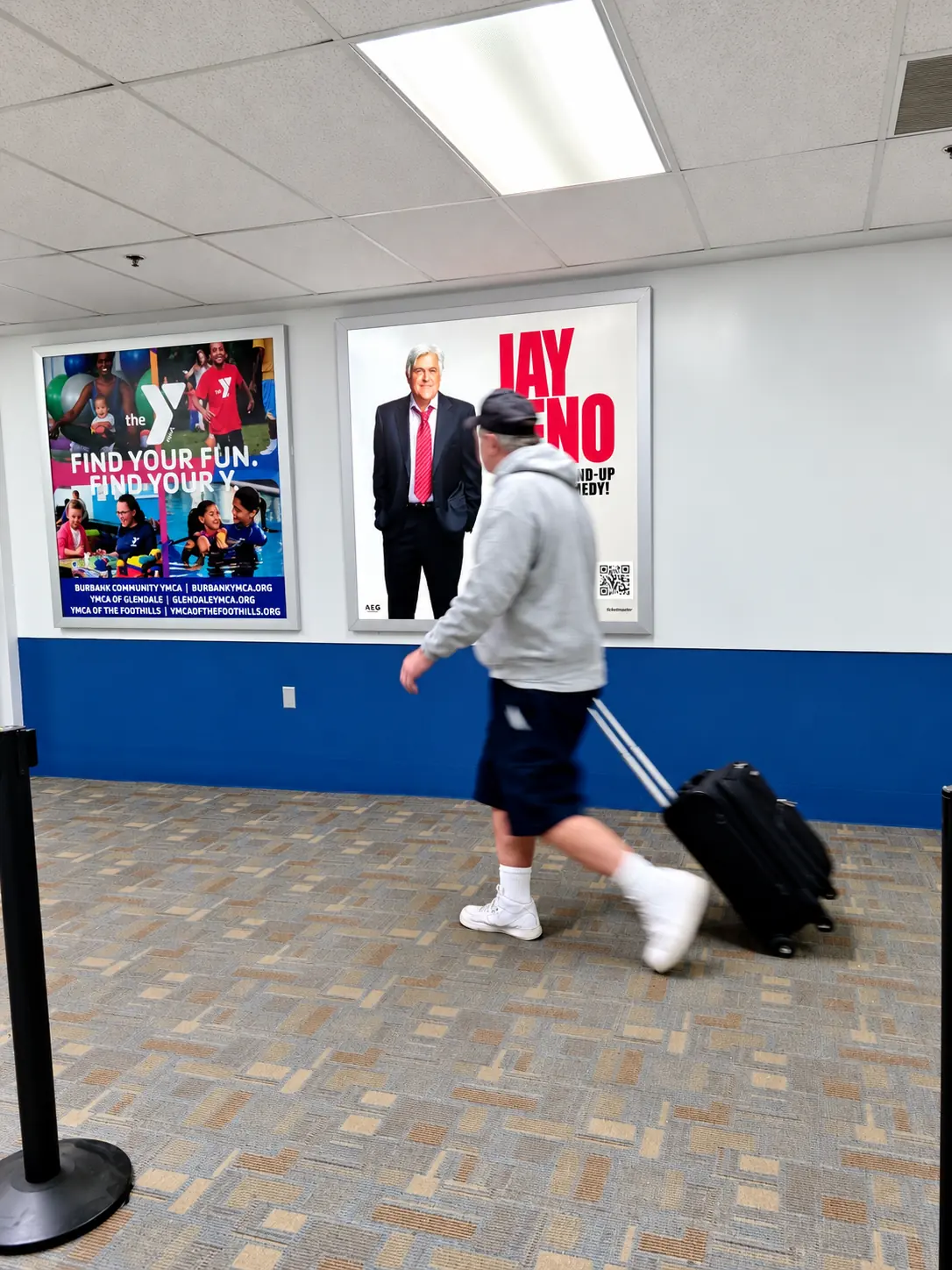
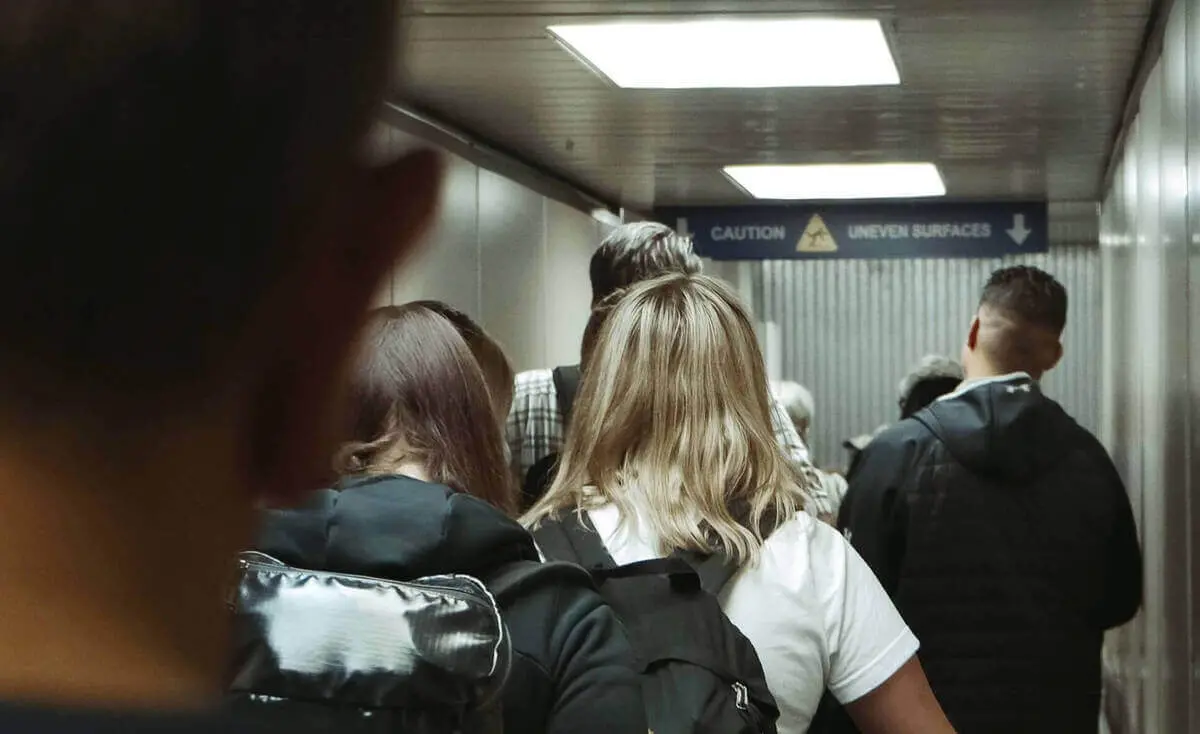
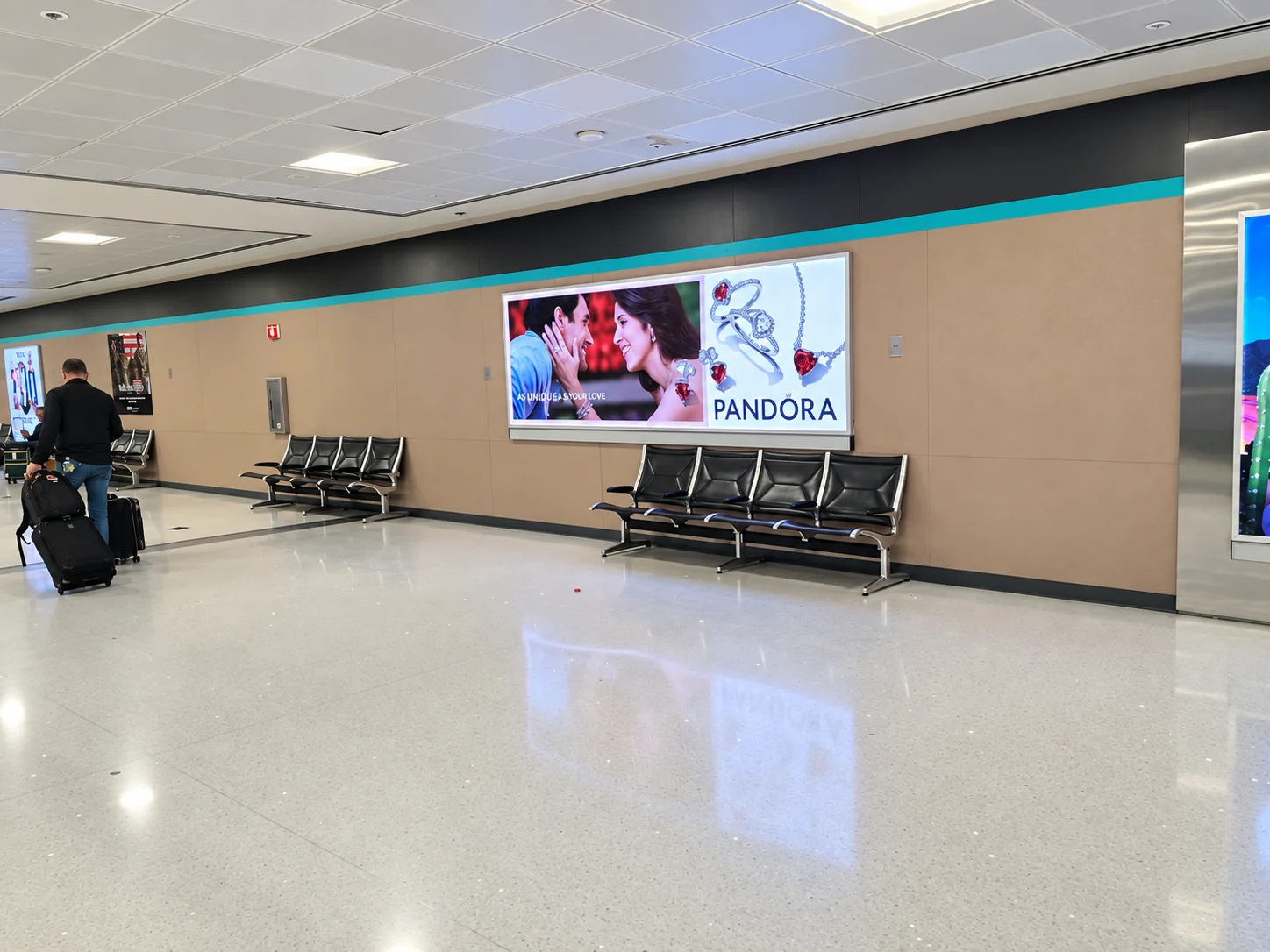
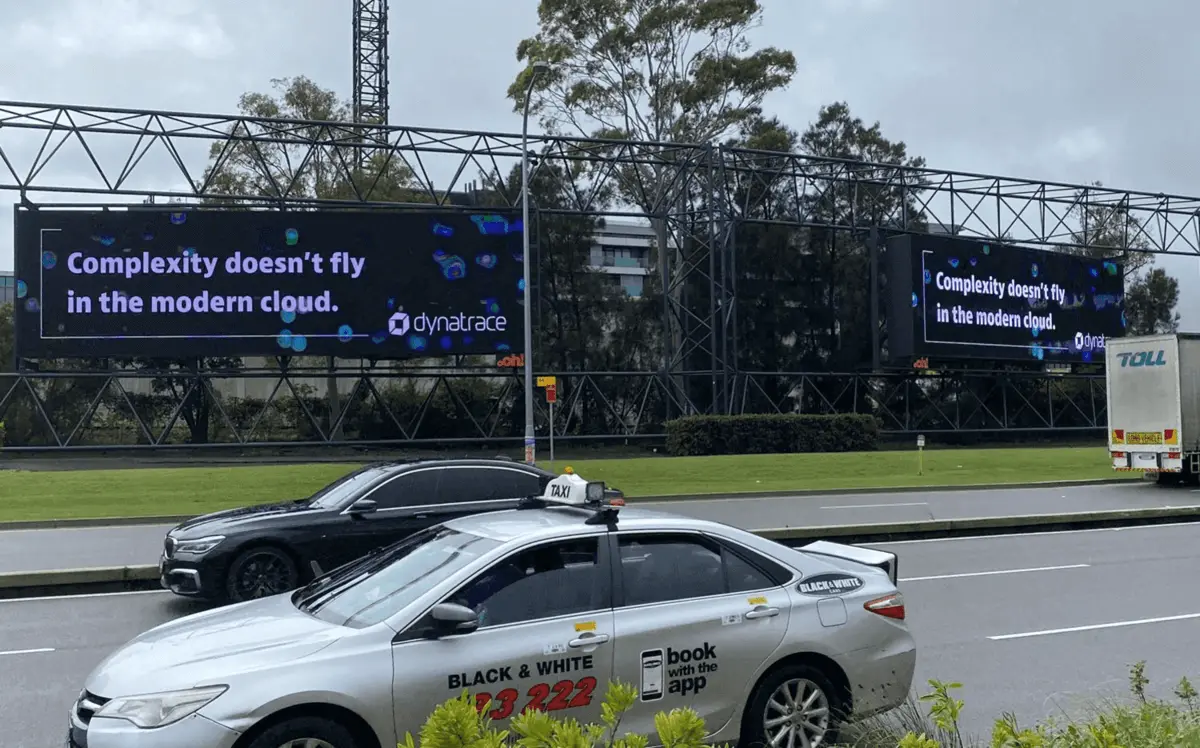
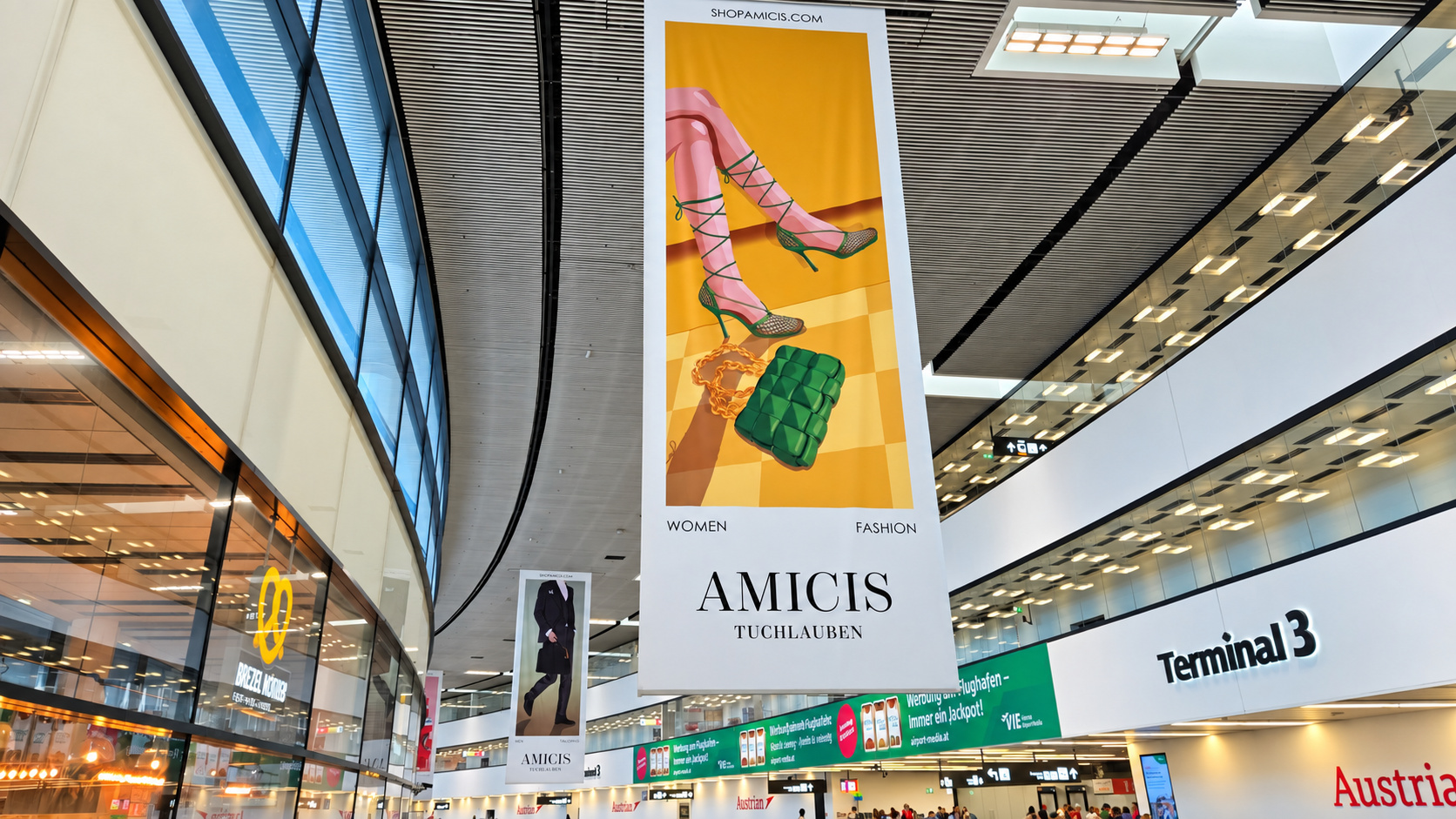
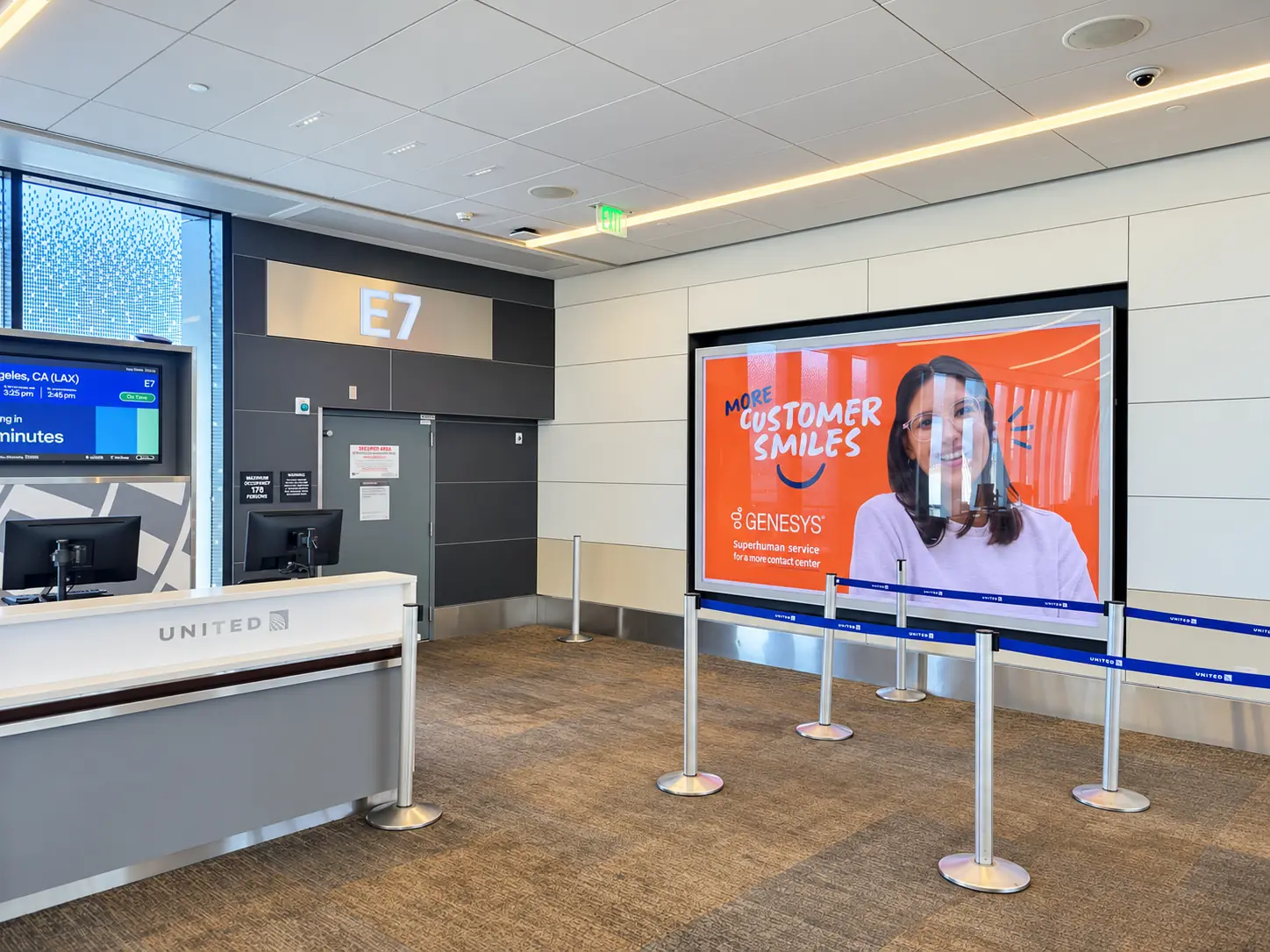
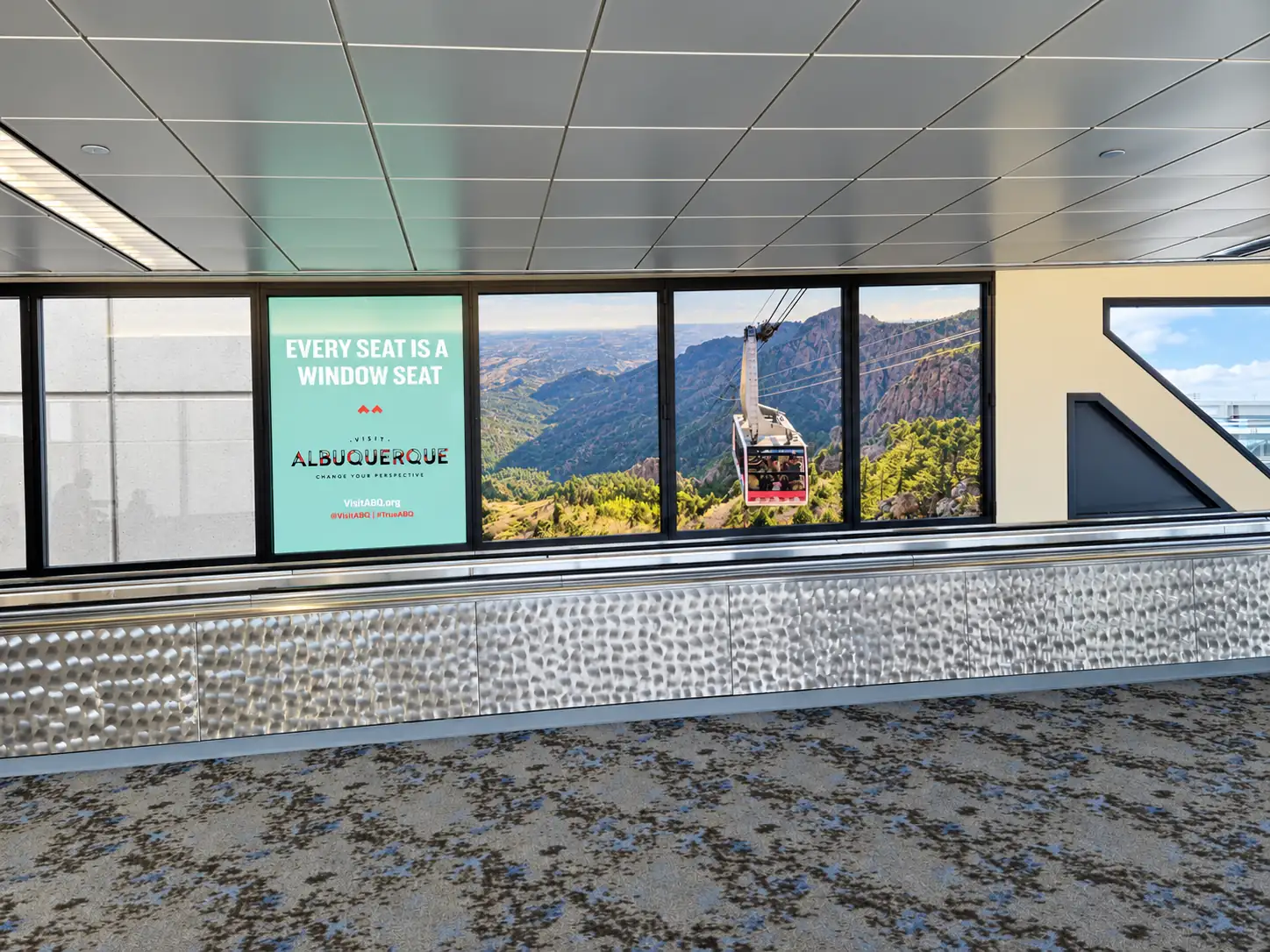
Live examples — some at AUS, some in other airports. The alt names which.
What has EAM run beyond Austin?
Other airports and multi-market campaigns. Click a card for the campaign and the result.
Sources: published campaign summaries on theairport.org/case-studies. Fabric is the takeover ceiling, labeled San Jose, not Austin. Impressions are vendor-reported delivery, not pipeline attribution.
Where else does EAM run airport campaigns?
How do you measure an AUS campaign?
Proof of posting and digital play logs are factual. Delivered impressions are modeled. Brand lift is the only method that speaks to effect, and it has to be fielded before the flight. Direct pipeline attribution is not reliably available. AUS has one measurement advantage most airports do not: the audience is resident, so a geo-targeted survey panel can be built in advance.
Airport advertising is measurable, but not in the way digital media is measurable, and the gap between those two things is where most internal arguments about this channel happen. Decide what you are measuring before the buy; retrofitting measurement after a period has ended rarely produces anything defensible.
Four things can be verified for an AUS campaign, and one thing cannot. Being clear about which is which is what makes the numbers hold up when someone senior pushes on them.
| Measure | What It Actually Tells You | When to Set It Up | Confidence |
|---|---|---|---|
| Proof of posting | Photographic confirmation that every unit ran, in the right place, for the full period. At AUS: close-up and environmental photos of every print location, and a 10% sample of screens plus stacked-content photos for digital networks, within five business days of posting. | Written into the contract before signing | High — factual |
| Delivered impressions | Modeled audience delivery based on monthly airport traffic (roughly 1.8 million passengers) and unit position. An estimate built from traffic data, not a count of people who looked. | Requested at proposal stage | Moderate — modeled |
| Digital play logs | Actual spot counts and share of voice on digital networks. The check on whether the loop crowding you planned against actually materialized. | Requested at contracting | High — logged |
| Brand lift study | Survey-based awareness or perception change against a control. The only method that measures effect rather than exposure. | Fielded pre-flight for a baseline | Moderate — needs budget and lead time |
| Direct attribution to pipeline | Not reliably available. Airport media has no click, and the same brands run other touchpoints at the same time. | — | Low — treat claims here with skepticism |
At most airports, the audience for a lift study is transient and hard to re-contact. At AUS, half of the always-on B2B audience works in the Austin metro, which means a pre- and post-flight survey can be fielded against a stable, geo-targeted panel of technology professionals rather than a general travel sample; the inbound half is best measured through the accounts you are already targeting. If you are going to run a lift study on airport media, an airport with a concentrated business audience is the cleanest opportunity you will get. For a SXSW period, the population is defined and the window is short, which makes a pre- and post-survey of that audience unusually clean.
The honest framing for anyone defending this spend internally: proof of posting and play logs prove the campaign ran as bought, delivered impressions size the audience, and a lift study is the only line that speaks to effect. A vendor promising attributed pipeline from airport media is overselling. EAM contracts proof of posting and delivery reporting on every campaign as standard and will tell you plainly when a proposed measurement approach will not produce a number worth presenting.
How does EAM run an AUS campaign?
One call, one plan, one contract. We follow up to learn who you need to reach and when, then come back with current availability and a recommended mix.
Tell us who you need to reach, the window, and the budget range. We follow up to learn the objective, then come back with current AUS availability, a recommended format mix, placement along the arrival path (and the departure side if the audience is resident), and a quoted range. Once approved, EAM handles the rest.
- Scope the window. Always-on, a SXSW period, an October period, or a product-cycle flight; target airlines if the audience skews to specific carriers; one airport or Austin as part of a Texas or national plan.
- Check avails and loop position. Which networks are open, how crowded the loops are, whether construction affects the units you want, and whether category separation is possible.
- Quote the mix. Networks, share of voice, and a range, not a scraped rate card. After we know who you need to reach, we come back with current availability and a plan you can take inside.
- Hold, contract, and traffic creative. Holds expire in five business days, so the decision is made inside that window. Specs across every screen in the buy, airport authority approval, print materials in market seven business days before posting.
- Go live and close the loop. Confirm posting before the period starts. Deliver proof of posting and play logs after the flight.
EAM Advertising is an independent airport and in-flight media agency, founded in 2015. We specialize in airport and in-flight media and nothing else, and we do not own media assets at AUS or any airport. That independence is why the recommendations hold up. We plan and buy across 125+ airports and 45+ airlines worldwide, which is the leverage and the current-availability knowledge a one-time AUS buyer does not have. Clients include Fortinet, Dynatrace, Rubrik, McGraw-Hill, and Wharton. When the strategy extends beyond Austin — a Texas plan, a multi-city launch, a national roadshow — the same relationship covers the other markets. See the main airport advertising hub.
Frequently Asked Questions
A single digital network or print unit typically runs $7,000 to $50,000 per 28-day period, depending on the network, the number of screens, and the month. A two- or three-network arrival-path package runs $15,000 to $110,000. A concourse domination or multi-period program runs north of $150,000. Print adds production and installation of $1,000 to $15,000 per install. SXSW and F1 periods carry a premium. Those are planning ranges; specific units and periods are quoted against current availability.
In 28-day periods. There is no one-week product; a SXSW campaign is a 28-day period that includes SXSW week. Contracts are non-cancellable once signed, holds expire five business days after confirmation, and multi-year agreements carry annual rate increases.
Three to four months. SXSW is the one period AUS behaves like a conference airport, and arrival-side digital fills with technology brands. Standard periods are workable at six to eight weeks. A hold expires five business days after it is confirmed, so a hold is a decision window rather than a reservation.
For enterprise technology, cloud, security, and semiconductor brands, it is one of the more efficient airports in the country, because the business audience is concentrated here. Tesla, Dell, Apple, Samsung, AMD, NXP, and the software companies around them are Austin-metro employers: their people fly out of one terminal every week, and the executives, buyers, and partners who meet with them fly into the same one. It is a business-travel buy, not a hub buy.
There is one. The South Terminal closed March 31, 2026, and all airlines now operate from the Barbara Jordan Terminal. Concourse zones differ by airline: international and Delta arrivals through the East Concourse, Frontier and Allegiant at the new West gates. Concourse placements can be weighted by zone; the arrivals escalators and baggage claim reach every arrival.
Yes, within limits. You cannot target by employer, but the Austin tech workforce is concentrated enough that an always-on buy in both directions reaches the companies headquartered here at useful frequency. Weight concourse zones by the airlines a target account's travelers use, run multiple periods, and pair the airport with the account-based digital you are already running so the airport impression lands on people who recognize the brand.
Yes. Executive MBA and certificate programs use the concourse networks to reach working professionals year-round; graduate and undergraduate recruiting campaigns run around the start and end of semesters; alumni campaigns run around UT home football weekends and graduation. Education brands EAM has placed in airports include Wharton, BYU, the University of Michigan, the University of Pittsburgh, and UT Dallas. A single period at AUS is enough to test; a semester-long run is where the frequency builds.
Yes, and more than most B2B marketers expect. Race weekend brings the teams' partners and sponsors, many of them enterprise technology, cloud, cybersecurity, and financial brands, along with the executives and clients they host in hospitality suites and at the Paddock Club. Partner summits, client dinners, and deal meetings cluster around the race, so the Thursday-to-Monday arrival and departure waves carry a dense executive audience alongside the fans. Buy the 28-day period that contains the race, weight arrivals Thursday and Friday and departures on Monday (the Monday after F1 is the busiest day in the airport's history), and expect to share the loop with luxury and automotive brands.
Print materials must be in market seven business days before posting; plan 14–18 business days from final art to allow production. Digital creative deadlines are set at contract. All creative is subject to airport authority approval before it posts.
Not by default. Competitive separation is not offered between print and digital, and separation within a network is at the concession's discretion. If exclusivity matters, it has to be written into the contract, and that is one of the things EAM asks for when it buys AUS.
Everything after the objective. We check what's open for the period, which loops are crowded and which units will sell out, and where on the arrival path your audience actually walks. We recommend the mix, secure the units, traffic the creative through airport approval, confirm posting on day one, and deliver proof of posting and play logs after. If AUS is one market in a larger plan, the same relationship covers the others.
Where else does EAM run airport campaigns?
EAM also runs campaigns in other North American and international airports.
- Atlanta - ATL
- Baltimore - BWI
- Boston - BOS
- Burbank - BUR
- Cancun - CUN
- Charlotte - CLT
- Cincinnati - CVF
- Chicago (ORD)
- Chicago - MDW
- Cleveland - CLE
- Columbus - CMH
- Dallas - DAL
- Dallas - DFW
- Denver - DEN
- Des Moines - DSM
- Detroit - DTW
- El Paso - ELP
- Fort Lauderdale - FLL
- Guadalajara - GDL
- Honolulu - HNL
- Houston - IAH
- Houston - HOU
- Indianapolis - IND
- Jacksonville - JAX
- Kansas City - MCI
- Las Vegas - LAS
- Little Rock - LIT
- Long Beach - LGB
- Los Angeles - LAX
- Nashville - BNA
- Maui - OGG
- Memphis - MEM
- Monterrey - MTY
- Miami - MIA
- Midland - MAF
- Milwaukee - MKE
- Minneapolis - MSP
- New Orleans - MSY
- Newark - EWR
- New York - JFK
- New York - LGA
- Oakland - OAK
- Oklahoma City - OKC
- Ontario - ONT
- Orange County - SNA
- Orlando - MCO
- Philadelphia PHL
- Phoenix - PHX
- Pittsburgh - PIT
- Portland - PDX
- Sacramento - SMF
- Salt Lake City - SLC
- San Antonio - SAT
- San Diego - SAN
- San Francisco - SFO
- San Juan - SJU
- San Jose - SJC
- Seattle - SEA
- Tampa - TPA
- Tijuana - TIJ
- Washington DC - DCA
- Washington DC - IAD
- West Palm Beach - PBI
- Passenger statistics from the City of Austin Department of Aviation 2025 year-end reporting (February 2026): 21,666,852 passengers, down 0.44% vs. 2024; Southwest 8,904,277; Delta 3,819,112; American 3,508,972. Single-day record of 45,048 departing passengers screened October 20, 2025. June 2026 busiest month on record.
- Terminal consolidation: the South Terminal closed March 31, 2026; Frontier and Allegiant moved to the Barbara Jordan Terminal's West gates April 1, 2026 (flyaustin.com).
- Expansion: Journey With AUS program; Concourse B (26 gates) and connecting tunnel planned for the early 2030s; temporary Concourse M and new midfield taxiways (Austin Department of Aviation).
- Event dates: SXSW March 15–21, 2027, with SXSW EDU March 13–16 (sxsw.com); ACL Music Festival October 2–4 and 9–11, 2026 (aclfestival.com); Formula 1 United States Grand Prix October 22–25, 2026 (circuitoftheamericas.com). F1 attendance per organizer-reported weekend figures for 2022 and 2024.
- Network descriptions, screen counts, loop structure, concourse zones, contract terms, proof-of-performance terms, and construction notes from current AUS airport media specifications, March 2026. Unit rates move with availability and are not published on this page. Gate assignments change; verify against the airport's current map when planning.
- Pricing ranges, booking windows, and premium character based on EAM Advertising planning and buying data across 125+ airports, 2015–2026.