
Static
Arrivals bag-claim LCD network
20 screens over all 10 carousels; arrivals and greeters
- Type
- 20 × ~65"; 1920×1080
- Your spot
- :10 /:330 (~3% SOV); static + motion
- Best for
- High-dwell O&D; hotels, destination, Music City Center inbound
25.7 million passengers a year: Nashville’s healthcare, music, and corporate workforce flying out, tourists, bachelorette weekends, and convention industries flying in, and CMA Fest and Music City Center weeks on top. Get the BNA media kit for formats, planning ranges, and booking windows.


You’re in good company






At a glance
BNA handled 25,715,851 passengers in calendar 2025 — a record. Fiscal 2026 closed at about 26.7 million (+7.7%). The June 2026 media grid cites about 2.14 million monthly traffic. The page is for Music City's primary commercial airport: one terminal, high leisure and corporate O&D, Southwest-led, not a fortress connecting mill.
Most BNA passengers are beginning or ending a trip in Middle Tennessee. Southwest's growing bank can still carry connectors who never leave the airside; bag claim, the arrivals escalators, and the curb reach people entering Nashville — hotel guests, Broadway visitors, Music City Center delegates, healthcare travelers, and residents coming home. Tourism and destination briefs weight the O&D path; network briefs can live on C/D airside.
One terminal after a shared security hall. Concourse B: Delta and United. Concourse C: American and Southwest (plus the C Satellite via shuttle). Concourse D: Southwest exclusive. T-gates: international and partner carriers (Aer Lingus, Icelandair, British Airways, Air Canada, WestJet, and others as assigned). Concourse A is closed for New Horizon reconstruction.
Two calendars drive the buy. Always-on reaches tourism, Broadway, music-industry visitors, healthcare, and the metro employer base. Music City Center weeks — ACG, NLC City Summit, NCBA, 3DEXPERIENCE World, ViVE — and CMA Fest (June 10–13, 2027) change who is in the building.
Planning ranges from published rate-card faces: a single unit or network runs $7,500–$26,000 per 28-day period. A two- or three-network package runs $20,000–$55,000 per 28-day period. Multi-network domination runs north of $70,000 per 28-day period. Lower quote-only columns exist on the kit; specific discounts come back at quote. Production and install are quoted separately when not included. Those are planning ranges, not a rate card.
Media on the current specifications is sold by the 28-day period. Digital spots are:10; loops run from:100 (about 10% share of voice) to:330 on the bag-claim LCD network (about 3% share of voice). Holds expire in 5 business days. Materials must be in market 14–18 business days before start for digital creative and 21–28 days before start for static creative. Creative needs airport authority approval. Competitive separation may be possible, but it isn’t guaranteed; ask when booking and write it into the contract.
Start your BNA plan
Three ways to start, depending on where you are.
What you can run
6 placements are in the current specifications: Arrivals bag-claim LCD network; Departures TSA-queue video walls; Arrivals escalator video walls; Concourse video walls (C + D); Arrivals bag-claim video walls; Premier concourse LCD package. Digital spots are ten seconds; share of voice depends on the loop — about 10% on the:100 walls, about 3% on the:330 bag-claim LCD network. The cards are this airport's units. The format library after them is photographed across airports, not as BNA photography.
Static
20 screens over all 10 carousels; arrivals and greeters
Digital
Two sections flanking Clear and TSA PreCheck entrances
Digital
Two large walls over arrivals escalators to claim / rideshare / exits
Digital
Two walkway walls on Concourse C; one head-on on Concourse D
Digital
Six LEDs on the back wall of bag claim
Digital
Seven screens: B×1, C×2, D×2, Satellite×2
The June 2026 pack in hand is digital-only. Print may exist in the broader program; production, install, and removal are quoted separately when those faces are sold.
Advertising sits on a portion of a larger airport-owned screen and is interrupted about four minutes each hour for refresh. Approved advertiser verticals on the kit include airlines, financial, B2B technology, higher education, alcohol, hotels, and healthcare; other verticals need approval when booking. Offensive or controversial political, religious, environmental, or social creative is prohibited.
They over-index Southwest and American. If your audience is on Delta or United in Concourse B, add premier digital coverage or confirm live B inventory — the three-wall concourse package in the current kit does not list B.
The:330 loop yields roughly 3% share of voice at a:10 spot. For short-loop claim presence, the six-wall arrivals LED package (:120) is the tighter read.
The digital, static, experiential, and exterior units brands buy in airports. For BNA we plan specific units and dates against what is open at the time.

Digital screens and video walls in airline business club lounges reach affluent business decision-makers and high-net-worth travelers in a captive setting.
Travelers often spend 90 minutes or more in the club. Screens in dining and seated areas and larger video walls (about 84–100 inches) give the brand both frequency and a dominant face.
Full motion or static creative can rotate through the loop while the audience is already seated.
* Differs depending on the airport.

Target high-level decision-makers and affluent individuals with entrance banners in airport business club lounges.
Engage with a discerning audience in a premium, brand-safe environment.
Showcase innovations for business-to-business brands or emphasize luxury for high-end brands.
* Differs depending on the airport.
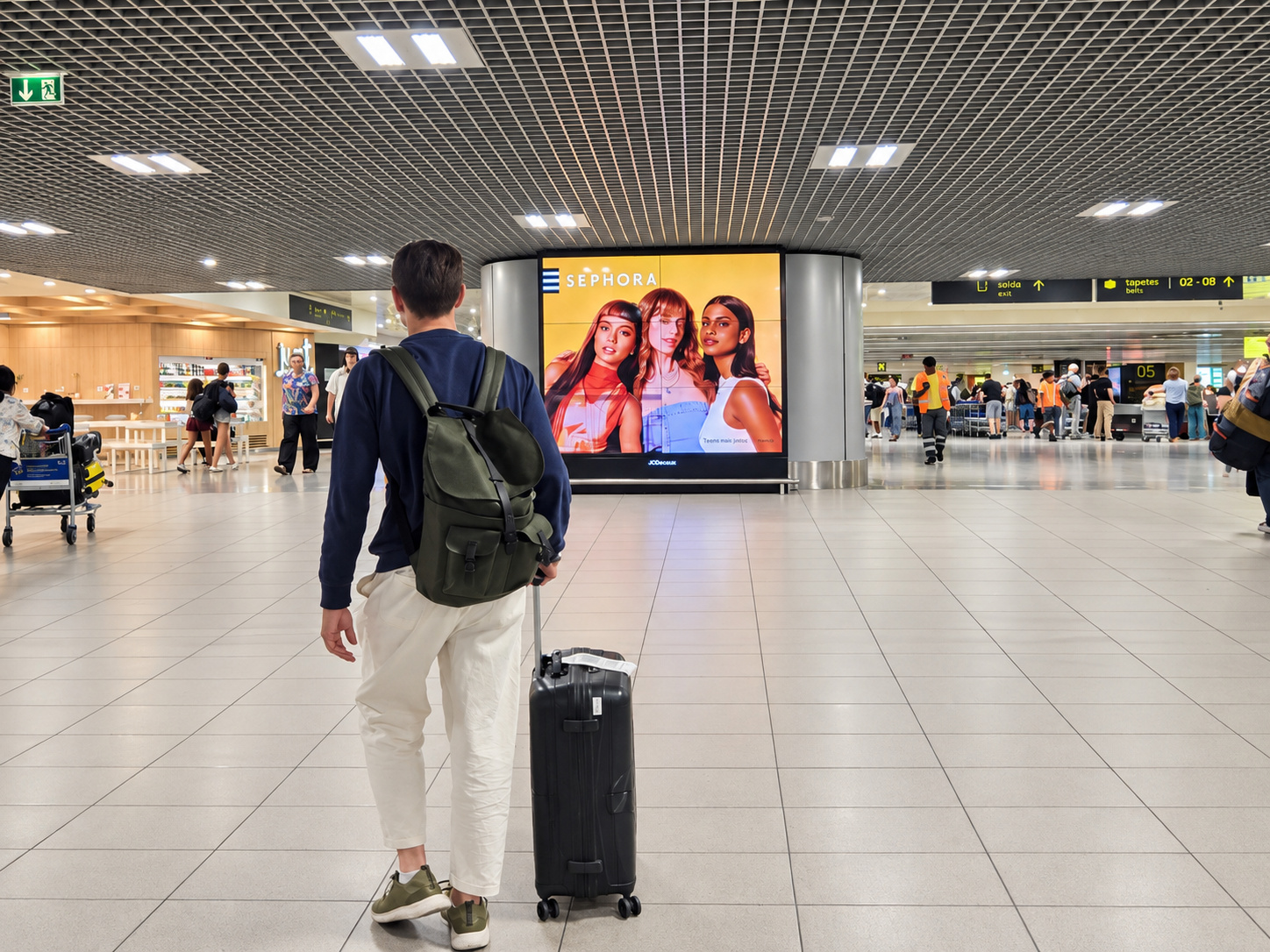
Baggage claim digital network screens provide a unique opportunity to connect with travelers at a prime moment.
Strategically placed in high-traffic areas throughout the baggage claim area, these screens ensure maximum exposure for your brand.
By using baggage claim digital network screens, you can deliver your message to travelers multiple times, building frequency and driving engagement.
* Differs depending on the airport.

Packages can range in screen size and quantity. Strategically positioned throughout central airport concourses.
These screens can target 100% of arriving and departing traffic as passengers move towards airport exits and a large percentage of departing traffic as passengers move through the concourses and frequent favorite concessions in the area.
* Differs depending on the airport.
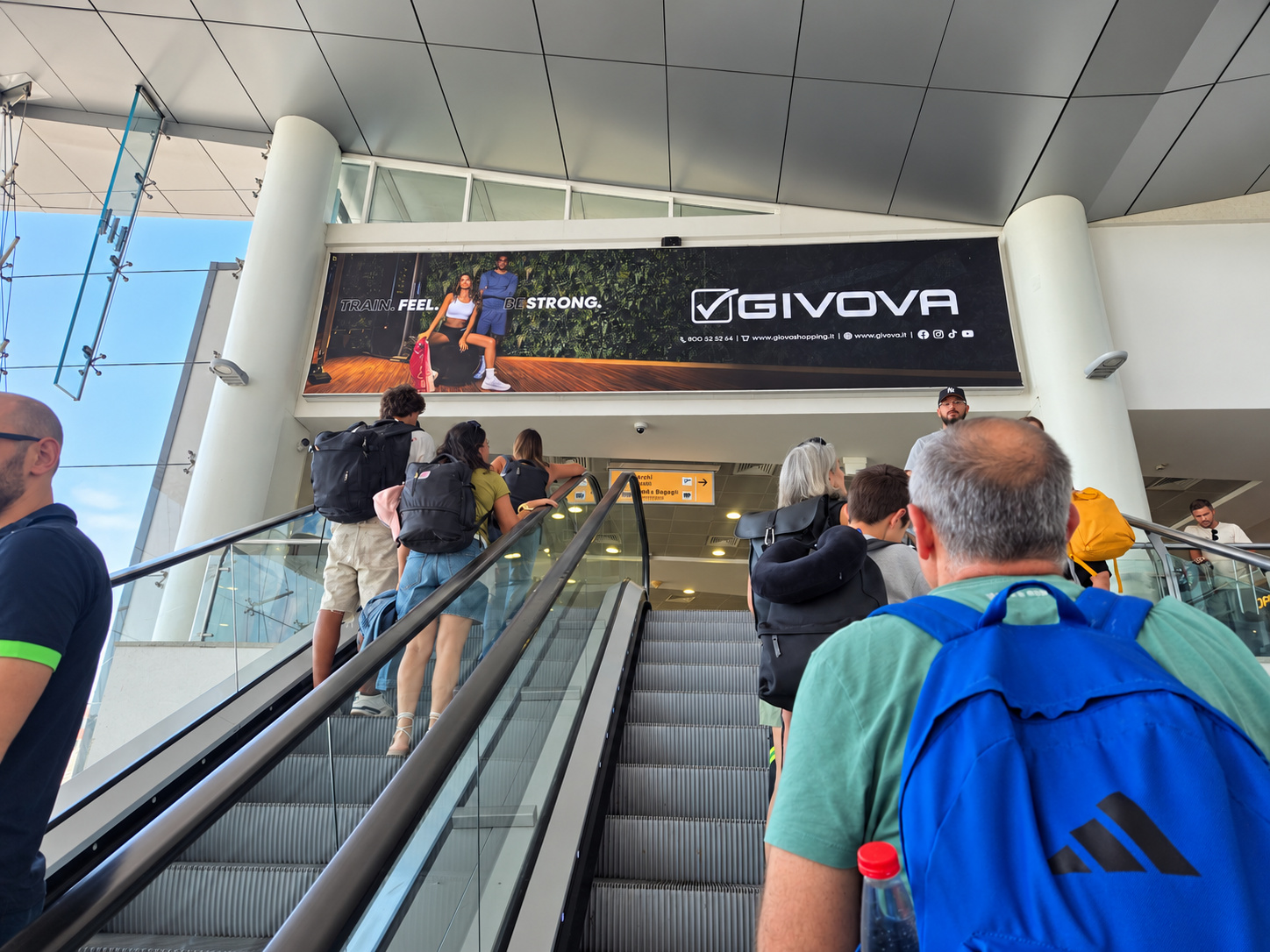
Large format banners offer a large, eye-catching space that can capture the attention of everyone walking through the airport.
They can be strategically placed on walls or hung from ceilings throughout the airport, ensuring maximum exposure for your brand.
With large format banners, you have the opportunity to own 100% of the share of voice in that area.
* Differs depending on the airport.

Experiential advertising at airports lets the brand interact with a captive audience through immersive installations.
Activations can include brand ambassadors, tech-focused displays, and product sampling.
Exhibit space is the same idea: a physical footprint where travelers can engage face-to-face.
* Differs depending on the airport.

Digital charging network screens are a highly effective advertising tool for brand marketers looking to reach a captive audience of travelers.
Travelers engage with the screens while charging devices, which adds dwell to the impression.
* Differs depending on the airport.
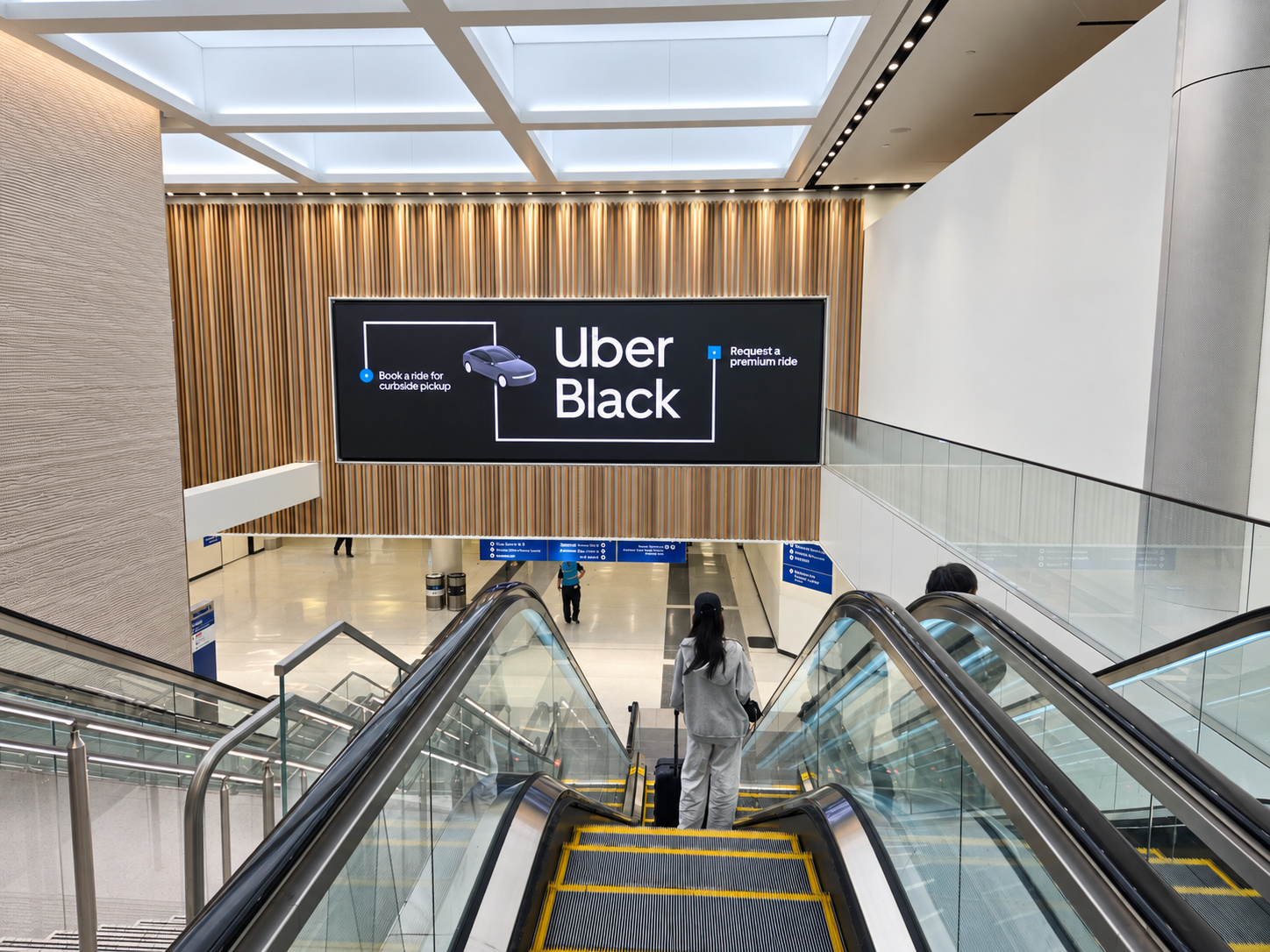
Digital spectacular screens offer a powerful advertising tool to capture significant attention in airports.
Strategically located in high-traffic areas, these screens provide maximum visibility and impact for your brand.
With their attention-grabbing size and creative flexibility, digital spectacular screens hold the attention of travelers and drive engagement.
* Differs depending on the airport.
By using digital network screens, you can deliver your message to travelers multiple times throughout their journey.
Strategically placed in high-traffic areas, these screens ensure maximum exposure for your brand.
These screens build frequency and drive engagement, making them an effective advertising option.
* Differs depending on the airport.
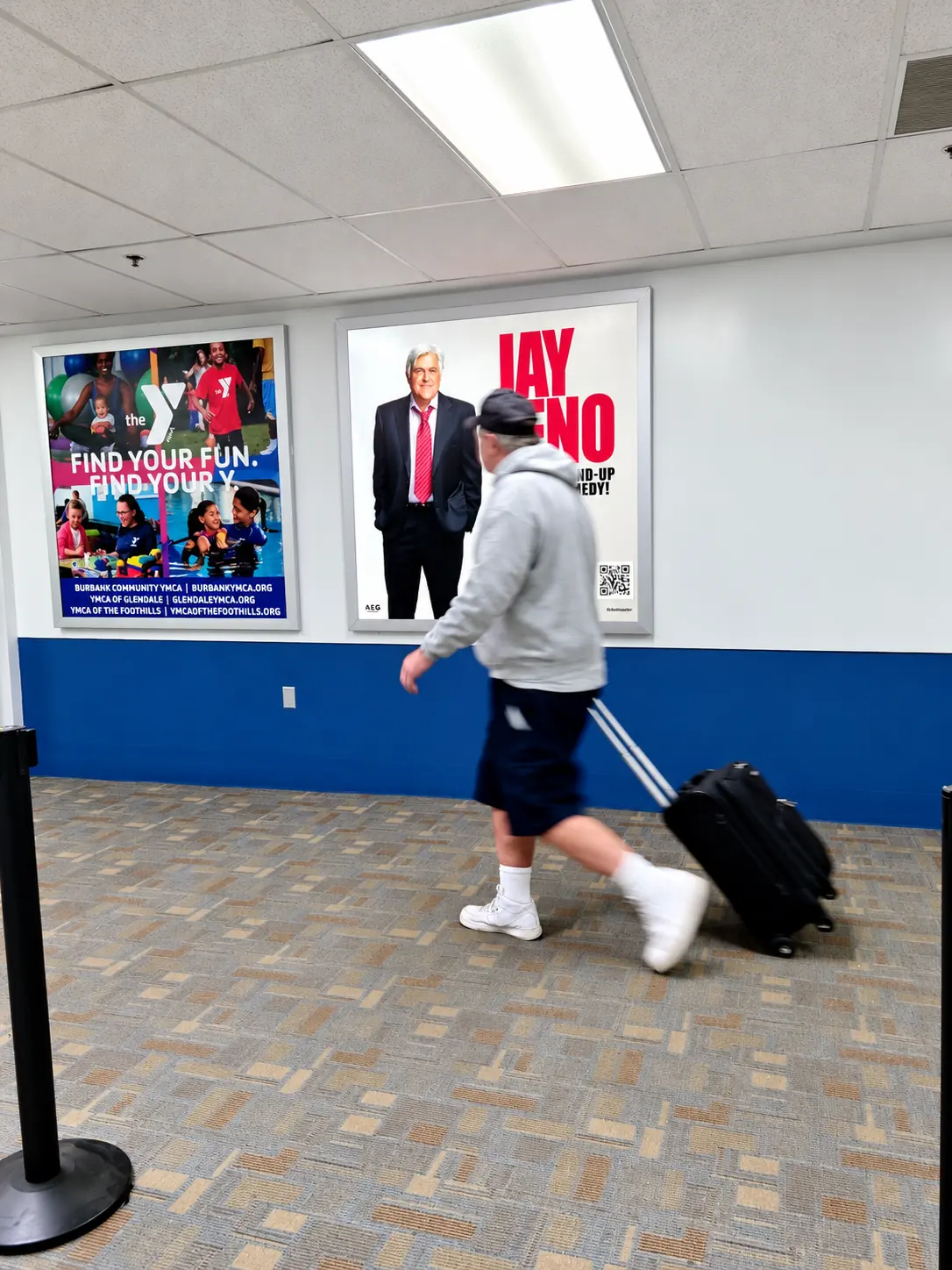
Dioramas are backlit displays at eye level in corridors and holdrooms.
They offer a lit, poster-scale face with 100% share of voice on that unit.
* Differs depending on the airport.

Leverage exterior signage to engage airport visitors as they arrive or depart, keeping the brand visible on the campus.
High-impact banners on the building or approach create a lasting impression before travelers enter the terminal.
* Differs depending on the airport.

Flight information screens are some of the most frequently viewed screens in the airport, where passengers already look for gate and time updates.
Advertising on these screens puts the message next to information travelers are actively reading.
* Differs depending on the airport.
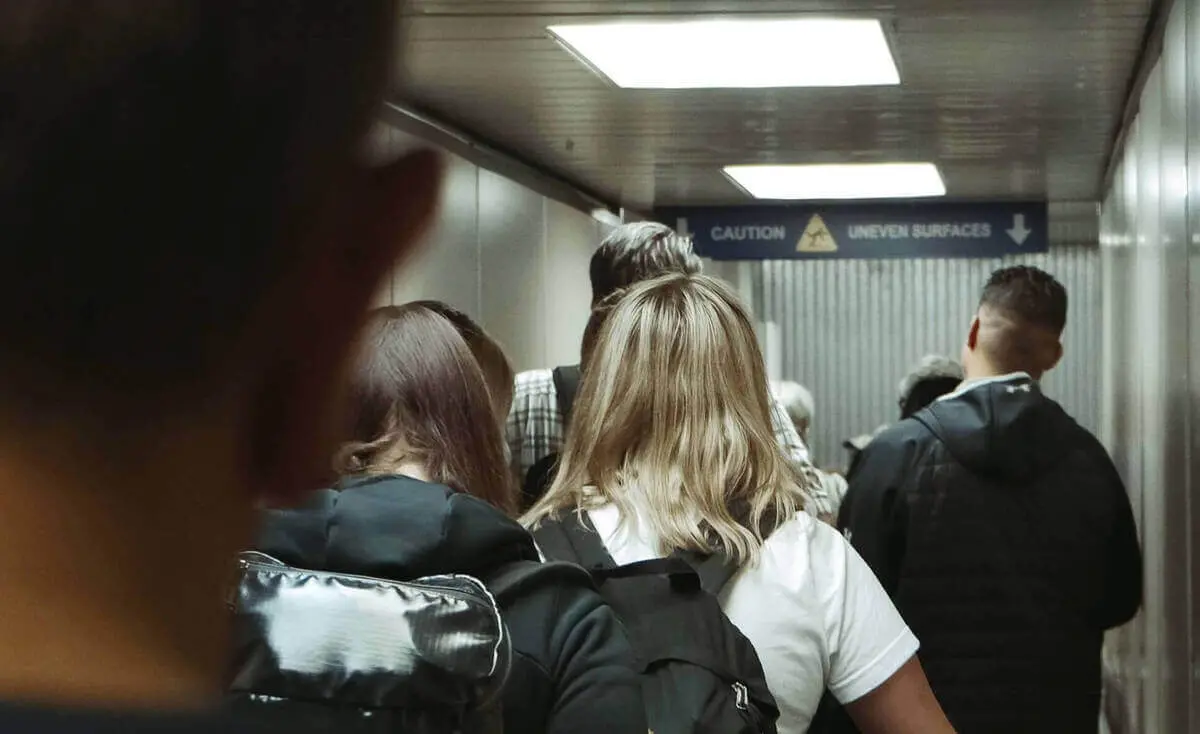
Jet bridge wraps put the brand on the walk between gate and aircraft.
The space is captive and sequential: every boarded passenger on that gate walks the length of the wrap.
* Differs depending on the airport.
Large format digital screens offer a unique opportunity to make a lasting impression on travelers.
These screens have the wow factor needed to capture your target audience's attention and inspire them to engage with your brand.
Large format digital screens offer creative flexibility to showcase your brand's messaging and art in a way that resonates with your target audience.
* Differs depending on the airport.

Large format banners offer a large, eye-catching space that can capture the attention of everyone walking through the airport.
They can be strategically placed on walls or hung from ceilings throughout the airport, ensuring maximum exposure for your brand.
With large format banners, you have the opportunity to own 100% of the share of voice in that area.
* Differs depending on the airport.
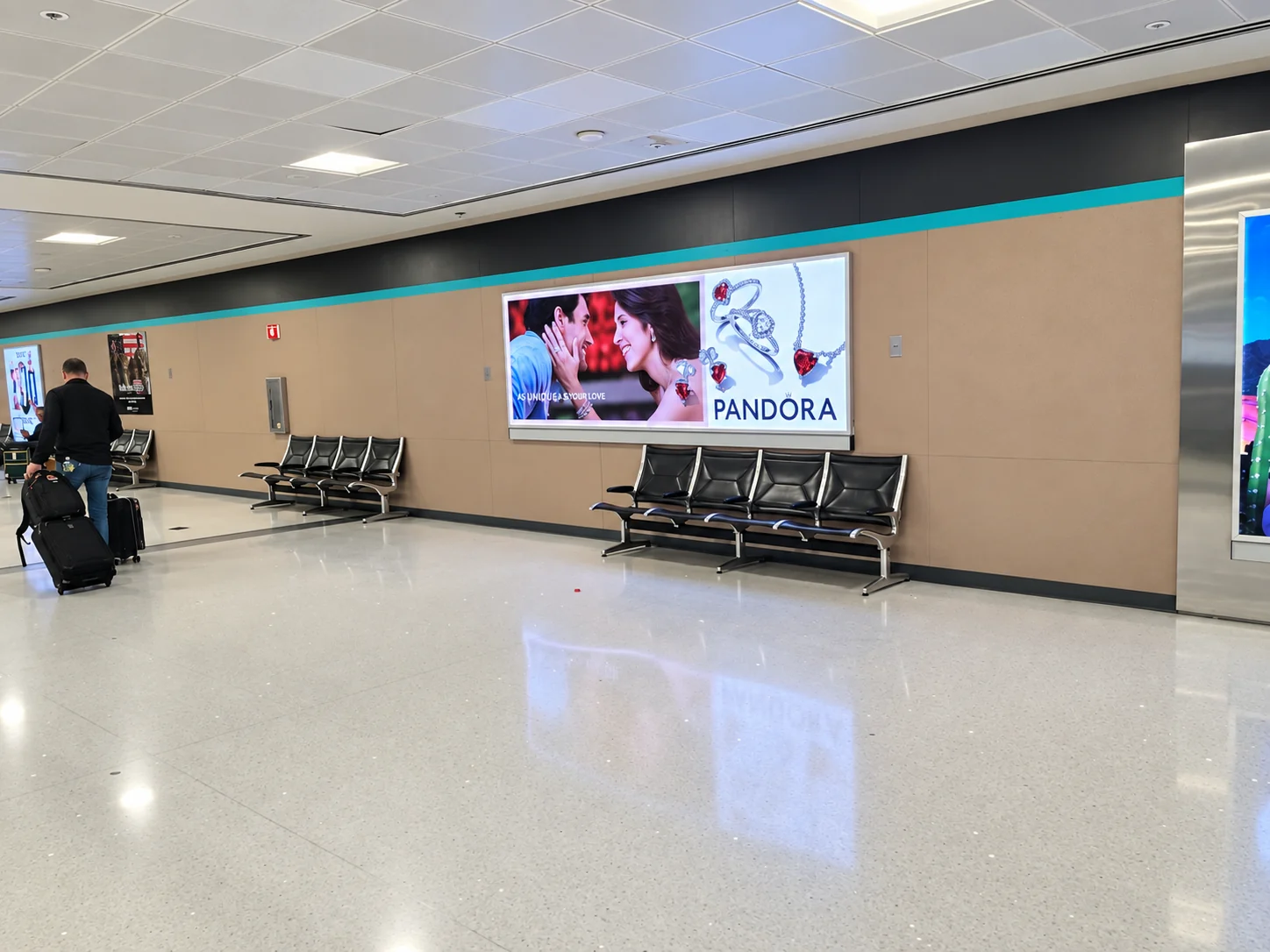
Mini-spectaculars are smaller spectacular units that still dominate a sightline without a full-wall takeover.
They own share of voice on that face and work in tighter terminal pockets.
* Differs depending on the airport.
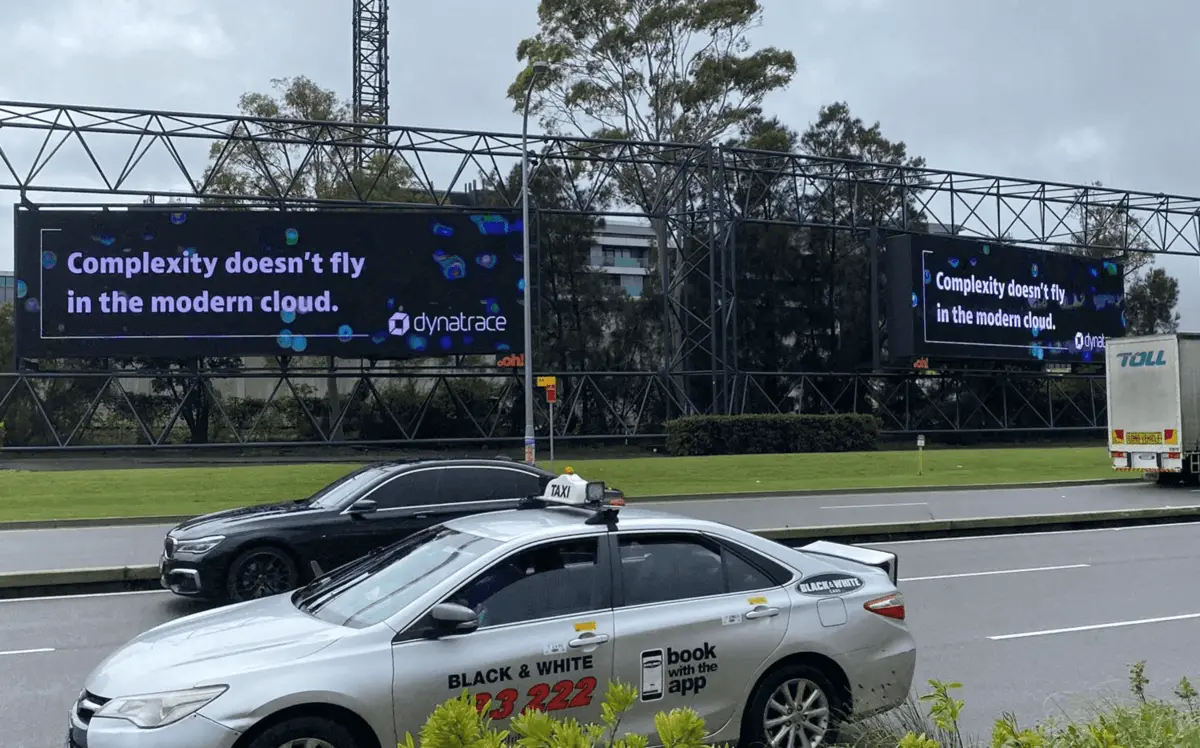
Exterior digital billboards at the airport engage a wide mix of travelers on the approach and campus roads.
Creative on digital billboards can run full motion or static.
* Differs depending on the airport.
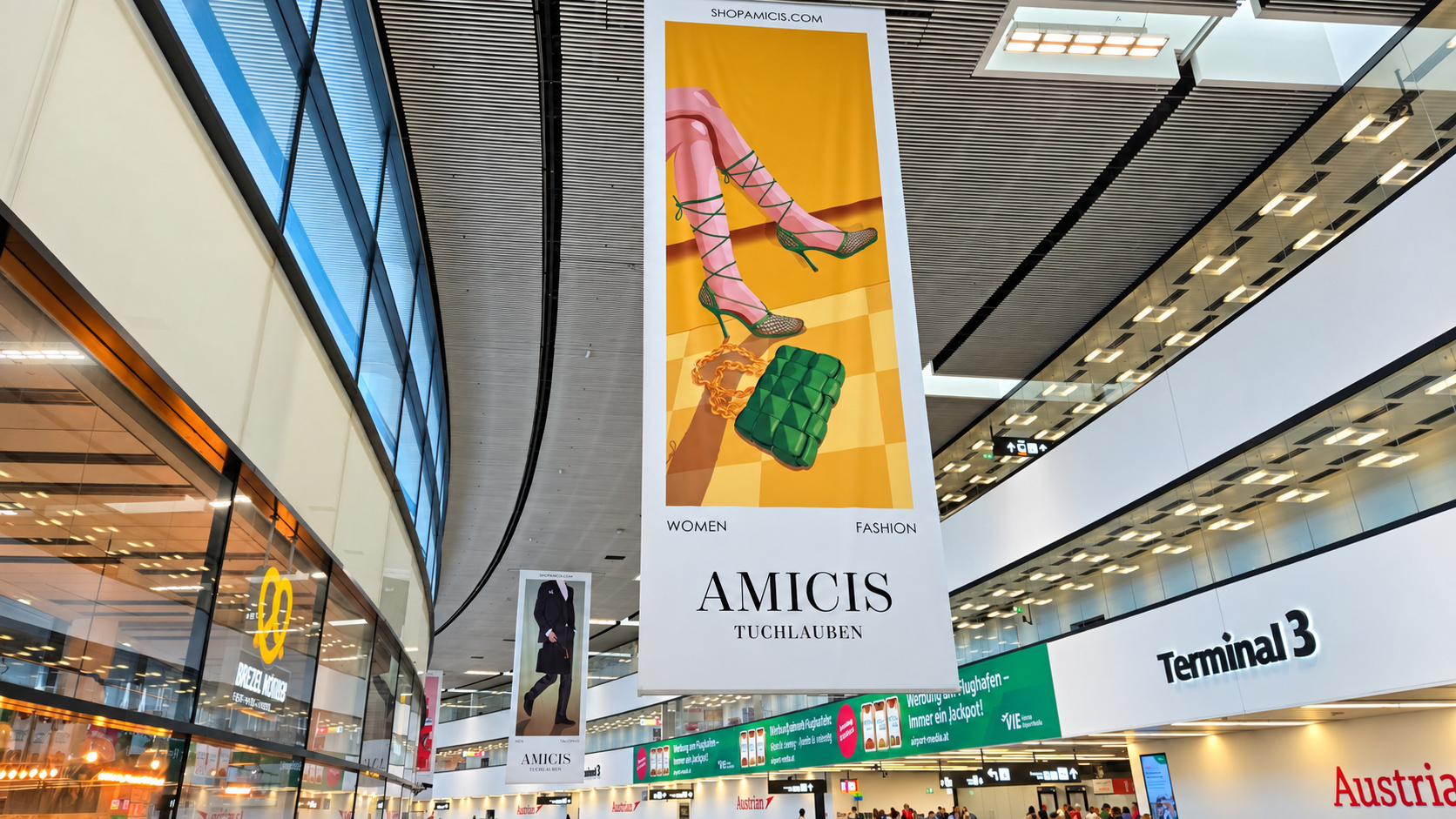
Large format banners offer a large, eye-catching space that can capture the attention of everyone walking through the airport.
An overhead banner package is sequenced across multiple faces so the brand owns a stretch of the travel journey and a specific airport area, which is what creates the wow effect.
They can be placed on walls or hung from ceilings, with 100% share of voice in that zone.
* Differs depending on the airport.
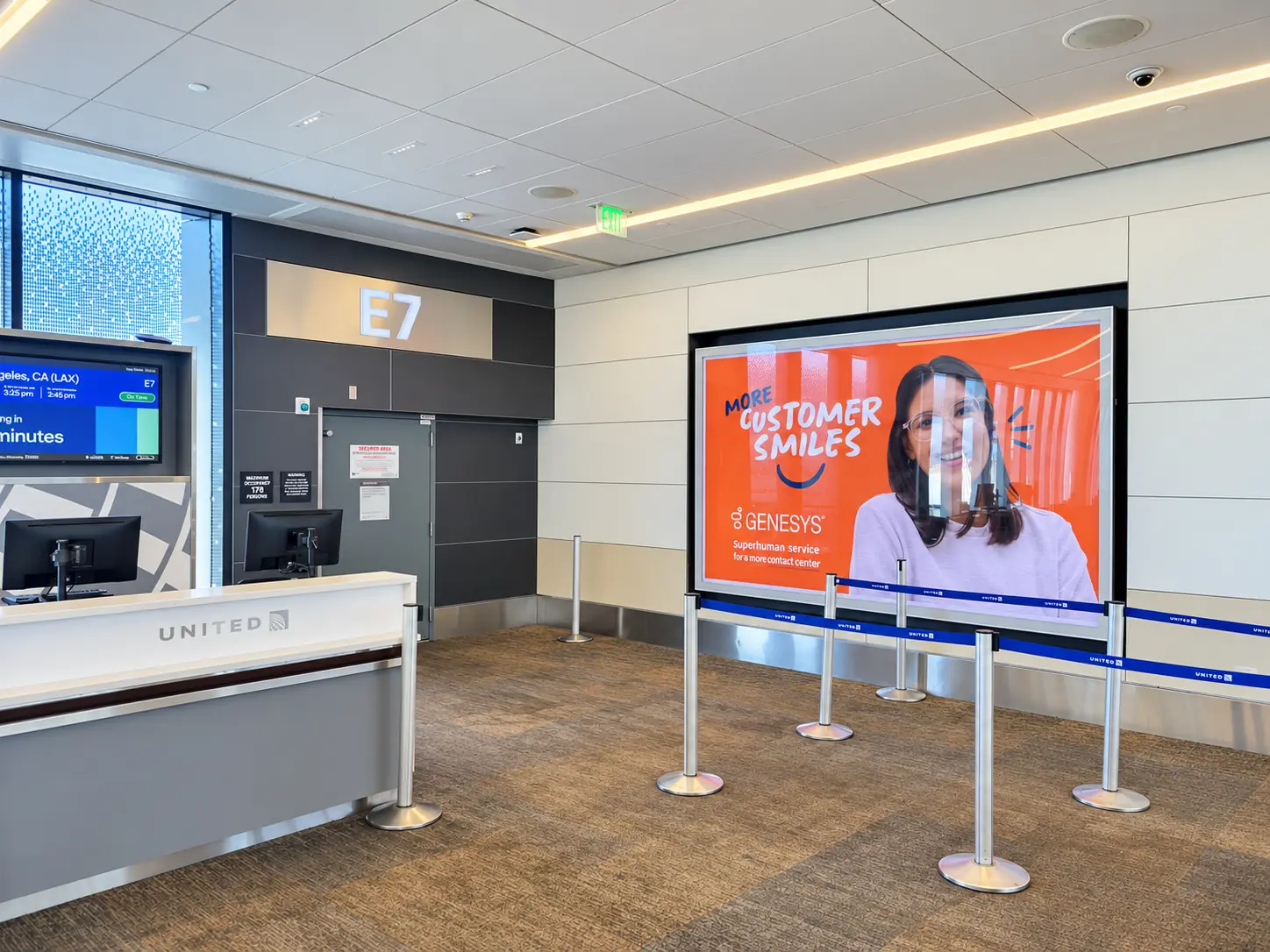
Spectaculars are large-format displays built for a single dominant face in a high-traffic terminal space.
With the ability to own 100% of the share of voice, your message is the only one being seen by travelers in that area.
* Differs depending on the airport.

Tension fabric displays are a visually stunning way to showcase your brand or product in the airport.
They command attention in a crowded terminal and offer a cost-effective way to reach a large audience.
With tension fabric displays, you have the opportunity to own 100% of the share of voice in that area.
* Differs depending on the airport.
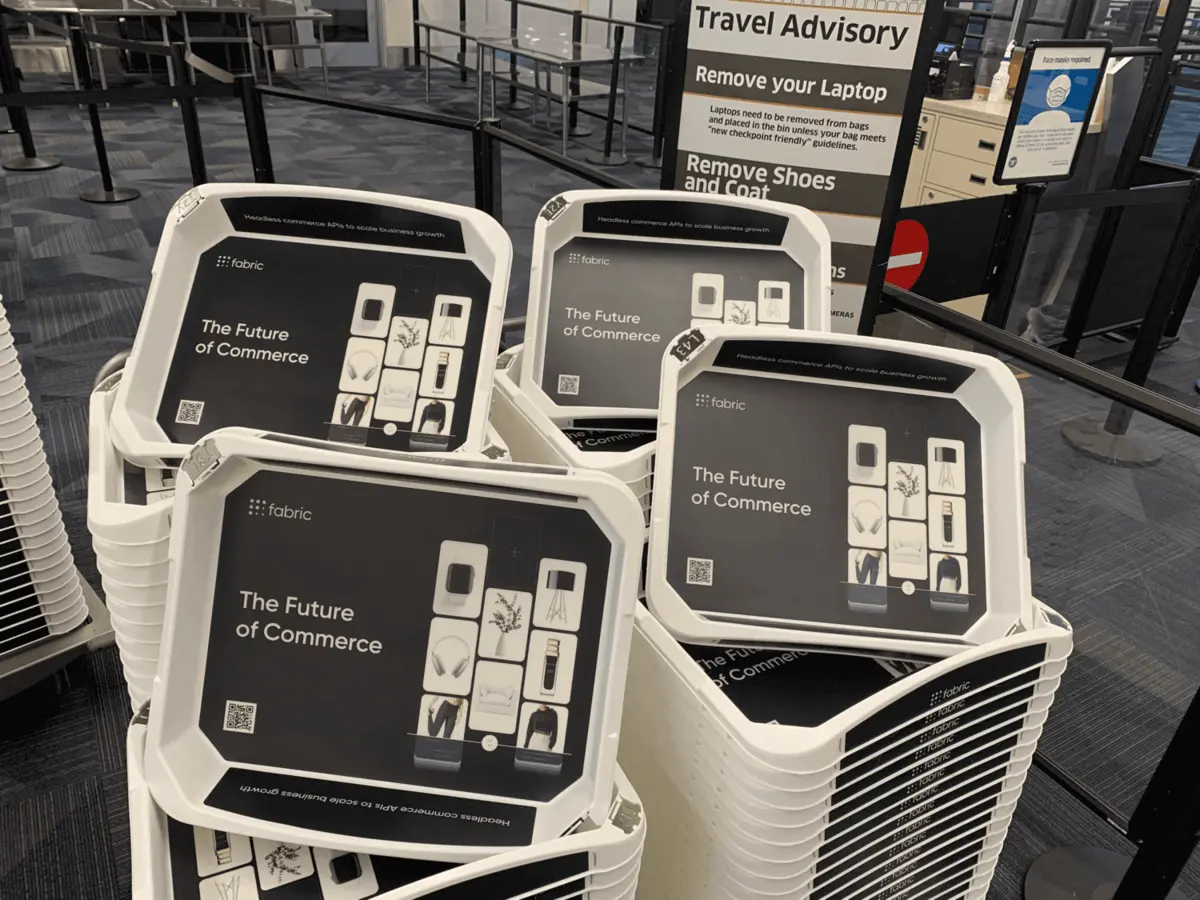
By advertising on airport security trays, the brand reaches travelers during an essential part of the departing journey.
Every passenger who uses that lane handles the tray.
* Differs depending on the airport.
By using vertical digital network screens, you can deliver your message to travelers multiple times throughout their journey.
These are vertical units with a different view profile: most sit at eye level and read with a poster feel.
Strategically placed in high-traffic areas, they build frequency as passengers walk the concourse.
* Differs depending on the airport.
Video walls are strategically positioned in high-traffic areas of the airport, ensuring maximum visibility and engagement for your brand.
These high-impact screens provide maximum visibility for your brand, making a lasting impression on travelers.
* Differs depending on the airport.
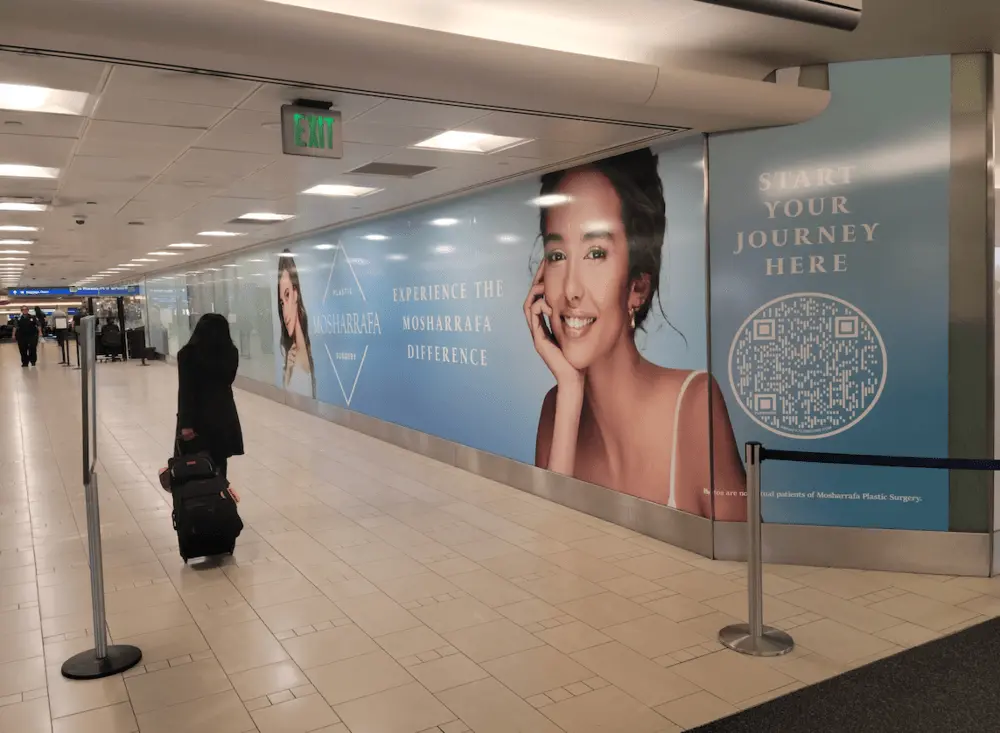
Wall wraps offer a visually striking and modern way to showcase your brand in the airport, with the ability to customize them to your brand.
Strategically placed in high-traffic areas, wall wraps capture attention and own 100% of the share of voice on that surface.
* Differs depending on the airport.

Sponsoring Wi-Fi access at airports engages travelers on their personal devices.
Call-to-action pages can be video or static, which is what turns access into a media placement.
* Differs depending on the airport.
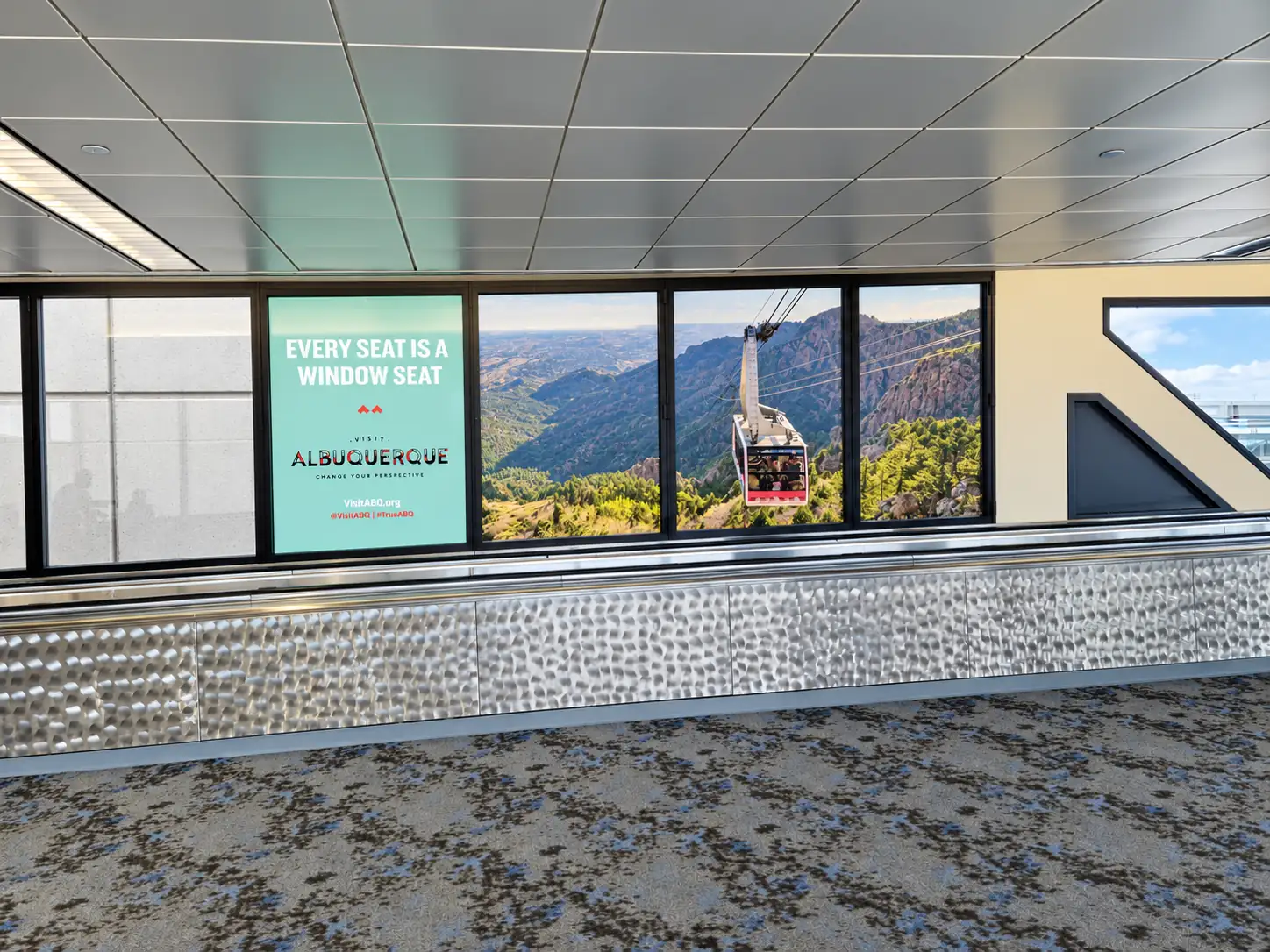
Window wraps offer a visually striking and modern way to showcase your brand on terminal glass, with the ability to customize them to your brand.
Strategically placed on windows in high-traffic areas, they capture attention from the interior walkway or the curb and own 100% of the share of voice on that glass.
* Differs depending on the airport.
Examples
Airport advertising in practice, photographed across many airports. Availability at BNA varies by format.
Real brands. Real campaigns.
Campaigns across several countries and media owners, each bought through one contract. Swipe or use the arrows for the markets, the scope, and the result.
 U.S. + Canada

Multiple media owners.
One coordinated buy.
EAM brought a U.S. and Canada airport campaign together across multiple media owners.
 Five continents

Different markets.
One media partner.
Large-format digital and screen networks across five continents, including London, Paris, Tokyo, and São Paulo.
 Airports + airline lounges

Airports and lounges.
One coordinated plan.
A combined airport and airline-lounge presence across the U.S., Europe, and the Middle East.
 Five U.S. airports

A year of visibility.
One coordinated rollout.
EAM bought year-long security-tray takeovers across five major U.S. airports.
 Latin America

Four airports.
One regional campaign.
EAM planned digital and physical branding across Buenos Aires, Santiago, Bogotá, and Mexico City.
 San Jose · SJC

One airport.
A complete takeover.
EAM coordinated a full San Jose airport takeover across digital displays and all 760 security trays.
 Airline lounges · 7 U.S. cities

Executive education.
Reached in the lounge.
EAM planned and executed a lounge campaign for Wharton Executive Education in United, Delta, and American clubs across Philadelphia, New York, Dallas, Atlanta, Denver, Minneapolis, and San Diego.
 4 markets · Year-round

Four markets.
A full year on screen.
EAM built a year-round enrollment campaign on airport digital video: always on in Salt Lake City, rotating through Dallas, Chicago, and Washington, D.C.
 U.S. + Spain

An album launch.
Two countries at once.
For the Saturno release, EAM planned and executed airport advertising in Miami, New York, Chicago, Madrid, and Barcelona, plus an in-flight buy across the JetBlue fleet.
“EAM made a nationwide airport campaign feel much easier to manage. The team were responsive, organized, and always on top of the details. They helped us make smart decisions with the budget, kept everything moving, and ultimately delivered exactly what we were looking for.”
Chief Marketing OfficerFortinet · nationwide airport campaign“This was one of the most challenging campaigns we had ever managed, launching during COVID and the unprecedented freeze in air travel. EAM was an incredible partner throughout the entire process. They worked closely with the airports and media partners to protect our placements and ensure our space was held until travel resumed. Their persistence, communication, and attention to detail made an extremely difficult situation manageable. Without EAM, navigating this campaign would have been a nightmare.”
Chief Marketing OfficerInvest in Canada · airports and airline lounges“We ran a security tray advertising program across several key airports, and EAM was a tremendous partner throughout the process. Their team helped secure the space, manage renewals, and coordinate the campaign seamlessly from start to finish.”
Chief Executive OfficerFlexispot · security tray programThese examples show past EAM campaigns—not a minimum campaign size, a forecast, or a guarantee of results. One-airport briefs are welcome, too.
Cost
$7,500–$26,000 for a single unit or network per 28-day period. $20,000–$55,000 for a two- or three-network package per 28-day period. North of $70,000 for multi-network domination per 28-day period. Digital spots are ten seconds; share of voice depends on the loop — about 10% on the:100 walls, about 3% on the:330 bag-claim LCD network. Those are planning ranges from published rate-card faces, not a rate card. Quote-only lower figures appear on the kit; specific discounts come back at quote.
Media on the June 2, 2026 specifications is sold by the 28-day period. For a CMA Fest or other Music City Center brief, one period covering the week is the usual buy; for always-on branding, brands stack periods. Shipping and install/removal lines on the kit carry a 9.25% tax where applicable; media tax is listed at 0%.
Digital share of voice sits next to price. The kit publishes:10 spots against loops of:100 (departures walls, escalator walls, concourse walls — roughly one of ten),:120 (arrivals bag-claim walls — roughly one of twelve),:180 (premier concourse LCDs — roughly one of eighteen), and:330 (arrivals bag-claim LCD network — roughly one of thirty-three). Read the live loop before comparing BNA to a weekly market.
What a budget buys at BNA
Planning ranges. Pick the one closest to your brief and we’ll build the plan from it.
A single unit or network, one 28-day period
A two- or three-network package, one period
Multi-network domination, one period
These are planning ranges, not packages or a rate card. Actual plans depend on the unit, the period, and what is open when you book.
Buying unit: one 28-day period. Holds expire 5 business days after confirmation; extensions are not guaranteed. Materials must be produced and received in market 14–18 business days before start for digital creative and 21–28 days before start for static creative. Creative requires final airport authority approval. Competitive separation may be possible, but it isn’t guaranteed; ask when booking and write it into the contract. Rates are non-cancellable; annual increases apply to multi-year agreements; pricing valid 30 days. Proof of performance: digital — one close-up and one environmental for single units, 10% of locations for packaged networks, plus stacked-content photos, within 5 business days of initial posting.
Unit-level rates, loop-position premiums, and period-specific quotes. Those numbers move with availability and with the period. What you can plan against: 28-day periods; $7,500–$26,000; $20,000–$55,000; North of $70,000. Specific units and periods come back as a quote.
| Unit (plain description) | Where it reaches them | Faces / size | Your spot in the loop | Best for |
|---|---|---|---|---|
| Arrivals bag-claim LCD network | 20 screens over all 10 carousels; arrivals and greeters | 20 × ~65"; 1920×1080 | :10 /:330 (~3% SOV); static + motion | High-dwell O&D; hotels, destination, Music City Center inbound |
| Departures TSA-queue video walls | Two sections flanking Clear and TSA PreCheck entrances | ~159" square sections; 2160×2160 | :10 /:100 (~10% SOV) | Departure-side branding; shares an airport-owned wall — ~4 min/hour refresh interrupt; approved verticals apply |
| Arrivals escalator video walls | Two large walls over arrivals escalators to claim / rideshare / exits | ~134"×49"; 1414×520 | :10 /:100 (~10% SOV) | First major O&D read for domestic arrivals; tourism and festival weeks |
| Concourse video walls (C + D) | Two walkway walls on Concourse C; one head-on on Concourse D | 3 faces; ~166"×80" / ~213"×54" | :10 /:100 (~10% SOV) | Southwest / American paths; airline restrictions; network + always-on |
| Arrivals bag-claim video walls | Six LEDs on the back wall of bag claim | 6 × ~142"×40"; 1440×406 | :10 /:120 (~8% SOV) | Claim dwell for hospitality and destination |
| Premier concourse LCD package | Seven screens: B×1, C×2, D×2, Satellite×2 | 82–98"; mixed orientation | :10 /:180 (~6% SOV) | Frequency across concourses; airline restrictions; includes satellite shuttle path |
Timing
For B2B and association buyers, the Music City Center calendar includes the American College of Gastroenterology (October 9–14, 2026), NLC City Summit in mid-November, then the Cattle Industry Convention, 3DEXPERIENCE World, ViVE, and CMA Fest into 2027. For branding, every week: tourism and Broadway do not wait for a show. Holidays and summer leisure add consumer volume.
The table covers the weeks that change who is in the building.
| Week | Timing | Who arrives | What it means for the buy |
|---|---|---|---|
| American College of Gastroenterology | October 9–14, 2026, Music City Center | GI clinicians and industry (~5,000 cited) | Healthcare inbound; contested claim path |
| National League of Cities City Summit | November 18–21, 2026, Music City Center | Municipal leaders and vendors | Civic / B2B; arrivals weight |
| Holiday / winter leisure stretch | Late November through early January | Families, visiting alumni, leisure | Consumer and hospitality; loops more contested |
| Safari Club International | January 20–23, 2027, Music City Center | Outfitters, hunters, outdoor brands | Trade inbound |
| Cattle Industry Convention & NCBA Trade Show | February 1–4, 2027, Music City Center | Cattle industry (~9,000 cited) | Large association week; early hold |
| 3DEXPERIENCE World | February 14–17, 2027, Music City Center | Industrial / design software audiences (~4,500 cited) | Tech-industrial B2B; dual direction |
| ViVE | March 14–17, 2027, Music City Center | Health IT and digital-health buyers (~6,000 cited) | Healthcare-tech peak; O&D arrivals + C/D airside |
| CMA Fest | June 10–13, 2027, downtown / new Nissan Stadium | Country fans, industry, press | Peak Music City festival week. Hold early; bag claim + escalator walls |
| Summer leisure | Memorial Day through Labor Day | Leisure and music tourism | Destination and hospitality always-on |
| Semester peaks | Late August, mid-January, May | Students, parents, faculty | University and recruiting briefs; departure-side weight |
| Standard weeks | All other periods | Tourism base, metro workforce, routine domestic traffic | Always-on branding; loops less contested |
The mistake at BNA is buying Concourse C and D airside as if every passenger were headed to Broadway — or treating the airport like a connecting mill. C/D units reach Southwest and American passengers who may never enter Nashville; bag claim and the arrivals escalator walls face O&D passengers entering Music City. Match direction to connecting vs landing, then pick the concourse. The bag-claim LCD network runs a long:330 loop (~3% share of voice); do not plan that network on a 10% SOV assumption.
CMA Fest, NCBA, ViVE, and the Thanksgiving-to-New-Year stretch: hold 4–6 months out. Mid-tier Music City Center weeks (ACG, 3DEXPERIENCE World, NLC) and semester peaks: 8–12 weeks. Standard always-on periods: 4–8 weeks is usually enough. BNA prices by the 28-day period. Peak weeks sell out on arrivals escalator walls, bag-claim LEDs, and C/D concourse walls first.
| Tier | Examples | Hold by | What sells first | Pricing character |
|---|---|---|---|---|
| Peak | CMA Fest 2027, NCBA, ViVE, Thanksgiving through New Year | 4–6 months | Arrivals escalator walls, bag-claim LEDs, C/D concourse walls | 28-day rates; contested availability |
| High | ACG, 3DEXPERIENCE World, NLC City Summit, semester starts | 8–12 weeks | Relevant claim and concourse faces | Contested on the paths the audience flies |
| Standard | Always-on tourism and branding periods | 4–8 weeks | Most networks open | Standard 28-day rates; best for multi-period always-on and tourism programs |
Ready to plan?
Tell us who you need to reach, where, and when. We come back with current availability at every airport in the plan and a recommended mix.
Placement
On the O&D path if the audience is actually coming to Nashville; on Southwest airside in C and D or American airside in C if the audience is connecting through those banks. Music City Center and CMA Fest inbound weights bag claim and the arrivals escalator walls. Resident and employer branding weights departure-side TSA-queue walls and C/D frequency. Premier digital is a frequency layer across concourses, including the satellite shuttle path — not a substitute for knowing which airline your audience uses.
| Step | Zone and units | What the passenger is doing | Priority |
|---|---|---|---|
| 1. Off the plane (C / D) | Concourse walkways; C/D video walls; premier LCDs | Walking to exit or to a connection | Medium for O&D; high for Southwest/American network briefs |
| 2. Off the plane (B / T-gates) | Concourse B and T-gate paths; premier B face | Walking to exit or connection | High when the audience is on Delta, United, or international partners |
| 3. Arrivals escalators | Two large video walls over escalators to claim / rideshare / exits | Descending toward claim and ground transport | Highest for domestic O&D first read |
| 4. Baggage claim and meeters | 20 LCD network over carousels; six back-wall LEDs | Waiting for bags; meeting parties | Highest for hotel, destination, MCC, CMA Fest inbound |
| 5. Curb and ground transport | Exit-adjacent path to rideshare, rental car, hotel shuttle | Choosing how to reach downtown (~8 miles) | High; last read before the city |
| Departure side | Check-in to TSA-queue walls to gate on C/D/B | Check-in, security, dwell before departure | High for resident, recruiting, university, and employer branding |
A CMA Fest buy is arrival-weighted on the inbound days (claim, escalator walls) with light C/D airside if attendees are on Southwest or American. A resident or employer branding buy is departure-weighted: TSA-queue walls plus premier and C/D frequency. An airside-only Southwest buy will overstate local reach on a city brief.
Concourse A is closed for full reconstruction; Concourse D was extended in July 2025; central core and roadway work continue under the multi-year New Horizon program. Gate and curb sightlines can shift. Confirm unit locations against the current map at contract, not against last year's plan.
Why this airport
Because Music City tourism and the Music City Center convention calendar share one airport. 25.7 million passengers in calendar 2025 move through a single terminal; Southwest and American dominate the busiest concourses. Brands buy the visitor and resident base on the departure and claim paths and the conference or festival inbound on arrivals — and they plan around which passengers actually leave for downtown.
Nashville International is bought for Music City's year-round tourism and corporate visitor base — Broadway, music, healthcare, and headquarters traffic — and peaked by Music City Center convention weeks and CMA Fest. About 25.7 million passengers moved through BNA in calendar 2025; the June 2026 kit cites roughly 2.14 million monthly traffic. One terminal feeds Concourses B, C, D, the C Satellite, and the T-gates. Southwest concentrates on C and D (D is Southwest-exclusive; satellite gates expand further in fall 2026); American sits on C; Delta and United concentrate on B. Bag claim and the arrivals escalator video walls reach people entering Nashville; concourse video walls on C and D reach Southwest and American passengers, including any connectors who never claim a bag. This page weights Music City branding and the convention / festival calendar equally.
BNA is primarily an origin-and-destination airport historically — tourism and corporate visitors coming to Nashville, residents leaving. It is still not a pure point-to-point mill. Southwest's focus-city and crew-base growth means some passengers on Concourses C and D may connect without claiming a bag. Concourse and gate-hold units reach everyone on those paths. Baggage claim, the arrivals escalator walls, and the curb reach people entering Music City. Hotel, destination, and "people actually in Nashville" briefs must weight the O&D path; airline-network and always-on brand briefs can live airside on C and D.
Audience
25.7 million passengers in calendar 2025 across one terminal. Southwest concentrates on Concourses C and D. American shares Concourse C. Delta and United concentrate on Concourse B. International and partner carriers use the T-gates. The useful audience for a convention brief is the industry landing that week; for a branding brief it is the tourism, music, healthcare, and metro workforce traffic that uses these concourses every week.
| Concourse | Airlines (airport / carrier guides) | What it means for the buy |
|---|---|---|
| Concourse B | Delta Air Lines; United Airlines | Legacy dwell; kit premier screens include one face here |
| Concourse C + Satellite | American Airlines; Southwest (main C); Allegiant / Spirit and overflow as assigned on satellite | Busiest bank; kit concourse video walls include two C faces; satellite requires shuttle |
| Concourse D | Southwest Airlines (exclusive) | Southwest-only path; kit concourse package includes one head-on D wall; D extension opened July 2025 |
| T-gates | Aer Lingus, Icelandair, British Airways, Air Canada, WestJet, and others as assigned; some American / United international links | International O&D and partners; post-arrival path joins shared claim |
| Concourse A | Closed for New Horizon reconstruction (target reopen ~2028) | Do not plan A inventory against last year's map |
Broadway, Lower Broadway entertainment, music tourism, and leisure weekends put visitors through claim and the curb every week. Always-on destination, hospitality, attractions, and arrival-moment brands weight bag claim and the arrivals escalator walls.
ACG, NLC City Summit, NCBA, 3DEXPERIENCE World, ViVE, and the rest of the Music City Center slate. They fly Southwest, American, Delta, and United into C/D/B, with international exhibitors via the T-gates. One 28-day period covering show week is the natural buy; arrival-side claim and escalator walls do the inbound day.
CMA Fest 2027 runs June 10–13 at the new Nissan Stadium, with daytime activity across downtown. Country fans, industry, and press fill hotels and BNA. Summer leisure and holiday stretches add consumer volume on top of the always-on tourism base.
Healthcare systems, music and entertainment companies, finance, and headquarters traffic use BNA as the weekly departure door. Recruiting, employer brand, healthcare, and B2B campaigns live on the departure side — especially the TSA-queue video walls and C/D concourse faces.
Vanderbilt, Belmont, Lipscomb, Tennessee State, and out-of-state programs peak every August, January, and May. Education brands EAM has placed in airports include Wharton, BYU, the University of Michigan, the University of Pittsburgh, and UT Dallas. ---
Who advertises
Destination and hospitality brands year-round; Music City Center exhibitors and sponsors on show weeks; CMA Fest and music-industry presence in June; healthcare and health-IT around ACG and ViVE; retail and destination brands around Music City Center weeks; universities recruiting; financial and B2B on the departure side; arrival-moment services at bag claim. The spine's two audiences — Music City branding and convention / festival inbound — lead the plan.
| Objective | Who buys it | Who it reaches at BNA | What the buy usually looks like |
|---|---|---|---|
| Convention / MCC inbound | Exhibitors and sponsors at ACG, NCBA, ViVE, 3DEXPERIENCE World | Their industry, arriving into C/D/B/T | One 28-day period covering show week; claim + escalator walls; C/D if audience is on Southwest/American |
| CMA Fest / music-industry presence | Labels, streaming, sponsors, hospitality | Fans, industry, press entering downtown | June period; bag claim + escalator walls; departure TSA walls for outbound |
| Account-based / B2B | Tech, cybersecurity, professional services, industrial software | Corporate travelers; Southwest/American frequent flyers | Premier + concourse frequency; multi-period |
| Recruiting and employer brand | Healthcare systems, music/entertainment employers, universities, finance | Metro workforce departing; candidates flying in | Departure-side TSA walls + C/D digital; semester and always-on |
| Universities and executive education | Vanderbilt, Belmont, Lipscomb, out-of-state programs | Students, parents, alumni, working professionals | Departure weight at semester peaks; peer brands already use airports |
| Healthcare and specialty care | Nashville and regional health systems, device and imaging brands | Residents, ACG/ViVE inbound, visiting families | Always-on digital + show-week arrivals |
| Financial and wealth | Private banks, wealth managers, fintech | Frequent flyers; conference decision makers | Departure TSA walls and premier digital; MCC weeks |
| Destination and attractions | Visit Music City, attractions, sports, hospitality | O&D leisure and music visitors | Arrivals path; summer and holidays |
| Arrival-moment services | Hotels, ride-hail, rental cars, ground transport | Arriving O&D deciding how to reach Broadway, MCC, or Vanderbilt | Bag claim and curb; always-on |
| Launch or brand moment | Product launch, new route, headquarters announcement | Full building for a period | Escalator walls + claim LEDs + C/D concourse |
People actually in Nashville: overweight bag claim, the arrivals escalator walls, and the curb. Southwest's connecting share on C and D: airside frequency is fine, knowing a share of impressions never enter the metro. Say which brief you have before picking units.
Tourism volume and festival weeks contest the claim path first. Consumer and hospitality brands that need June should hold early; always-on B2B can often live in quieter periods unless the brief is specifically festival-adjacent.
For Southeast reach, ATL and CLT add inventory, and EAM buys them as one plan when a brief needs it. That is a scoping conversation, not something this page needs to argue.
How EAM works
One call, one plan, one contract. We follow up to learn who you need to reach and the objective, then come back with current availability and a recommended mix.
Step 01
Music City Center show, CMA Fest, or always-on tourism / employer; which concourse and airline the audience uses; arrivals, departures, or both; whether connectors count; BNA only or part of a Southeast plan with ATL or CLT.
You getThe period, the audience, and the direction
Step 02
Which networks are open for the 28-day period, how crowded the:10 loops are (especially the:330 claim LCD network vs the:100 walls), whether New Horizon construction affects sightlines, and whether category separation is possible (competitive separation may be possible, but it isn’t guaranteed).
You getAvailability and loop position
Step 03
Formats, share of voice, and a range, not a scraped rate card. After we know who you need to reach, we come back with current availability and a plan you can take inside.
You getA quoted plan you can take inside
Step 04
Specs across every screen shape in the buy, airport approval, files in market 14–18 business days before start for digital creative and 21–28 days before start for static creative before the flight.
You getOne contract and one spec sheet
Step 05
Confirm posting before the first arrival wave. Deliver proof of posting and play logs after the flight.
You getProof of posting and play logs in one report
EAM Advertising is an independent airport and in-flight media agency, founded in 2015. We specialize in airport and in-flight media and nothing else, and we do not own media assets at BNA or any airport. That independence is why the recommendations hold up. We plan and buy across 125+ airports and 45+ airlines worldwide, which is the leverage and the current-availability knowledge a one-time BNA buyer does not have. Clients include Fortinet, Dynatrace, Rubrik, McGraw-Hill, and Wharton. When the strategy extends beyond Nashville — a Spanish plan with Madrid, a European launch, an MWC roadshow — the same relationship covers the other markets. See the airport advertising hub.
For agencies and consultants
Agencies and consultants bring EAM Advertising in as the airport specialist behind a client’s plan. The client relationship stays with you. We plan, buy, and report under NDA, and can work white-label.
Get our media kitMeasurement
Proof of posting and digital play logs are factual. Delivered impressions are modeled. Brand lift is the only method that speaks to effect, and it has to be fielded before the flight. Direct pipeline attribution is not reliably available. A Southwest airside buy overstates the local audience on Concourse C and D units; bag-claim and escalator-wall buys size closer to people actually in Nashville. A Music City Center week or CMA Fest is a defined population for a short lift window.
| Measure | What It Actually Tells You | When to Set It Up | Confidence |
|---|---|---|---|
| Proof of posting | Photographic confirmation that every unit ran, in the right place, for the full period. Kit terms: 1 close-up + 1 environmental for single units; 10% of locations for packaged networks; stacked-content photos; within 5 business days of initial posting. | Written into the contract before signing | High — factual |
| Delivered impressions | Modeled audience delivery based on airport traffic and unit position. An estimate built from traffic data, not a count of people who looked. | Requested at proposal stage | Moderate — modeled |
| Digital play logs | Actual spot counts and share of voice on digital networks. The check on whether the loop crowding you planned against actually materialized. | Requested at contracting | High — logged |
| Brand lift study | Survey-based awareness or perception change against a control. The only method that measures effect rather than exposure. | Fielded pre-flight for a baseline | Moderate — needs budget and lead time |
| Direct attribution to pipeline | Not reliably available. Airport media has no click, and the same brands run other touchpoints at the same time. | — | Low — treat claims here with skepticism |
CMA Fest gives a defined population for a short lift window. An always-on or tourism program can use a Middle Tennessee geo panel. Concourse-C- or D-only reporting on a Southwest bank counts connectors who never saw Broadway — fine for a network brief, misleading for a city brief.
The honest framing for anyone defending this spend internally: proof of posting and play logs prove the campaign ran as bought, delivered impressions size the audience, and a lift study is the only line that speaks to effect. A vendor promising attributed pipeline from airport media is overselling. EAM contracts proof of posting and delivery reporting on every campaign as standard and will tell you plainly when a proposed measurement approach won't produce a number worth presenting.
Delivered impressions are modeled from airport traffic and unit position — audience sizing, not verified views. Play logs check whether the loop floor you planned against (10% on a:100 wall, ~3% on the:330 claim LCD network) actually held.
Questions
A single unit or network runs $7,500 to $26,000 per 28-day period, depending on format and availability. A two- or three-network package runs $20,000 to $55,000 per 28-day period. Multi-network domination runs north of $70,000 per 28-day period. Quote-only lower figures appear on the kit; specific discounts come back at quote. Production and install are quoted separately when not included. Those are planning ranges; specific units and periods are quoted against current availability.
By the 28-day period on the current specifications. Digital networks run ten-second spots; loops range from:100 (about 10% share of voice) to:330 on the bag-claim LCD network (about 3% share of voice). Holds expire five business days after confirmation. Materials must be in market 14–18 business days before start for digital creative and 21–28 days before start for static creative. Creative requires airport authority approval.
The one your audience's airlines use. Southwest concentrates on Concourses C and D (D is Southwest-exclusive). American shares Concourse C. Delta and United concentrate on Concourse B. International and partner carriers use the T-gates. Premier digital covers B, C, D, and the Satellite in one package; the three-wall concourse package over-indexes C and D. Confirm the airline map at contract — Concourse A is closed for reconstruction.
Some, on Concourse C and D airside and on premier faces on those paths — and BNA is still primarily an origin-and-destination airport. Connecting passengers typically never see bag claim, the arrivals escalators, or the curb. If your brief is people actually in Nashville (Music City Center delegates, hotel guests, Broadway visitors), weight the O&D path. If your brief is a Southwest network, airside frequency is the point.
Yes, after they join the shared public path. International arrivals on the T-gates reach public advertising at bag claim and the curb, not only at the gate. Volumes are smaller than domestic tourism; plan international as a layer, not the spine.
CMA Fest, NCBA, and ViVE: plan to hold four to six months out. ACG, 3DEXPERIENCE World, and NLC: eight to twelve weeks is often enough. Always-on periods are often workable at four to eight weeks.
Yes — as a tourism-adjacent corporate and healthcare branding buy year-round and as a conference buy when your industry is at Music City Center. ACG, ViVE, NCBA, and 3DEXPERIENCE World are clear B2B peaks. Outside those weeks, target the metro employer base and Southwest/American frequent flyers — not every passenger as a local decision maker.
Hospitality, attractions, and arrival-moment services are natural buyers on claim and escalator inventory, especially in summer and around CMA Fest. That does not lock out B2B — it means category pressure on the O&D path is real in peak weeks, and departure-side walls plus quieter periods are often the better always-on plan.
Yes. Vanderbilt, Belmont, Lipscomb, Tennessee State, and out-of-state programs recruiting Middle Tennessee students, plus alumni campaigns around commencement. Education brands EAM has placed in airports include Wharton, BYU, the University of Michigan, the University of Pittsburgh, and UT Dallas. Natural periods are late August, mid-January, and May.
Materials must be produced and received in market 14–18 business days before start for digital creative and 21–28 days before start for static creative to guarantee an on-time post. All creative is subject to airport authority approval before production or posting. Multi-network buys often include multiple screen sizes and orientations across claim LCDs, LEDs, and concourse walls.
Competitive separation may be possible, but it isn’t guaranteed; ask when booking and write it into the contract. Any separation has to be written into the contract. Ask for what is available in the quote and write any separation into the contract; do not assume category exclusivity.
Everything after the objective. We check what's open for the week, which loops are crowded and which units will sell out, and where on the arrival path your audience actually walks. We recommend the mix, secure the units, traffic the creative through airport approval, confirm posting on day one, and deliver proof of posting and play logs after. If BNA is one market in a larger plan, the same relationship covers the others.
Independent airport advertising media agency. Est. 2015.
Send your work email for the media kit: formats, planning ranges, and how EAM works. We’ll follow up to learn who you need to reach and when, then come back with current availability and a recommended mix.
Independent since 2015 · 125+ airports · 40+ media vendors
Sources